## Screenshot: Code Block with Three Theorems
### Overview
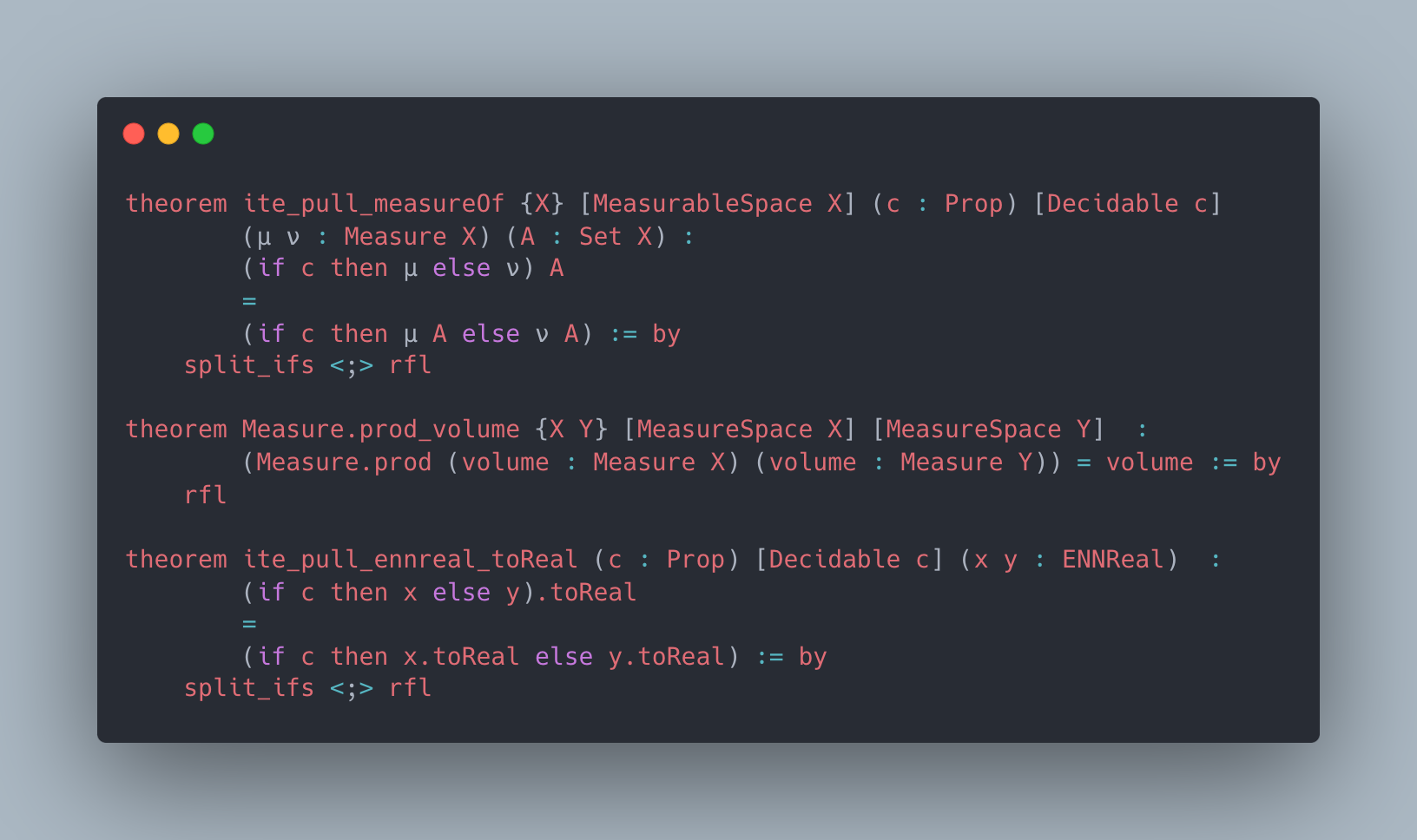
The image shows a code snippet in a text editor with syntax highlighting. It contains three theorem definitions related to measure theory and real number conversions. The code uses functional programming constructs, conditional logic, and type annotations.
### Components/Axes
- **Syntax Highlighting**:
- Keywords (`theorem`, `if`, `then`, `else`, `by`, `split_ifs`, `toReal`) in red/magenta.
- Variables (`X`, `Y`, `c`, `μ`, `v`, `A`, `x`, `y`) in teal.
- Functions (`Measure`, `prod_volume`, `ite_pull_measureOf`, `ite_pull_ennreal_toReal`) in orange.
- Logical operators (`:=`, `=`, `:`, `:Prop`, `:Decidable`, `:ENNReal`) in cyan.
- **Structure**:
- Three theorems separated by blank lines.
- Each theorem has a name, parameters, and a body with conditional logic.
### Detailed Analysis
1. **Theorem 1: `ite_pull_measureOf`**
- **Parameters**:
- `X` (MeasurableSpace X)
- `c` (Prop, Decidable c)
- **Body**:
```
(μ v : Measure X) (A : Set X) :
(if c then μ else v) A
=
(if c then μ A else v A) := by
split_ifs <;> rfl
```
- Defines a measure pullback using a conditional (`if c then ... else ...`).
- Uses `split_ifs` to split the conditional into cases.
2. **Theorem 2: `Measure.prod_volume`**
- **Parameters**:
- `X` (MeasureSpace X)
- `Y` (MeasureSpace Y)
- **Body**:
```
(Measure.prod (volume : Measure X) (volume : Measure Y))
= volume := by
rfl
```
- Asserts that the product of two measures equals their combined volume.
- Uses `rfl` (reflexivity) to confirm equality.
3. **Theorem 3: `ite_pull_ennreal_toReal`**
- **Parameters**:
- `c` (Prop, Decidable c)
- `x y` (ENNReal)
- **Body**:
```
(if c then x else y).toReal
=
(if c then x.toReal else y.toReal) := by
split_ifs <;> rfl
```
- Converts extended real numbers (`ENNReal`) to real numbers (`Real`) conditionally.
- Uses `split_ifs` to handle the conditional conversion.
### Key Observations
- **Conditional Logic**: All theorems use `if c then ... else ...` constructs, suggesting a focus on decidable properties (`Decidable c`).
- **Functional Programming**: Heavy use of lambda abstractions (`(μ v : Measure X) ...`) and function composition.
- **Formal Verification**: Theorems are structured for proof assistants (e.g., Lean 4), with `by` and `rfl` indicating proof steps.
- **Measure Theory**: Terms like `Measure`, `volume`, and `MeasurableSpace` indicate a focus on integration and measure spaces.
### Interpretation
- **Purpose**: These theorems formalize properties of measure theory and real number conversions in a proof assistant.
- `ite_pull_measureOf` defines how measures behave under conditional transformations.
- `Measure.prod_volume` establishes the product measure’s volume as the product of individual volumes.
- `ite_pull_ennreal_toReal` ensures conditional conversions from extended reals to standard reals preserve equality.
- **Significance**: Critical for verifying correctness in systems involving probabilistic models, integration, or numerical computations.
- **Anomalies**: No numerical data or visual trends; purely symbolic/logical assertions.
### Spatial Grounding
- Theorems are vertically stacked, with each body indented under its name.
- Syntax highlighting colors are consistent across the block, aiding readability.
- No legends or axes, as this is code, not a chart.