## Code Snippet: Theorem Definitions
### Overview
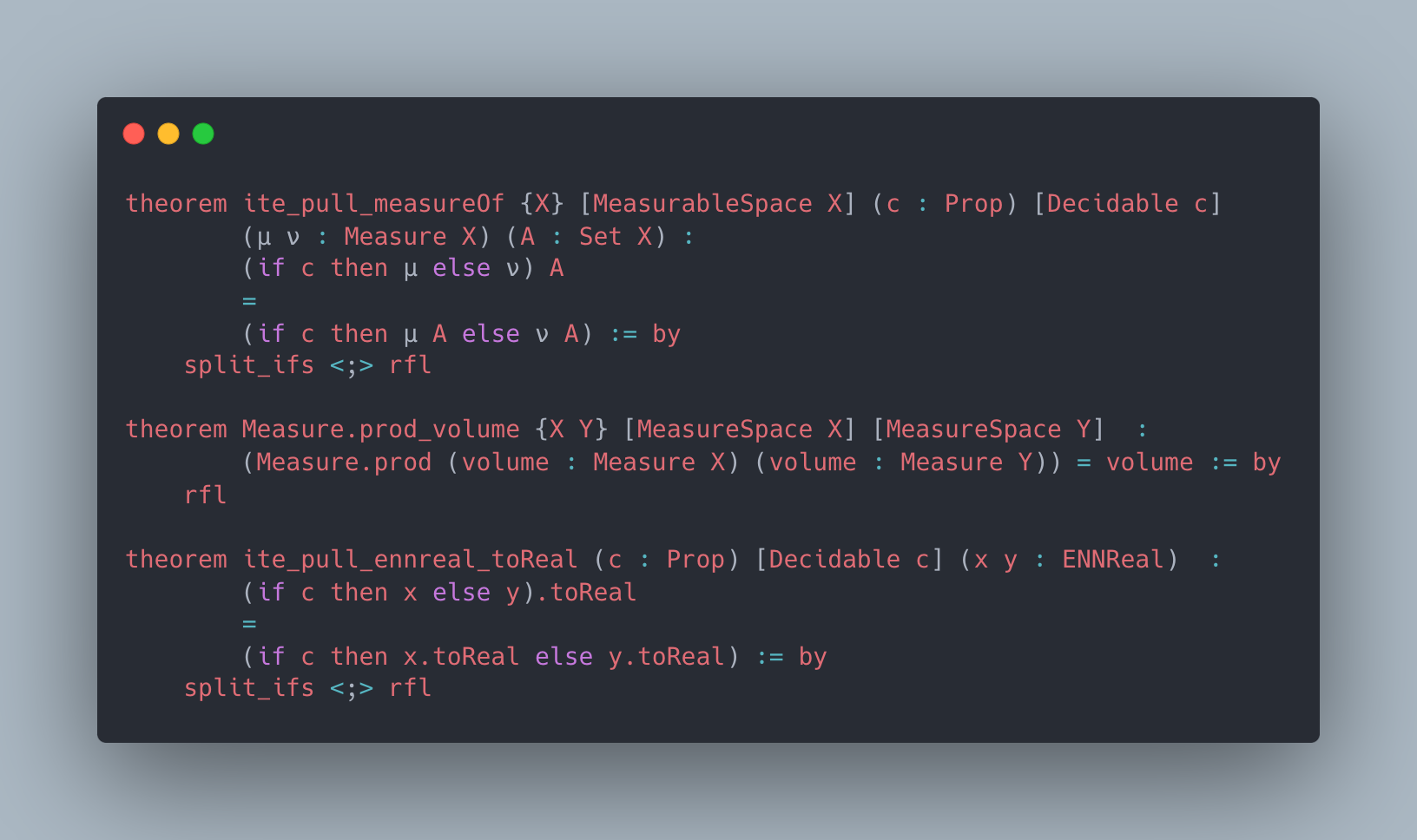
The image displays a code snippet, likely from a formal verification system like Lean or Coq, defining three theorems related to measure theory and real numbers. The code uses a functional programming style with dependent types.
### Components/Axes
* **Header:** Contains three colored circles (red, yellow, green) in the top-left corner, likely for window management.
* **Main Content:** The code snippet itself, consisting of three theorem definitions.
### Detailed Analysis or ### Content Details
**Theorem 1: `ite_pull_measureOf`**
* **Name:** `ite_pull_measureOf`
* **Type Parameters:** `X` (presumably a type representing a set)
* **Context:**
* `[MeasurableSpace X]` (X is a measurable space)
* `(c : Prop)` (c is a proposition)
* `[Decidable c]` (c is decidable)
* `(μ ν : Measure X)` (μ and ν are measures on X)
* `(A : Set X)` (A is a set in X)
* **Statement:** `(if c then μ else v) A = (if c then μ A else v A) := by split_ifs <;> rfl`
* This theorem states that applying the conditional measure (if c then μ else v) to a set A is equivalent to applying the measures μ and ν to A conditionally and then combining the results.
* `:= by split_ifs <;> rfl` indicates that the proof is done by splitting cases based on the condition `c` and then using reflexivity (`rfl`).
**Theorem 2: `Measure.prod_volume`**
* **Name:** `Measure.prod_volume`
* **Type Parameters:** `X Y`
* **Context:**
* `[MeasureSpace X]` (X is a measure space)
* `[MeasureSpace Y]` (Y is a measure space)
* **Statement:** `(Measure.prod (volume : Measure X) (volume : Measure Y)) = volume := by rfl`
* This theorem states that the product of the volumes (measures) on measure spaces X and Y is equal to the volume.
* `:= by rfl` indicates that the proof is done by reflexivity.
**Theorem 3: `ite_pull_ennreal_toReal`**
* **Name:** `ite_pull_ennreal_toReal`
* **Context:**
* `(c : Prop)` (c is a proposition)
* `[Decidable c]` (c is decidable)
* `(x y : ENNReal)` (x and y are extended non-negative real numbers)
* **Statement:** `(if c then x else y).toReal = (if c then x.toReal else y.toReal) := by split_ifs <;> rfl`
* This theorem states that converting a conditional extended non-negative real number (if c then x else y) to a real number is equivalent to converting x and y to real numbers conditionally and then combining the results.
* `:= by split_ifs <;> rfl` indicates that the proof is done by splitting cases based on the condition `c` and then using reflexivity.
### Key Observations
* All three theorems involve conditional expressions (`if c then ... else ...`).
* All three theorems are proven by splitting cases based on the condition `c` and then using reflexivity.
* The theorems relate to measure theory and real numbers, suggesting a focus on formal verification in these areas.
### Interpretation
The code snippet demonstrates the use of a formal verification system to define and prove theorems in measure theory and real analysis. The theorems are relatively simple, but they illustrate the basic principles of conditional reasoning and the use of reflexivity for proving equalities. The use of dependent types allows for precise specification of the types of objects involved, which is crucial for formal verification. The theorems likely form part of a larger library of verified mathematical results.