\n
## Code Snippet: Mathematical Theorems
### Overview
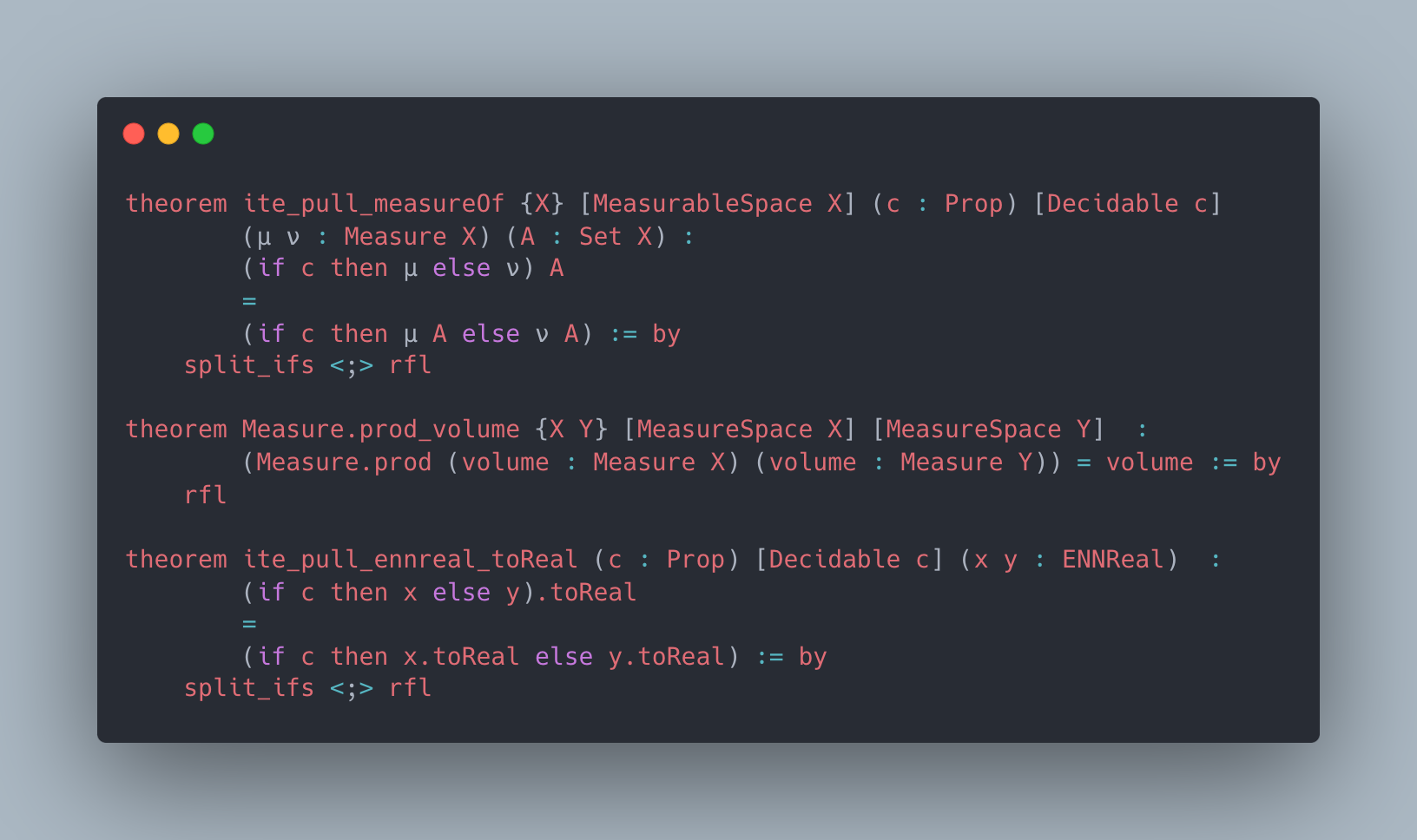
The image displays a code snippet, likely from a formal proof assistant system (such as Lean or Coq), containing three mathematical theorems. The code is presented in a monospaced font against a dark background. The theorems involve concepts from measure theory and real analysis.
### Components/Axes
There are no axes or traditional chart components. The content consists entirely of text-based code. The code is structured into three distinct theorem definitions, each separated by a blank line. Each theorem definition includes:
* `theorem` keyword
* Theorem name (e.g., `ite_pull_measure0f`)
* Type signature with arguments enclosed in square brackets (e.g., `{X} [MeasurableSpace X] (c : Prop) [Decidable c]`)
* Theorem body, defining the relationship between variables and functions.
* `:= by` followed by a proof tactic (e.g., `split_ifs <>; rfl`)
### Detailed Analysis or Content Details
**Theorem 1: `ite_pull_measure0f`**
```
theorem ite_pull_measure0f {X} [MeasurableSpace X] (c : Prop) [Decidable c]
(μ v : Measure X) (A : Set X) :
(if c then μ else v) A
=
(if c then μ A else v A) := by
split_ifs <>; rfl
```
* **Arguments:**
* `{X}`: A type variable representing a set.
* `[MeasurableSpace X]`: A typeclass instance indicating that `X` is a measurable space.
* `(c : Prop)`: A proposition `c`.
* `[Decidable c]`: A typeclass instance indicating that `c` is decidable (i.e., we can determine whether it is true or false).
* `(μ v : Measure X)`: Two measures, `μ` and `v`, defined on the measurable space `X`.
* `(A : Set X)`: A measurable set `A` within the measurable space `X`.
* **Statement:** The theorem states that applying the conditional measure `(if c then μ else v)` to the set `A` is equivalent to applying the conditional measure to `A` individually for each measure `μ` and `v`.
* **Proof:** The proof uses the `split_ifs` tactic to split the goal into cases based on the truth value of `c`, and then uses the `rfl` (reflexivity) tactic to show that the two sides are equal in each case.
**Theorem 2: `Measure.prod_volume`**
```
theorem Measure.prod_volume {X Y} [MeasureSpace X] [MeasureSpace Y] :
(Measure.prod (volume : Measure X) (volume : Measure Y)) = volume := by
rfl
```
* **Arguments:**
* `{X Y}`: Type variables representing two sets.
* `[MeasureSpace X]`: A typeclass instance indicating that `X` is a measure space.
* `[MeasureSpace Y]`: A typeclass instance indicating that `Y` is a measure space.
* **Statement:** The theorem states that the product measure of the volumes of two measure spaces `X` and `Y` is equal to the volume itself.
* **Proof:** The proof uses the `rfl` tactic, indicating that the two sides are definitionally equal.
**Theorem 3: `ite_pull_enreal_toReal`**
```
theorem ite_pull_enreal_toReal (c : Prop) [Decidable c] (x y : ENNReal) :
(if c then x else y).toReal
=
(if c then x.toReal else y.toReal) := by
split_ifs <>; rfl
```
* **Arguments:**
* `(c : Prop)`: A proposition `c`.
* `[Decidable c]`: A typeclass instance indicating that `c` is decidable.
* `(x y : ENNReal)`: Two extended non-negative real numbers, `x` and `y`.
* **Statement:** The theorem states that converting the conditional extended non-negative real number `(if c then x else y)` to a real number is equivalent to converting each extended non-negative real number `x` and `y` individually and then applying the conditional.
* **Proof:** The proof uses the `split_ifs` tactic to split the goal into cases based on the truth value of `c`, and then uses the `rfl` tactic to show that the two sides are equal in each case.
### Key Observations
* The theorems all involve conditional statements (`if...then...else`) and measure-theoretic concepts.
* The proofs are very concise, relying heavily on tactics like `split_ifs` and `rfl`, which suggest that the underlying definitions are well-suited for automated reasoning.
* The use of typeclasses (`[MeasurableSpace X]`, `[Decidable c]`) indicates a strong emphasis on type safety and generality.
### Interpretation
The code snippet demonstrates a formalization of mathematical concepts within a proof assistant system. The theorems likely serve as building blocks for more complex proofs in measure theory and real analysis. The use of conditional statements and typeclasses allows for precise and general statements about mathematical objects. The concise proofs suggest that the system is capable of automating significant portions of the reasoning process. The theorems relate to the properties of measures, conditional measures, and conversions between extended real numbers and real numbers. The overall purpose is to establish rigorous mathematical truths in a machine-checkable format.