## Photograph: Group Interaction in Urban Setting
### Overview
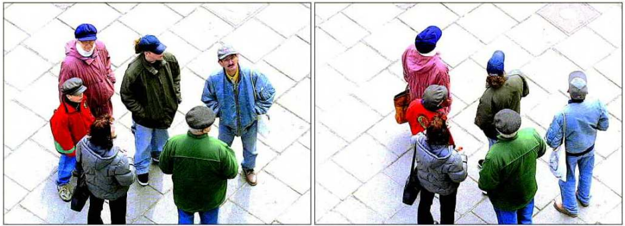
The image consists of two side-by-side photographs capturing groups of people in an outdoor public space. Both photos show individuals standing on a tiled floor, dressed in casual attire, with no visible textual elements, charts, diagrams, or data tables. The composition suggests a focus on human interaction or observational study.
### Components/Axes
- **No textual labels, axes, legends, or data markers** are present in either photograph.
- **Visual elements**:
- **Subjects**: Groups of 5–6 individuals in each photo.
- **Attire**: Jackets, hats, and layered clothing (e.g., red, green, blue, gray tones).
- **Setting**: Tiled flooring, neutral-toned walls, and daylight lighting.
### Detailed Analysis
- **Left Photo**:
- Group of 5 individuals facing inward, suggesting a discussion or collaborative interaction.
- One person in a red jacket stands slightly apart, holding a bag.
- Background includes a person in a pink jacket and another in a green jacket.
- **Right Photo**:
- Group of 6 individuals, with one person in a blue jacket holding a white object (possibly a bag or document).
- Two individuals in green jackets face each other, while a person in a red jacket stands near the edge of the frame.
- A person in a pink jacket is partially visible in the background.
### Key Observations
1. **Repetition of Colors**: Red, green, and blue jackets appear in both photos, potentially indicating a thematic or contextual link (e.g., uniformed groups or coordinated activity).
2. **Spatial Arrangement**: Groups are positioned centrally in both photos, with individuals oriented toward one another, emphasizing interaction.
3. **Absence of Text**: No labels, signs, or annotations are visible, limiting contextual clues about the event or purpose.
### Interpretation
The photographs likely document a study of human behavior in public spaces, focusing on group dynamics or social interactions. The lack of textual data suggests the emphasis is on visual cues (e.g., body language, attire) rather than explicit information. The repeated color patterns (red, green, blue) may imply a controlled experiment or observational study with unspoken variables. The tiled flooring and urban setting indicate a structured environment, possibly a plaza or transit hub.
**Note**: No numerical data, trends, or categorical labels are extractable due to the absence of charts, diagrams, or textual elements. The analysis is limited to visual composition and inferred context.