## Comparative Analysis: Buddhist Shunyavada vs. Advaita Vedanta
### Overview
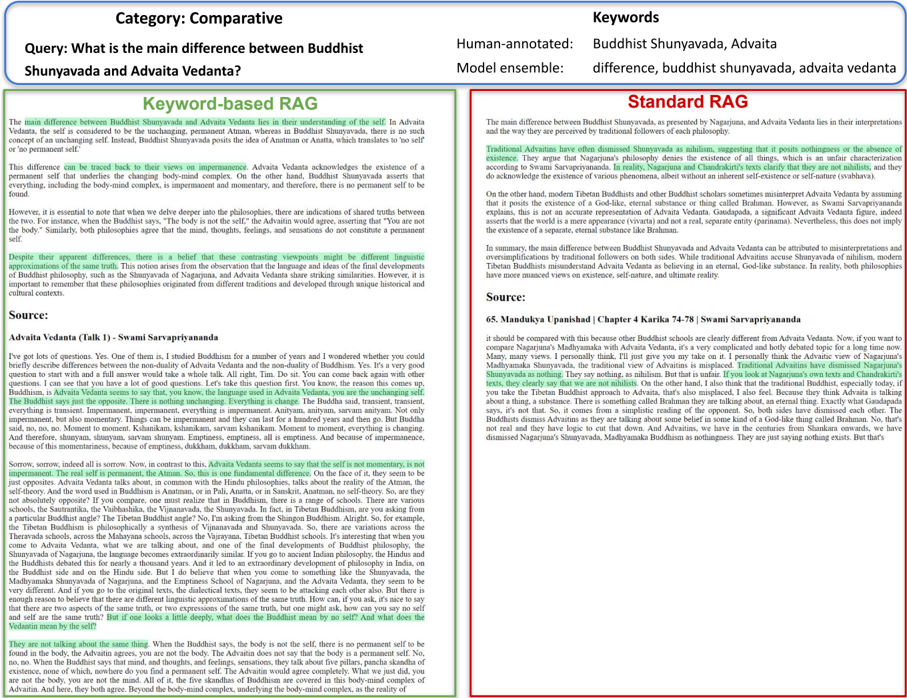
The image presents a comparative analysis of Buddhist Shunyavada and Advaita Vedanta, focusing on their differing understandings of the self. It includes information extracted using Keyword-based RAG and Standard RAG methods, along with source texts from Advaita Vedanta and Mandukya Upanishad.
### Components/Axes
* **Category:** Comparative
* **Query:** What is the main difference between Buddhist Shunyavada and Advaita Vedanta?
* **Keywords:**
* Human-annotated: Buddhist Shunyavada, Advaita
* Model ensemble: difference, buddhist shunyavada, advaita vedanta
* **Sections:**
* Keyword-based RAG (left side)
* Standard RAG (right side)
* **Sources:**
* Advaita Vedanta (Talk 1) - Swami Sarvapriyananda (left side)
* 65. Mandukya Upanishad | Chapter 4 Karika 74-78 | Swami Sarvapriyananda (right side)
### Detailed Analysis or Content Details
**Keyword-based RAG (Left Side):**
* **Main Difference:** The primary distinction lies in their understanding of the self. Advaita Vedanta considers the self as unchanging and permanent (Atman), while Buddhist Shunyavada denies the existence of an unchanging self, positing Anatman or Anatta ("no self" or "no permanent self").
* **Impermanence:** Advaita Vedanta acknowledges a permanent self underlying the changing body-mind complex. Shunyavada asserts that everything, including the body-mind complex, is impermanent and momentary, thus no permanent self exists.
* **Shared Truths:** Despite differences, both philosophies share some common ground. Advaitins agree with Buddhists that "the body is not the self," and both acknowledge that mind, thoughts, feelings, and sensations do not constitute a permanent self.
* **Linguistic Approximations:** The contrasting viewpoints might be different linguistic approximations of the same truth, stemming from the language and ideas of the final developments of Buddhist philosophy (Shunyavada of Nagarjuna) and Advaita Vedanta sharing similarities.
* **Source Text (Advaita Vedanta Talk 1):** A dialogue discussing the differences between the non-duality of Advaita Vedanta and Buddhism. It highlights the differing views on the self (unchanging vs. changing) and references concepts like Anityam (impermanence), Kshanikam (momentariness), and Shunyam (emptiness). It also mentions the Atman in Advaita Vedanta.
**Standard RAG (Right Side):**
* **Main Difference:** The main difference lies in the interpretations of Buddhist Shunyavada (as presented by Nagarjuna) and Advaita Vedanta, and how they are perceived by traditional followers of each philosophy.
* **Traditional Advaitin View:** Traditional Advaitins often dismiss Shunyavada as nihilism, suggesting it posits nothingness or the absence of existence. They argue that Nagarjuna's philosophy denies the existence of all things, which is considered an unfair characterization. Nagarjuna and Chandrakirti's texts clarify that they are not nihilists.
* **Modern Buddhist View:** Modern Tibetan Buddhists and other Buddhist scholars sometimes misinterpret Advaita Vedanta as positing a God-like, eternal substance called Brahman. However, this is not an accurate representation. Gaudapada asserts that the world is a mere appearance (vivarta).
* **Summary:** The main difference can be attributed to misinterpretations and oversimplifications by traditional followers on both sides. Traditional Advaitins accuse Shunyavada of nihilism, while modern Tibetan Buddhists misunderstand Advaita Vedanta as believing in an eternal, God-like substance.
* **Source Text (Mandukya Upanishad):** Discusses the Advaitic view of Nagarjuna's Madhyamaka Shunyavada and how it is sometimes misplaced by traditional Advaitins. It mentions that traditional Advaitins have dismissed Nagarjuna's Shunyavada as nothing, which is considered unfair. It also notes that traditional Buddhists may misinterpret Advaita as talking about an eternal substance called Brahman.
### Key Observations
* Both RAG methods identify the understanding of the "self" as a key point of divergence between the two philosophies.
* The Keyword-based RAG focuses more on the core philosophical tenets, while the Standard RAG emphasizes the interpretations and misinterpretations by followers of each tradition.
* Both sides acknowledge potential misinterpretations and oversimplifications in understanding the other's philosophy.
### Interpretation
The image highlights the nuanced differences between Buddhist Shunyavada and Advaita Vedanta. While both philosophies address the nature of reality and the self, their approaches and interpretations differ significantly. The Keyword-based RAG provides a concise overview of the core philosophical differences, while the Standard RAG delves into the historical and interpretative aspects, revealing how each tradition has sometimes misunderstood the other. The inclusion of source texts provides context and allows for a deeper understanding of the original philosophical arguments. The analysis suggests that a deeper understanding of both philosophies requires moving beyond simplistic interpretations and engaging with the original texts and historical context.