TECHNICAL ASSET FINGERPRINT
cd689705e02939e276c20d3e
Click to view fullscreen
Press ESC or click to close
FOUND IN PAPERS
EXPERT: healer-alpha-free VERSION 1
RUNTIME: free/openrouter/healer-alpha
INTEL_VERIFIED
\n
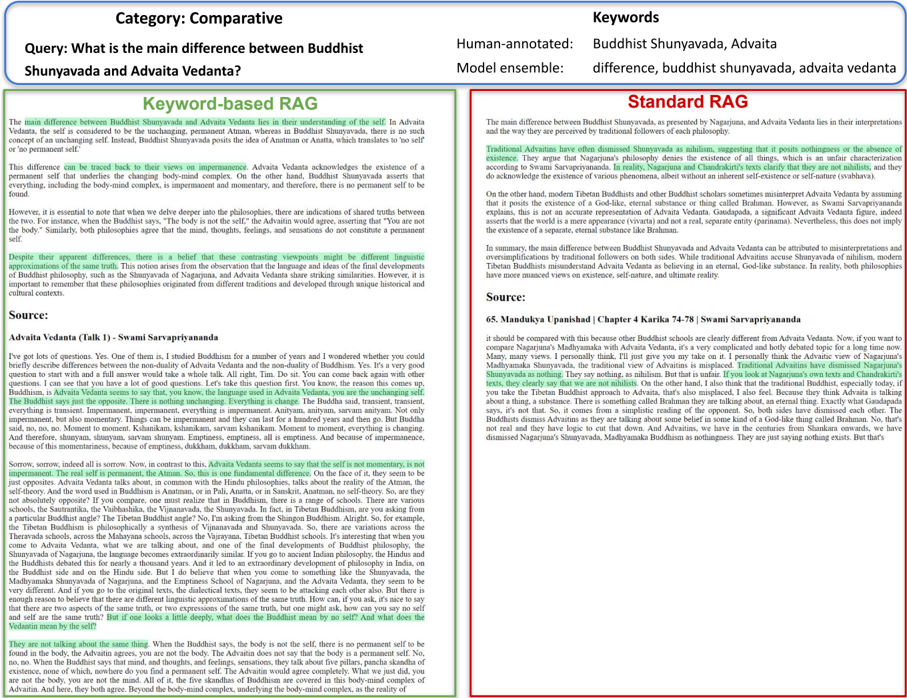
## Comparative Diagram: Keyword-based RAG vs. Standard RAG on a Philosophical Query
### Overview
This image is a structured comparison of two Retrieval-Augmented Generation (RAG) methods—**Keyword-based RAG** and **Standard RAG**—applied to the same philosophical query. The diagram visually contrasts the quality and accuracy of the generated responses, using color-coded highlights (green for correct/relevant, red for incorrect/misleading) and includes source attributions. The overall purpose is to demonstrate the superior performance of the Keyword-based RAG method for this specific complex, comparative query.
### Components/Axes
The diagram is organized into three main horizontal sections:
1. **Header Section (Top):**
* **Left Label:** `Category: Comparative`
* **Right Label:** `Keywords`
* `Human-annotated: Buddhist Shunyavada, Advaita`
* `Model-acknowledge: difference, buddhist shunyavada, advaita vedanta`
* **Central Query:** `Query: What is the main difference between Buddhist Shunyavada and Advaita Vedanta?`
2. **Main Comparison Body (Center):** Divided into two vertical columns.
* **Left Column Header:** `Keyword-based RAG` (Text highlighted in **green**).
* **Right Column Header:** `Standard RAG` (Text highlighted in **red**).
3. **Source Section (Bottom):** Each column has a `Source:` label followed by a specific reference.
* **Left Source:** `Advaita Vedanta (Talk 1) - Swami Sarvapriyananda`
* **Right Source:** `65. Mandukya Upanishad | Chapter 4 Karika 74-78 | Swami Sarvapriyananda`
### Detailed Analysis / Content Details
**A. Keyword-based RAG Column (Left - Green Highlights):**
* **Core Argument:** The main difference lies in their understanding of the self. Advaita posits a permanent Self (Atman), while Buddhist Shunyavada denies any such permanent, independent self (Anatman).
* **Key Points Extracted:**
* This difference extends to their views on impermanence. Advaita acknowledges impermanence in the phenomenal world but posits an eternal, unchanging reality (Brahman). Shunyavada applies impermanence to everything, including the mind and body, concluding there is no permanent self.
* Despite differences, there are shared traits: both deny a permanent, independent self and agree that thoughts, feelings, and sensations do not constitute a permanent self.
* The text notes that the language and ideas of early Buddhist philosophy influenced later Hindu schools like Vedanta, leading to shared terminology but different interpretations.
* **Source Content (Transcribed Excerpt):** The source is a dialogue where a speaker (likely Swami Sarvapriyananda) explains the core difference: "The Buddhist says just the opposite. There is nothing permanent. Everything is change... The Advaita Vedanta seems to say the opposite: that there is something permanent." The speaker clarifies that while both deny the body-mind complex as the self, Advaita posits an underlying reality (Atman/Brahman), whereas Buddhism does not posit any such permanent entity.
**B. Standard RAG Column (Right - Red Highlights):**
* **Core Argument (Presented as Flawed):** The text states the main difference lies in interpretations and perceptions by followers. It claims traditional Advaita often misrepresented Shunyavada as nihilism, which modern scholars correct.
* **Key Points Extracted (Marked as Problematic):**
* It suggests Advaita followers historically accused Shunyavada of nihilism, but modern scholars like Nagarjuna clarify their texts deny inherent existence, not existence itself.
* It claims modern Tibetan Buddhists sometimes misinterpret Advaita as asserting a "real, separate entity (paramatman)," which is not accurate.
* The summary concludes that misinterpretations by traditional followers on both sides are the primary source of difference.
* **Source Content (Transcribed Excerpt):** The source is a lecture on the Mandukya Upanishad. The speaker argues that Buddhist Shunyavada is *not* nihilism but a denial of inherent existence. He criticizes the "Advaita Vedanta" view for dismissing Shunyavada as nihilistic and states that both philosophies, when properly understood, are "saying the same thing" in denying a permanent, independent self, though they may use different terminology.
### Key Observations
1. **Visual Coding:** The use of **green** for the Keyword-based RAG text and **red** for the Standard RAG text is a deliberate visual cue indicating correctness vs. error or lower quality.
2. **Content Divergence:** The two methods produce fundamentally different summaries. Keyword-based RAG focuses on the **philosophical doctrinal difference** (Atman vs. Anatman). Standard RAG focuses on **historical misinterpretations and scholarly debates** between the traditions.
3. **Source Alignment:** Both columns cite the same speaker (Swami Sarvapriyananda) but from different talks. The Keyword-based RAG source directly addresses the core doctrinal comparison, while the Standard RAG source addresses common misconceptions, which may explain the difference in output focus.
4. **Model Acknowledgment:** The header notes the model "acknowledges" the keywords "difference, buddhist shunyavada, advaita vedanta," indicating it processed the query's intent.
### Interpretation
This diagram serves as a **technical evaluation of RAG system performance** on a nuanced, domain-specific query. It demonstrates that:
* **Keyword-based RAG** successfully retrieved and synthesized information that directly answers the query's core: the fundamental philosophical distinction regarding the "self." It provides a clear, doctrinally accurate comparison.
* **Standard RAG** retrieved information that is tangentially related (scholarly debates and misinterpretations) but fails to succinctly state the primary doctrinal difference. The red highlighting suggests this output is considered less accurate or off-target for the specific query asked.
* The underlying message is that for complex comparative questions requiring precise doctrinal knowledge, a retrieval method that effectively targets **key conceptual terms** (like "self," "Atman," "Anatman") yields superior results compared to a more general retrieval approach. The diagram argues for the importance of precision in retrieval mechanisms when dealing with specialized knowledge domains like comparative philosophy.
DECODING INTELLIGENCE...