## Screenshot: Comparative Analysis of Buddhist Shunyavada and Advaita Vedanta
### Overview
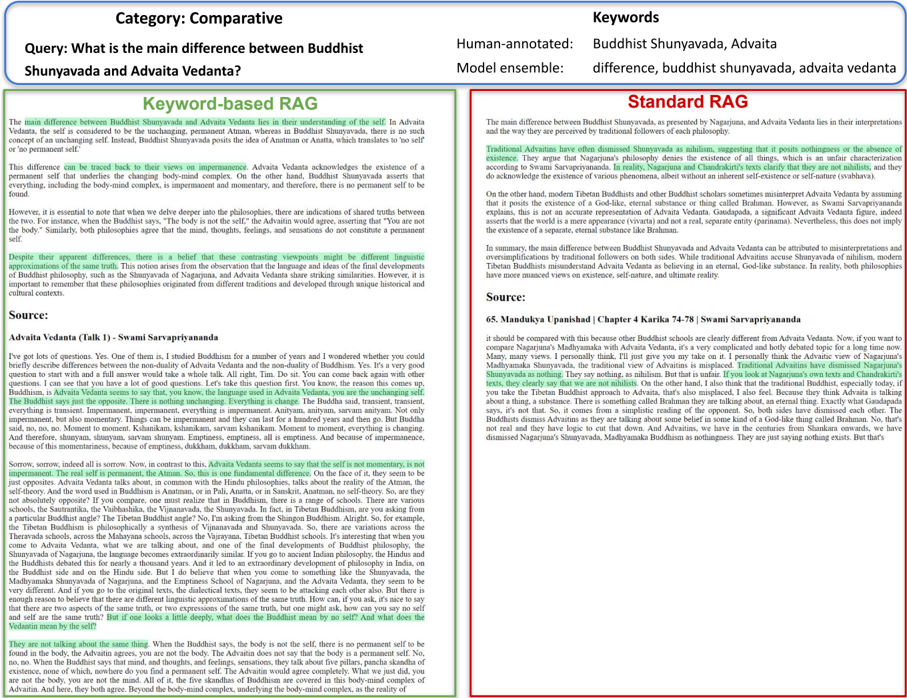
The image is a screenshot of a comparative analysis between Buddhist Shunyavada and Advaita Vedanta philosophies, focusing on their views of the self. It includes two sections:
1. **Keyword-based RAG** (green border)
2. **Standard RAG** (red border)
Both sections discuss the core differences in their interpretations of existence, self, and impermanence, citing sources from Buddhist and Hindu texts.
---
### Components/Axes
#### Header Section
- **Category**: Comparative
- **Query**: "What is the main difference between Buddhist Shunyavada and Advaita Vedanta?"
- **Keywords**:
- Human-annotated: "Buddhist Shunyavada, Advaita"
- Model ensemble: "difference, buddhist shunyavada, advaita vedanta"
#### Keyword-based RAG Section
- **Title**: Keyword-based RAG
- **Content**:
- Discusses the concept of "self" (Atman) in Advaita Vedanta vs. "no permanent self" (Anatta) in Shunyavada.
- Highlights impermanence (Anitya) in Shunyavada and the existence of a permanent self in Advaita.
- Notes shared truths between the philosophies (e.g., emptiness, momentariness).
- **Source**:
- Advaita Vedanta (Talk 1) - Swami Sarvapriyananda
#### Standard RAG Section
- **Title**: Standard RAG
- **Content**:
- Compares Nagarjuna’s Shunyavada with Advaita Vedanta, addressing misinterpretations (e.g., nihilism vs. Brahman).
- Cites Swami Sarvapriyananda’s analysis of texts like the Mandukya Upanishad.
- Emphasizes that both philosophies reject nihilism but differ in their views on existence (vivarta vs. satya).
- **Source**:
- 65. Mandukya Upanishad | Chapter 4 Karika 74-78 | Swami Sarvapriyananda
---
### Detailed Analysis
#### Keyword-based RAG
- **Main Argument**:
- Advaita Vedanta posits a permanent, unchanging self (Atman), while Shunyavada denies any permanent self.
- Shunyavada views all phenomena (body, mind, sensations) as impermanent and momentary.
- **Key Phrases**:
- "The body is not the self" (Advaita) vs. "no permanent self" (Shunyavada).
- "Everything is transient" (Shunyavada) vs. "impermanent" (Advaita).
#### Standard RAG
- **Main Argument**:
- Traditional Shunyavada is misrepresented as nihilism, but Nagarjuna’s texts clarify that it acknowledges dependent origination (pratityasamutpada).
- Advaita Vedanta’s Brahman is an eternal substance, contrasting with Shunyavada’s emphasis on emptiness (śūnyatā).
- **Key Phrases**:
- "Nagarjuna’s Shunyavada is not nihilism" (highlighted).
- "Brahman as eternal substance" (highlighted).
---
### Key Observations
1. **Contrasting Views on Self**:
- Advaita Vedanta asserts a permanent self (Atman), while Shunyavada rejects it entirely.
2. **Misinterpretations**:
- Traditional Advaitins dismiss Shunyavada as nihilism, but modern scholars (e.g., Swami Sarvapriyananda) argue both philosophies share deeper truths.
3. **Textual Sources**:
- Both sections cite Swami Sarvapriyananda, indicating a focus on his interpretations of Buddhist and Hindu texts.
---
### Interpretation
- **Philosophical Divide**:
The image highlights a fundamental disagreement: Advaita Vedanta’s eternal self vs. Shunyavada’s rejection of permanence. However, both philosophies agree on the impermanence of the body-mind complex.
- **Role of Misinterpretation**:
The Standard RAG section critiques traditional Advaitin dismissals of Shunyavada as nihilism, suggesting a need for nuanced understanding of Nagarjuna’s middle path.
- **Shared Truths**:
Despite differences, both philosophies acknowledge concepts like emptiness and momentariness, implying overlapping insights into the nature of reality.
---
**Note**: No numerical data or visual trends are present. The analysis is based solely on textual content and philosophical arguments.