## Pie Chart: Template distribution across different tasks
### Overview
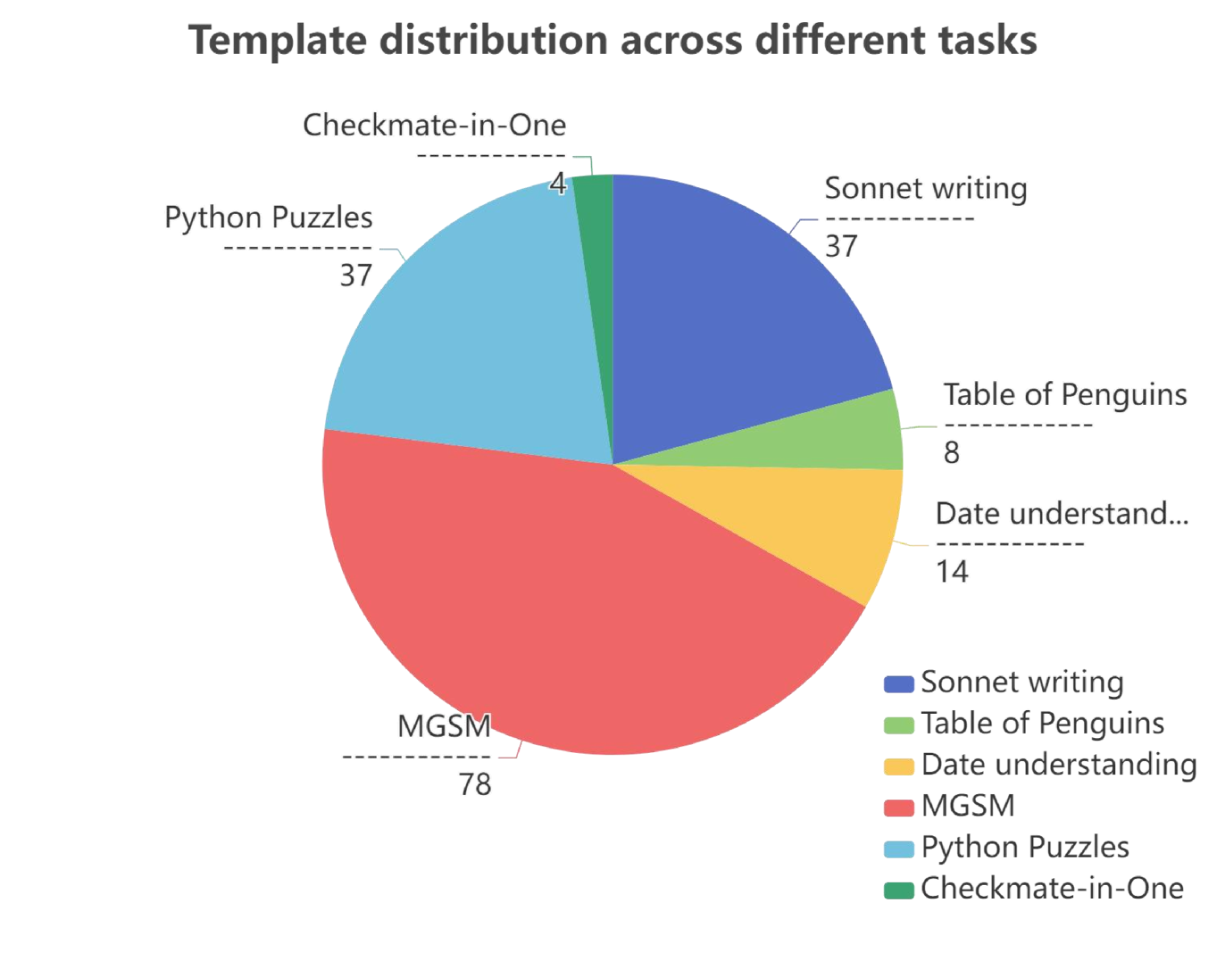
This image is a pie chart titled "Template distribution across different tasks." It visually represents the distribution of a quantity (likely the number of templates) across six distinct task categories. The chart uses color-coded slices, with each slice labeled with the task name and its corresponding numerical value. A legend is provided in the bottom-right corner for reference.
### Components/Axes
* **Title:** "Template distribution across different tasks" (centered at the top).
* **Chart Type:** Pie chart.
* **Data Series (Slices):** Six slices, each representing a task. The slices are labeled directly on the chart with the task name and a numerical value.
* **Legend:** Located in the bottom-right quadrant of the image. It lists the six tasks with their corresponding color swatches.
* **Legend Order (Top to Bottom):**
1. Sonnet writing (Blue)
2. Table of Penguins (Light Green)
3. Date understanding (Yellow)
4. MGSM (Red)
5. Python Puzzles (Light Blue)
6. Checkmate-in-One (Dark Green)
### Detailed Analysis
The chart displays the following data points, cross-referenced with the legend colors and their spatial placement:
1. **MGSM (Red Slice):**
* **Placement:** Occupies the largest portion of the chart, spanning the bottom-left and bottom-center.
* **Value:** 78.
* **Trend/Size:** This is the dominant category, representing the largest share of the distribution.
2. **Sonnet writing (Blue Slice):**
* **Placement:** Located in the top-right quadrant.
* **Value:** 37.
* **Trend/Size:** A major category, tied for the second-largest share.
3. **Python Puzzles (Light Blue Slice):**
* **Placement:** Located in the top-left quadrant.
* **Value:** 37.
* **Trend/Size:** A major category, tied with "Sonnet writing" for the second-largest share.
4. **Date understanding (Yellow Slice):**
* **Placement:** A smaller slice located on the right side, between the "Table of Penguins" and "MGSM" slices.
* **Value:** 14.
* **Trend/Size:** A mid-sized category.
5. **Table of Penguins (Light Green Slice):**
* **Placement:** A small slice located on the right side, between the "Sonnet writing" and "Date understanding" slices.
* **Value:** 8.
* **Trend/Size:** A minor category.
6. **Checkmate-in-One (Dark Green Slice):**
* **Placement:** The smallest slice, located at the very top of the chart, between the "Python Puzzles" and "Sonnet writing" slices.
* **Value:** 4.
* **Trend/Size:** The smallest category in the distribution.
**Total Sum of Values:** 78 + 37 + 37 + 14 + 8 + 4 = 178.
### Key Observations
* **Dominant Category:** The "MGSM" task accounts for the largest share (78 out of 178, approximately 43.8%).
* **Tied Categories:** "Sonnet writing" and "Python Puzzles" have identical values (37 each), together making up a significant portion (approximately 41.6% combined).
* **Minor Categories:** "Table of Penguins" (8) and "Checkmate-in-One" (4) represent very small fractions of the total.
* **Visual Hierarchy:** The chart clearly emphasizes the disparity between the high-volume tasks (MGSM, Sonnet writing, Python Puzzles) and the low-volume tasks.
### Interpretation
This pie chart illustrates the allocation or occurrence of templates across a set of diverse tasks, likely from a benchmark or evaluation suite. The data suggests a highly uneven distribution:
* **Resource Focus:** The "MGSM" task (likely a math or reasoning benchmark) requires or utilizes the greatest number of templates, indicating it may be a core or heavily templated component of the evaluation.
* **Balanced Secondary Tasks:** "Sonnet writing" (creative/generative) and "Python Puzzles" (coding) are equally prominent, suggesting a balanced emphasis on these two distinct skill areas within the dataset.
* **Niche Tasks:** "Date understanding," "Table of Penguins," and "Checkmate-in-One" appear to be more specialized or less template-dependent tasks, contributing minimally to the overall template count.
* **Implication:** The distribution implies that the underlying system or benchmark is heavily weighted towards mathematical reasoning (MGSM) and has substantial, equal components for creative writing and programming puzzles. The minor tasks add variety but are not the primary focus in terms of template volume. This could reflect the design priorities of the benchmark, the inherent nature of the tasks (some requiring more structured prompts), or the availability of data for each category.