## Pie Chart: Template distribution across different tasks
### Overview
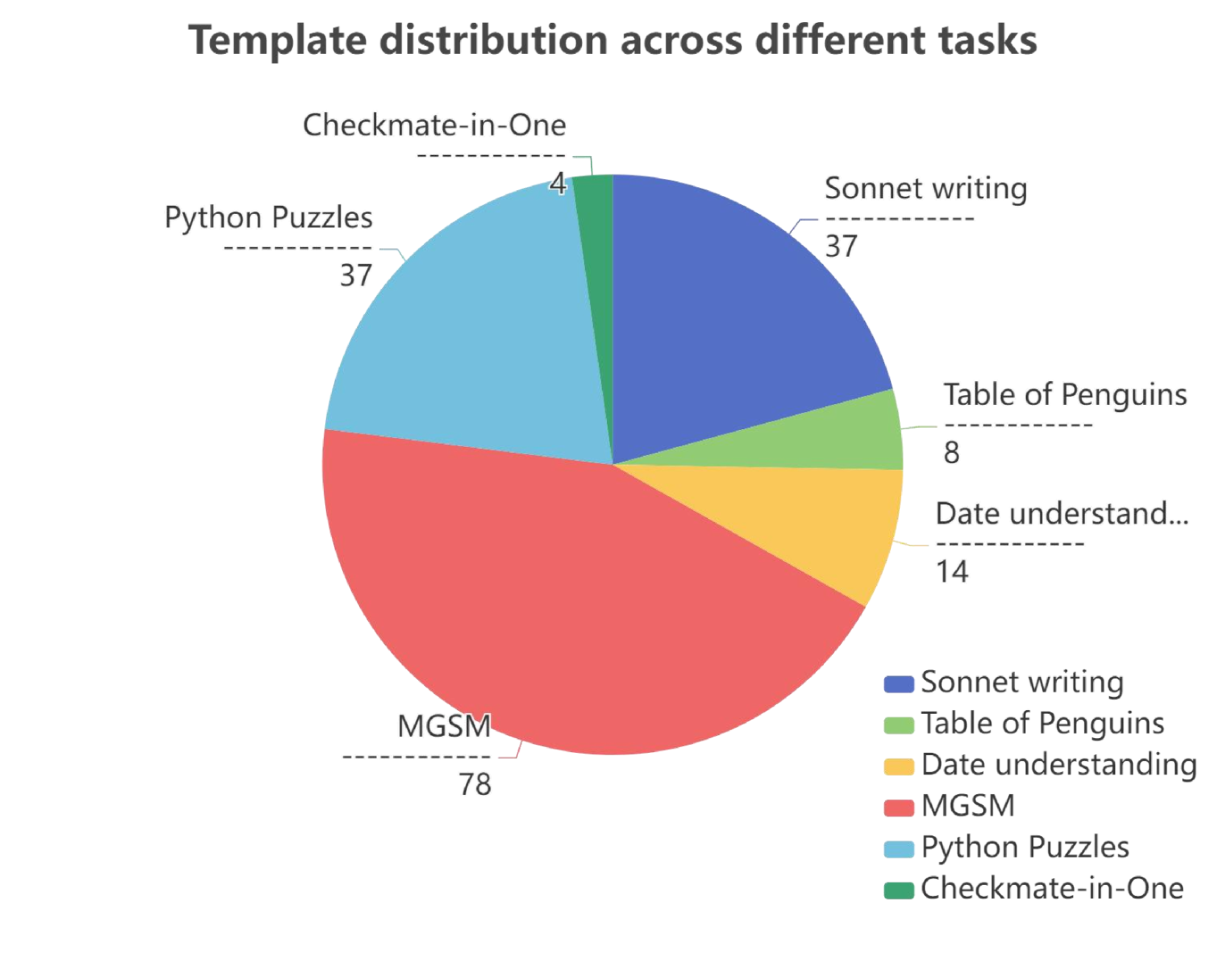
The image displays a pie chart illustrating the distribution of templates across six different tasks. The chart uses distinct colors for each task, with numerical values and labels indicating the proportion of each task. The largest segment dominates the chart, while the smallest segment is significantly smaller.
### Components/Axes
- **Title**: "Template distribution across different tasks" (centered at the top)
- **Legend**: Located on the right side, mapping colors to tasks:
- Blue: Sonnet writing
- Green: Table of Penguins
- Yellow: Date understanding
- Red: MGSM
- Light Blue: Python Puzzles
- Dark Green: Checkmate-in-One
- **Segments**: Six colored sections with labels and numerical values:
- **Sonnet writing** (blue): 37
- **Table of Penguins** (green): 8
- **Date understanding** (yellow): 14
- **MGSM** (red): 78
- **Python Puzzles** (light blue): 37
- **Checkmate-in-One** (dark green): 4
### Detailed Analysis
- **MGSM** (red) occupies the largest portion (78 units), followed by **Sonnet writing** (37) and **Python Puzzles** (37), which are tied for second place.
- **Date understanding** (yellow) accounts for 14 units, while **Table of Penguins** (green) has 8 units.
- The smallest segment, **Checkmate-in-One** (dark green), represents only 4 units.
### Key Observations
1. **Dominance of MGSM**: The red segment (MGSM) is overwhelmingly the largest, accounting for over half of the total distribution.
2. **Tied Segments**: Sonnet writing and Python Puzzles share identical values (37 units each), suggesting equal usage.
3. **Minor Segments**: Table of Penguins (8) and Checkmate-in-One (4) are significantly smaller, with the latter being the least used.
4. **Sum Discrepancy**: The total sum of values (78 + 37 + 37 + 14 + 8 + 4 = 178) exceeds 100, indicating these values likely represent absolute counts rather than percentages.
### Interpretation
The chart highlights a clear hierarchy in template usage, with MGSM being the most frequently used template by a substantial margin. The near-identical counts for Sonnet writing and Python Puzzles suggest these tasks may have similar template requirements or user preferences. The small values for Table of Penguins and Checkmate-in-One imply these tasks are either less common or require fewer templates. The total sum exceeding 100 indicates the data represents raw counts rather than normalized percentages, which could be clarified in the chart's metadata or accompanying documentation. This distribution might reflect workflow priorities, task complexity, or user behavior patterns in a technical or creative workflow context.