## Chart Type: Line Chart of Average Correct Flips per Iteration
### Overview
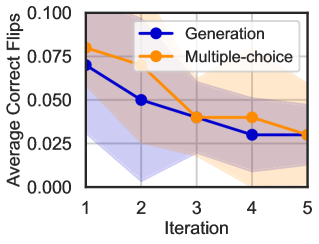
This image displays a 2D line chart comparing the "Average Correct Flips" over "Iteration" for two different methods: "Generation" and "Multiple-choice". Both methods show a general decreasing trend in average correct flips as the number of iterations increases, with shaded areas indicating uncertainty or confidence intervals around the mean lines.
### Components/Axes
* **Y-axis Label**: "Average Correct Flips"
* **Y-axis Range**: From 0.000 to 0.100.
* **Y-axis Major Ticks**: 0.000, 0.025, 0.050, 0.075, 0.100.
* **X-axis Label**: "Iteration"
* **X-axis Range**: From 1 to 5.
* **X-axis Major Ticks**: 1, 2, 3, 4, 5.
* **Legend**: Located in the top-right quadrant of the plot area.
* **Generation**: Represented by a solid blue line with circular markers.
* **Multiple-choice**: Represented by a solid orange line with circular markers.
### Detailed Analysis
The chart presents two data series, each with a central line representing the average and a shaded region indicating variability (likely a confidence interval or standard deviation).
1. **Generation Series (Blue Line with Circular Markers)**:
* **Visual Trend**: The blue line generally slopes downwards, indicating a decrease in "Average Correct Flips" with increasing "Iteration". The rate of decrease appears steeper between Iteration 1 and 3, then flattens out.
* **Data Points (Approximate)**:
* Iteration 1: Approximately 0.070
* Iteration 2: Approximately 0.050
* Iteration 3: Approximately 0.038
* Iteration 4: Approximately 0.029
* Iteration 5: Approximately 0.028
* **Uncertainty Area**: A light blue shaded region surrounds the blue line. This region is relatively wide at Iteration 1, narrows around Iteration 3, and widens again towards Iteration 5, suggesting higher variability at the beginning and end of the observed iterations.
2. **Multiple-choice Series (Orange Line with Circular Markers)**:
* **Visual Trend**: The orange line also generally slopes downwards, showing a decrease in "Average Correct Flips" over iterations. The decrease is steep between Iteration 1 and 3, then the line appears to plateau between Iteration 3 and 4, before decreasing again towards Iteration 5.
* **Data Points (Approximate)**:
* Iteration 1: Approximately 0.080
* Iteration 2: Approximately 0.070
* Iteration 3: Approximately 0.039
* Iteration 4: Approximately 0.039
* Iteration 5: Approximately 0.029
* **Uncertainty Area**: A light orange shaded region surrounds the orange line. Similar to the Generation series, this region is wider at Iteration 1, narrows around Iteration 3, and widens again towards Iteration 5.
### Key Observations
* **Initial Performance**: At Iteration 1, the "Multiple-choice" method starts with a higher "Average Correct Flips" (approx. 0.080) compared to the "Generation" method (approx. 0.070).
* **Convergence/Crossover**: Both lines show a significant decrease in "Average Correct Flips" from Iteration 1 to Iteration 3. The lines cross or converge around Iteration 3, where both methods achieve approximately 0.038-0.039 "Average Correct Flips".
* **Mid-range Performance**: Between Iteration 3 and 4, the "Multiple-choice" method shows a plateau, maintaining its performance, while the "Generation" method continues to decrease.
* **Final Performance**: By Iteration 5, both methods achieve very similar "Average Correct Flips" values, approximately 0.028-0.029.
* **Uncertainty**: The shaded regions indicate that there is some variability in the "Average Correct Flips" for both methods, which is more pronounced at the beginning and end of the iterations. The overlap of the shaded regions suggests that the difference between the two methods might not be statistically significant at all points, especially where the average lines are close.
### Interpretation
The data suggests that while the "Multiple-choice" method initially outperforms the "Generation" method in terms of "Average Correct Flips", both methods converge to a similar level of performance after several iterations. The "Average Correct Flips" can be interpreted as a measure of success or efficiency, and the decreasing trend for both methods implies that as iterations progress, the task or process being measured becomes more challenging, or the "correct flips" become less frequent.
The steep drop in performance for both methods between Iteration 1 and 3 is a significant trend. The plateau observed in the "Multiple-choice" method between Iteration 3 and 4, while "Generation" continues to decline, indicates a potential difference in how these methods adapt or perform in the mid-stages of the process. However, this difference is short-lived as both methods ultimately reach a similar low point by Iteration 5.
The convergence at Iteration 5 suggests that for the long run, neither method offers a distinct advantage over the other in terms of "Average Correct Flips" in this context. The uncertainty bands highlight that these are average trends, and individual runs or instances might show more variability, especially at the extremes of the iteration range. This chart could be demonstrating a learning curve or a decay in performance over time for two different approaches to a task.