## Multi-Panel Scientific Diagram: Neuronal Dynamics and Energy Landscapes
### Overview
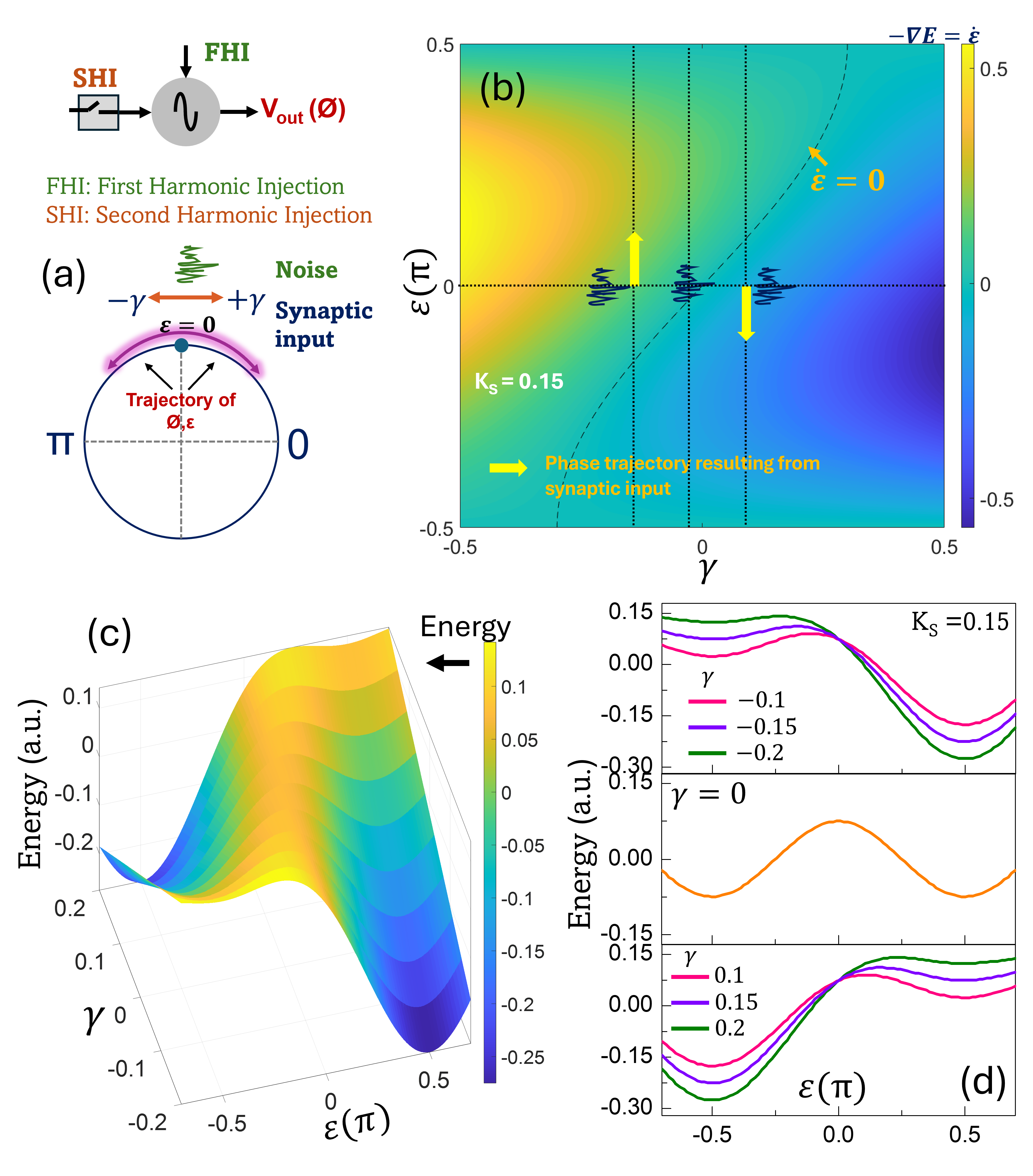
The image presents a multi-panel scientific diagram analyzing neuronal dynamics through harmonic injections, phase trajectories, and energy landscapes. Key elements include:
- First/Second Harmonic Injection (FHI/SHI) mechanisms
- Phase-space trajectories with synaptic noise
- Energy landscapes as functions of phase (ε) and gain (γ)
- Stability analysis across parameter space
### Components/Axes
#### Panel (a): Harmonic Injection Mechanism
- **Diagram Elements**:
- Circular trajectory labeled "Trajectory of Θ,ε"
- Arrows indicating:
- Noise: ±γ (orange)
- Synaptic input: +γ (blue)
- Labels:
- FHI: First Harmonic Injection (green)
- SHI: Second Harmonic Injection (orange)
- Axes: Θ (horizontal), ε (vertical)
#### Panel (b): Phase Trajectory Heatmap
- **Axes**:
- x-axis: γ (gain parameter, -0.5 to 0.5)
- y-axis: ε(π) (phase, -0.5 to 0.5)
- **Color Scale**:
- Blue (-0.5) to Yellow (0.5) representing -∇E = ε
- **Key Features**:
- Vertical dashed line at γ = 0
- Yellow arrows marking:
- ε = 0 (horizontal equilibrium)
- -∇E = ε (diagonal equilibrium)
- Ks = 0.15 (critical coupling parameter)
#### Panel (c): 3D Energy Landscape
- **Axes**:
- x-axis: ε(π) (-0.5 to 0.5)
- y-axis: γ (-0.2 to 0.2)
- z-axis: Energy (a.u., -0.25 to 0.1)
- **Color Gradient**:
- Blue (low energy) to Yellow (high energy)
- **Key Feature**:
- Saddle-like structure with energy minima/maxima
#### Panel (d): Energy vs Phase Curves
- **Axes**:
- x-axis: ε(π) (-0.5 to 0.5)
- y-axis: Energy (a.u., -0.3 to 0.15)
- **Data Series** (Ks = 0.15):
- Orange: γ = 0 (baseline)
- Red: γ = -0.1 (downward slope)
- Purple: γ = -0.15 (steepest descent)
- Green: γ = -0.2 (most negative slope)
- Blue: γ = 0.1 (ascending slope)
- Pink: γ = 0.15 (shallow ascent)
- Green: γ = 0.2 (steepest ascent)
### Detailed Analysis
#### Panel (a)
- Circular trajectory shows phase-amplitude coupling
- Noise (γ) modulates trajectory width
- FHI/SHI labels suggest harmonic perturbation mechanisms
#### Panel (b)
- Phase trajectories cluster near:
- ε = 0 (horizontal equilibrium)
- -∇E = ε (diagonal stability boundary)
- Ks = 0.15 indicates moderate coupling strength
#### Panel (c)
- Energy landscape reveals:
- Double-well structure for γ < 0
- Monotonic increase for γ > 0
- Critical point at γ = 0, ε = 0
#### Panel (d)
- Energy curves demonstrate:
- γ < 0: Energy decreases with increasing ε
- γ > 0: Energy increases with ε
- Steeper slopes for |γ| > 0.15
### Key Observations
1. **Bistability**: Panel (c) shows distinct energy minima for negative γ values
2. **Critical Coupling**: Ks = 0.15 appears in both (b) and (d), suggesting parameter consistency
3. **Slope Correlation**: Panel (d) confirms steeper energy gradients for |γ| > 0.15
4. **Equilibrium Points**: Panel (b) identifies two stable equilibria (ε=0 and -∇E=ε)
### Interpretation
This diagram illustrates how synaptic noise (γ) and phase (ε) interact to shape neuronal energy landscapes. The FHI/SHI mechanism (a) likely represents input perturbations that drive the system toward different stability regimes. The heatmap (b) reveals how gain (γ) modulates phase trajectories, with Ks = 0.15 marking a critical coupling threshold. The 3D landscape (c) visualizes energy minima/maxima, while panel (d) quantifies how γ affects energy-phase relationships. Notably, negative γ values create bistable energy wells, suggesting potential for memory-like states in neuronal dynamics. The consistent Ks value across panels implies a unified parameter space for analyzing these interactions.