\n
## Diagram: Hierarchical Name Sets with Final Answer
### Overview
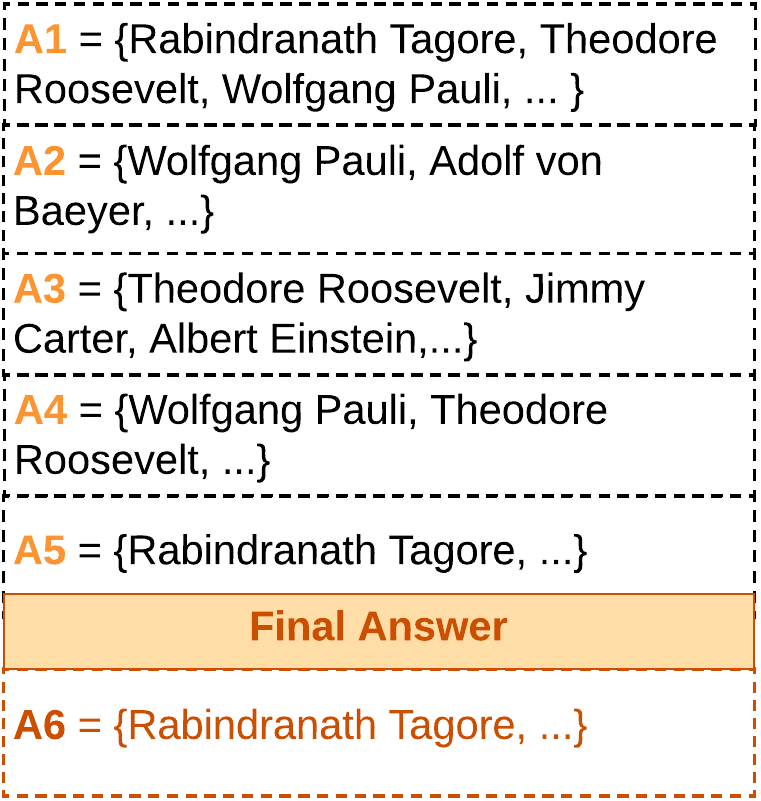
The image displays a vertically structured diagram composed of seven rectangular boxes with dashed borders, each containing a labeled set of names. The boxes are arranged in a single column. The sixth box from the top is visually distinct, highlighted with an orange background and labeled "Final Answer." The diagram appears to represent a process of filtering, selection, or aggregation of names from initial sets (A1-A5) leading to a final result (A6).
### Components/Axes
The diagram has no traditional chart axes. Its components are:
* **Labeled Boxes:** Six boxes labeled A1 through A6.
* **"Final Answer" Box:** A highlighted box positioned between A5 and A6.
* **Content:** Each box contains a set notation listing proper names, followed by an ellipsis ("..."), indicating the sets are incomplete or truncated in this view.
* **Spatial Layout:** The boxes are stacked vertically. A1 is at the top, followed sequentially by A2, A3, A4, and A5. The "Final Answer" box is centered below A5. A6 is at the bottom, below the "Final Answer" box.
### Detailed Analysis
**Transcription of Textual Content:**
* **Box A1 (Top):**
* Label: `A1`
* Content: `{Rabindranath Tagore, Theodore Roosevelt, Wolfgang Pauli, ... }`
* **Box A2:**
* Label: `A2`
* Content: `{Wolfgang Pauli, Adolf von Baeyer, ...}`
* **Box A3:**
* Label: `A3`
* Content: `{Theodore Roosevelt, Jimmy Carter, Albert Einstein,...}`
* **Box A4:**
* Label: `A4`
* Content: `{Wolfgang Pauli, Theodore Roosevelt, ...}`
* **Box A5:**
* Label: `A5`
* Content: `{Rabindranath Tagore, ...}`
* **"Final Answer" Box:**
* Label: `Final Answer` (centered, bold text on an orange background)
* Content: (This box contains only the label, acting as a header for the box below it.)
* **Box A6 (Bottom):**
* Label: `A6`
* Content: `{Rabindranath Tagore, ...}`
### Key Observations
1. **Name Recurrence:** Several names appear across multiple sets:
* **Wolfgang Pauli:** Appears in A1, A2, and A4.
* **Theodore Roosevelt:** Appears in A1, A3, and A4.
* **Rabindranath Tagore:** Appears in A1, A5, and is the sole listed name in A6.
2. **Set Reduction:** The sets appear to become less populated or more specific as they progress downward, culminating in A6 which contains only one named individual.
3. **Visual Hierarchy:** The "Final Answer" box creates a clear visual break, suggesting that A6 is the output or conclusion derived from the preceding sets (A1-A5).
4. **Ellipses:** The consistent use of "..." in every set (A1-A5 and A6) explicitly indicates that the lists shown are not exhaustive; there are additional members in each set that are not displayed in this diagram.
### Interpretation
This diagram likely illustrates a logical or computational process, such as a **set operation, a filtering algorithm, or a decision tree**. The flow is top-down: initial candidate sets (A1-A5) are provided, and through some unstated process (perhaps intersection, union, or a rule-based filter), a final, narrowed-down result is produced in A6.
The key investigative insight is the **convergence on Rabindranath Tagore**. While other notable figures like Wolfgang Pauli and Theodore Roosevelt appear frequently in the intermediate sets, only Tagore persists into the final answer set (A6). This suggests the underlying process is designed to identify an individual who meets specific criteria present across the initial sets—for example, perhaps a person who is a Nobel laureate in Literature (Tagore, 1913) and also appears in other curated lists. The ellipses are crucial; they imply the full data contains more names, and the diagram is a simplified view of a more complex selection mechanism. The "Final Answer" is not necessarily the only member of the ultimate set, but the one highlighted by this specific process.