## Diagram: Ball Collision Simulation Frames
### Overview
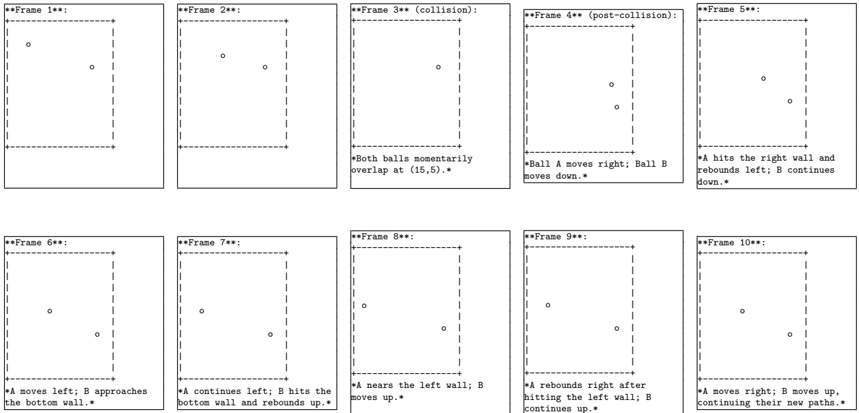
The image depicts a sequence of 10 frames illustrating a simulated collision between two balls (A and B) within a rectangular boundary. The frames show the positions of the balls at different time steps, along with textual descriptions of their movements and interactions. The rectangular boundary is represented by dashed lines.
### Components/Axes
* **Frames:** 1 through 10, each showing a snapshot of the simulation.
* **Balls:** Two balls, labeled implicitly as A and B, represented by small circles.
* **Boundary:** A rectangular area defined by dashed lines, representing the simulation space.
* **Textual Descriptions:** Short descriptions below each frame explaining the balls' movements and interactions.
### Detailed Analysis
Here's a frame-by-frame breakdown:
* **Frame 1:** Ball A is positioned in the upper-left quadrant, and Ball B is in the upper-right quadrant.
* **Frame 2:** Ball A is slightly lower and more to the right, while Ball B is slightly lower and more to the left.
* **Frame 3 (collision):** The balls are shown at approximately the same location, indicating a collision. The text states: "Both balls momentarily overlap at (15,5)."
* **Frame 4 (post-collision):** Ball A is now to the right of the collision point, and Ball B is below it. The text states: "Ball A moves right; Ball B moves down."
* **Frame 5:** Ball A is further to the right, near the right boundary. Ball B is further down. The text states: "A hits the right wall and rebounds left; B continues down."
* **Frame 6:** Ball A is moving left, and Ball B is approaching the bottom wall. The text states: "A moves left; B approaches the bottom wall."
* **Frame 7:** Ball A continues left, and Ball B hits the bottom wall and rebounds up. The text states: "A continues left; B hits the bottom wall and rebounds up."
* **Frame 8:** Ball A nears the left wall, and Ball B moves up. The text states: "A nears the left wall; B moves up."
* **Frame 9:** Ball A rebounds right after hitting the left wall, and Ball B continues up. The text states: "A rebounds right after hitting the left wall; B continues up."
* **Frame 10:** Ball A moves right, and Ball B moves up, continuing their new paths. The text states: "A moves right; B moves up, continuing their new paths."
### Key Observations
* The simulation depicts a collision between two balls within a confined space.
* The collision occurs around the center of the frame.
* After the collision, the balls change direction and eventually rebound off the walls.
* The textual descriptions provide additional information about the balls' movements and interactions.
### Interpretation
The diagram illustrates a basic physics simulation of a collision between two objects. The simulation demonstrates the concepts of momentum transfer and elastic collisions. The textual descriptions enhance the understanding of the simulation by providing explicit details about the balls' movements and interactions with the boundaries. The simulation appears to be simplified, as it doesn't account for factors like friction or energy loss during the collision. The coordinate (15,5) in Frame 3 likely refers to the approximate location of the collision within the simulation space, but without knowing the scale of the simulation, the units are unclear.