\n
## Diagram: Ball Collision Simulation
### Overview
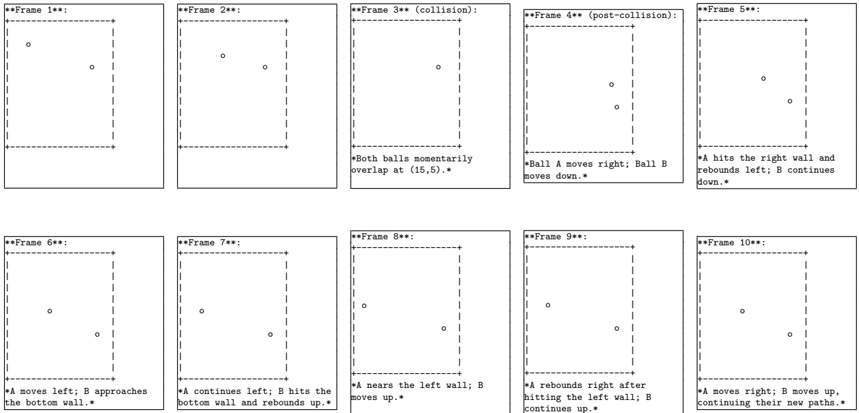
The image presents a sequence of ten frames depicting a simulation of two balls (labeled A and B) colliding within a rectangular boundary. Each frame shows the position of the balls at a specific time step. The diagram illustrates the movement of the balls before, during, and after the collision, including rebounds off the walls of the boundary.
### Components/Axes
The diagram consists of ten individual frames arranged in a 2x5 grid. Each frame is labeled with a frame number (1 through 10) in the top-left corner. Each frame contains two circular objects representing the balls, and a dashed rectangular boundary. Text descriptions are provided below some of the frames, describing the action occurring in that frame. There are no explicit axes, but the position of the balls can be inferred within the rectangular frame.
### Detailed Analysis or Content Details
**Frame 1:**
* Ball A is positioned near the top of the frame.
* Ball B is positioned near the bottom of the frame.
**Frame 2:**
* Ball A has moved slightly downwards.
* Ball B has moved slightly upwards.
**Frame 3 (Collision):**
* Both balls momentarily overlap at approximately (15, 6.5).
* Text: "Both balls momentarily overlap at (15,6.5)."
**Frame 4 (Post-Collision):**
* Ball A has moved to the right and slightly upwards.
* Ball B has moved downwards.
* Text: "Ball A moves right; Ball B moves down."
**Frame 5:**
* Ball A continues moving to the right and rebounds off the right wall, changing direction to the left.
* Ball B continues moving downwards.
* Text: "A hits the right wall and rebounds left; B continues down."
**Frame 6:**
* Ball A is moving to the left.
* Ball B is approaching the bottom wall.
* Text: "A moves left; B approaches the bottom wall."
**Frame 7:**
* Ball A continues moving to the left.
* Ball B hits the bottom wall and rebounds upwards.
* Text: "A continues left; B hits the bottom wall and rebounds up."
**Frame 8:**
* Ball A nears the left wall and is moving upwards.
* Ball B is moving upwards.
* Text: "A nears the left wall; B moves up."
**Frame 9:**
* Ball A rebounds right after hitting the left wall and continues upwards.
* Ball B continues moving upwards.
* Text: "A rebounds right after hitting the left wall; B continues up."
**Frame 10:**
* Ball A moves right and continues upwards.
* Ball B moves upwards, continuing its new path.
* Text: "A moves right; B moves up, continuing their new paths."
### Key Observations
* The collision in Frame 3 appears to be elastic, as the balls change direction after the impact.
* The balls exhibit rebounding behavior when they hit the walls of the rectangular boundary.
* The simulation demonstrates basic physics principles of motion and collision.
* The coordinate (15, 6.5) is provided as the point of collision.
### Interpretation
The diagram illustrates a simplified physics simulation of a two-ball collision within a confined space. The sequence of frames demonstrates how the balls' trajectories change before, during, and after the collision, as well as when they interact with the boundaries. The provided coordinate (15, 6.5) suggests a specific point within the frame is used for collision detection. The simulation likely uses idealized conditions (e.g., no friction, perfectly elastic collision) to simplify the physics. The diagram serves as a visual representation of the simulation's behavior, allowing for a qualitative understanding of the collision dynamics. The text descriptions provide additional context and clarify the actions occurring in each frame.