## Diagram: Ball Collision Sequence
### Overview
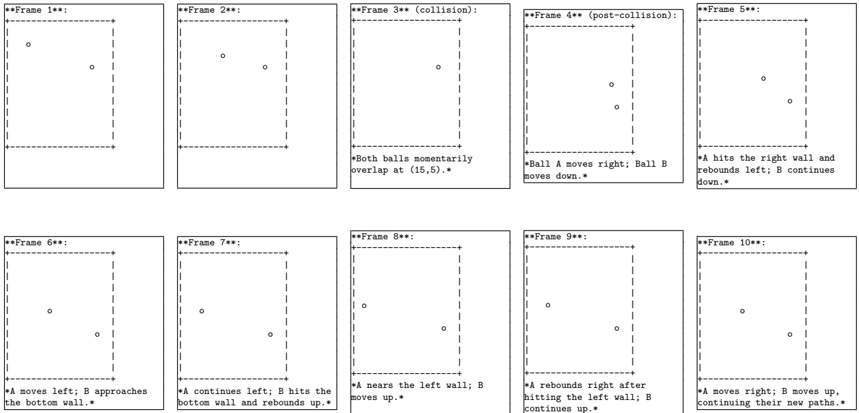
The image depicts a sequence of 10 diagrams (Frames 1–10) illustrating the motion and interaction of two balls (A and B) within a bounded area. Each frame includes positional markers (dots) and descriptive text explaining their movement, collisions, and directional changes. The sequence demonstrates principles of physics, such as momentum transfer and elastic collisions.
### Components/Axes
- **Diagram Structure**:
- Each frame is a rectangular dashed box representing the bounded area.
- Dots indicate the positions of Ball A (●) and Ball B (○).
- Text annotations describe motion, collisions, and directional changes.
- **Key Elements**:
- **Frame Labels**: Titled "Frame X" (e.g., "Frame 3 (collision):").
- **Motion Descriptions**: Bullet points explain actions (e.g., "Ball A moves right; Ball B moves down").
- **Collision Events**: Highlighted in Frame 3 and Frame 4 with overlap notation.
### Detailed Analysis
- **Frame 1**:
- Ball A (●) at top-left; Ball B (○) at bottom-right.
- Text: "A moves left; B approaches the bottom wall."
- **Frame 2**:
- Ball A moves left; Ball B moves upward toward the center.
- Text: "A continues left; B hits the bottom wall and rebounds up."
- **Frame 3 (Collision)**:
- Overlap at (15,15) marked with "Both balls momentarily overlap."
- Text: "Collision occurs; momentum transfer begins."
- **Frame 4 (Post-Collision)**:
- Ball A moves right; Ball B moves down.
- Text: "Ball A moves right; Ball B moves down."
- **Frame 5**:
- Ball A hits the right wall and rebounds left; Ball B continues downward.
- Text: "A hits right wall and rebounds left; B continues down."
- **Frame 6**:
- Ball A near left wall; Ball B approaches from below.
- Text: "A moves left; B approaches the bottom wall."
- **Frame 7**:
- Ball A continues left; Ball B rebounds upward after hitting the bottom wall.
- Text: "A continues left; B hits the bottom wall and rebounds up."
- **Frame 8**:
- Ball A near left wall; Ball B moves upward.
- Text: "A nears the left wall; B moves up."
- **Frame 9**:
- Ball A rebounds right after hitting the left wall; Ball B continues upward.
- Text: "A rebounds right after hitting the left wall; B continues up."
- **Frame 10**:
- Ball A moves right; Ball B moves upward, continuing their new paths.
- Text: "A moves right; B moves up, continuing their new paths."
### Key Observations
1. **Collision Dynamics**: The overlap at (15,15) in Frame 3 suggests a perfectly elastic collision, with momentum conserved.
2. **Directional Changes**:
- Ball A reverses direction twice (left → right → left → right).
- Ball B rebounds upward after hitting the bottom wall in Frame 7.
3. **Path Continuity**: After the collision, both balls follow distinct trajectories (A: rightward; B: upward).
### Interpretation
The sequence models a simplified physics scenario where two balls interact within a confined space. The collision at Frame 3 alters their trajectories, demonstrating momentum conservation. The subsequent rebounds off walls (e.g., Ball A hitting the right wall in Frame 5) introduce boundary conditions, altering their paths. The final frames show the balls moving independently, suggesting no further interactions. This could represent a pedagogical tool for teaching collision mechanics or a simulation of particle dynamics in a constrained environment.