\n
## Diagram: Model of Awareness
### Overview
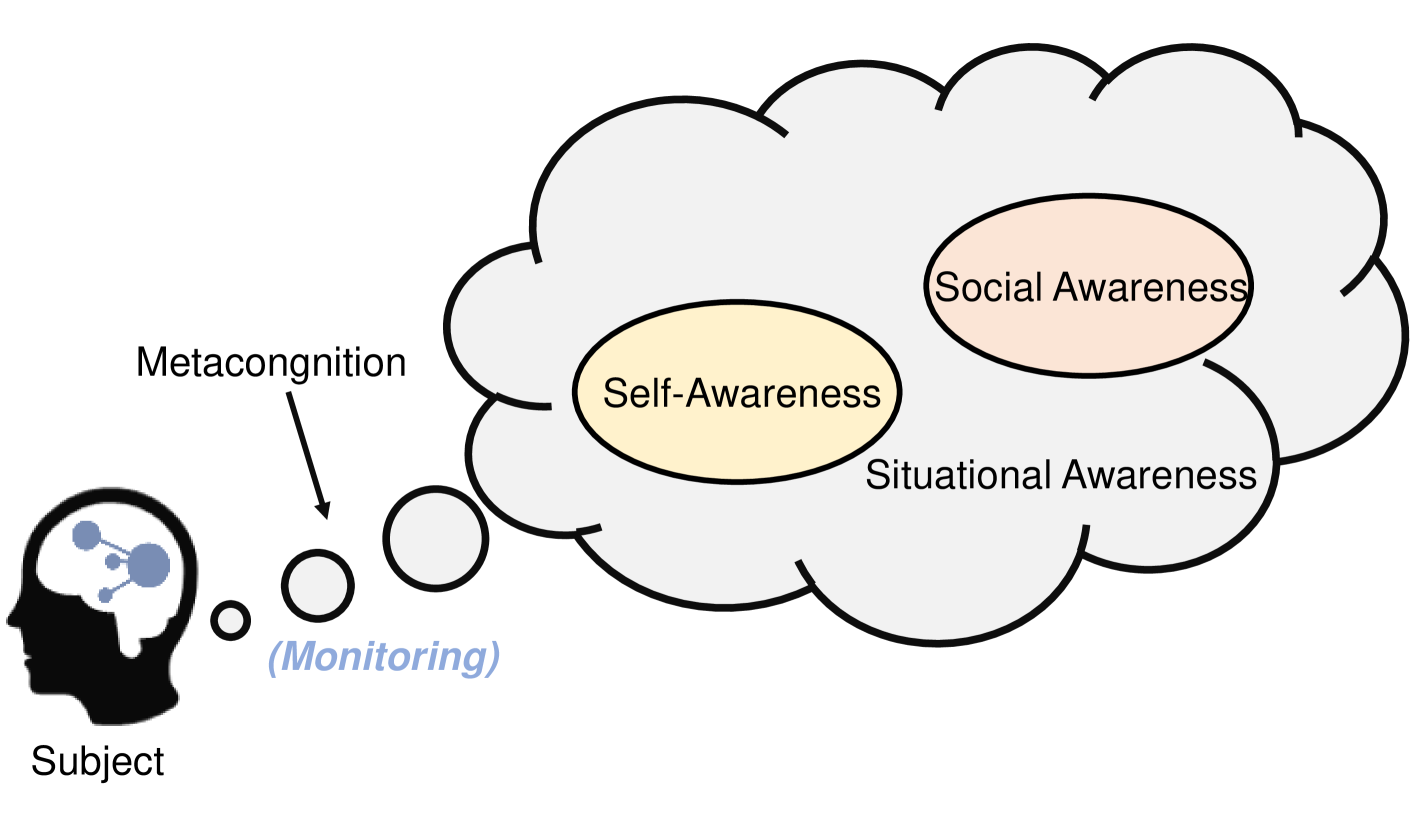
The image depicts a diagram illustrating a model of awareness, showing the relationship between a "Subject" and various levels of awareness: Metacognition, Self-Awareness, Social Awareness, and Situational Awareness. The diagram uses a cloud-like shape to represent the overall awareness space, with connections to the subject via arrows and concentric circles.
### Components/Axes
The diagram consists of the following components:
* **Subject:** A silhouette of a head with a glowing brain inside, labeled "Subject".
* **Metacognition:** A label connected to the subject via an arrow.
* **Self-Awareness:** An oval shape within the cloud, labeled "Self-Awareness".
* **Social Awareness:** An oval shape within the cloud, labeled "Social Awareness".
* **Situational Awareness:** An oval shape within the cloud, labeled "Situational Awareness".
* **Monitoring:** A series of concentric circles between the subject and the cloud, labeled "(Monitoring)".
* **Cloud Shape:** A large, irregular cloud-like shape encompassing Self-Awareness, Social Awareness, and Situational Awareness.
* **Arrows:** Lines connecting the Subject to Metacognition and the cloud shape to the various awareness levels.
### Detailed Analysis or Content Details
The diagram shows a hierarchical relationship between the different levels of awareness.
* The "Subject" (head silhouette) is positioned on the left side of the image.
* "Metacognition" is directly linked to the subject via a single arrow, suggesting a direct connection.
* The "Monitoring" circles are positioned between the subject and the cloud, indicating a process of observation or assessment. There are four concentric circles, diminishing in size as they move towards the cloud.
* "Self-Awareness" is centrally located within the cloud, suggesting it is a foundational element.
* "Social Awareness" and "Situational Awareness" are positioned to the right and bottom-right of "Self-Awareness" respectively, indicating they build upon it.
* The cloud shape itself represents the broader context of awareness, encompassing all three levels.
* The arrows connecting the cloud to the awareness levels are curved, suggesting a dynamic and interconnected relationship.
### Key Observations
The diagram emphasizes the importance of self-awareness as a core component of overall awareness. It also highlights the role of monitoring in the process of becoming aware. The positioning of the elements suggests a flow of information from the subject, through monitoring, and into the different levels of awareness.
### Interpretation
This diagram likely represents a cognitive model of how individuals develop and utilize different levels of awareness. The "Subject" represents the individual, and the brain within the silhouette suggests the cognitive processes involved. "Metacognition" – thinking about thinking – is shown as a direct link to the individual, implying it's a fundamental aspect of awareness. The "Monitoring" circles suggest a continuous process of self-observation and assessment.
The hierarchical arrangement of "Self-Awareness," "Social Awareness," and "Situational Awareness" suggests that these levels build upon each other. Self-awareness is the foundation, allowing individuals to understand their own thoughts, feelings, and behaviors. Social awareness builds upon this by enabling individuals to understand the thoughts, feelings, and behaviors of others. Finally, situational awareness integrates both self and social awareness to understand the broader context of a given situation.
The cloud shape could represent the complexity and fluidity of awareness, suggesting that it is not a static state but rather a dynamic process. The diagram implies that developing these levels of awareness is crucial for effective functioning and interaction with the world. The diagram does not provide any quantitative data, but rather a conceptual framework.