## Conceptual Diagram: Metacognition and Awareness
### Overview
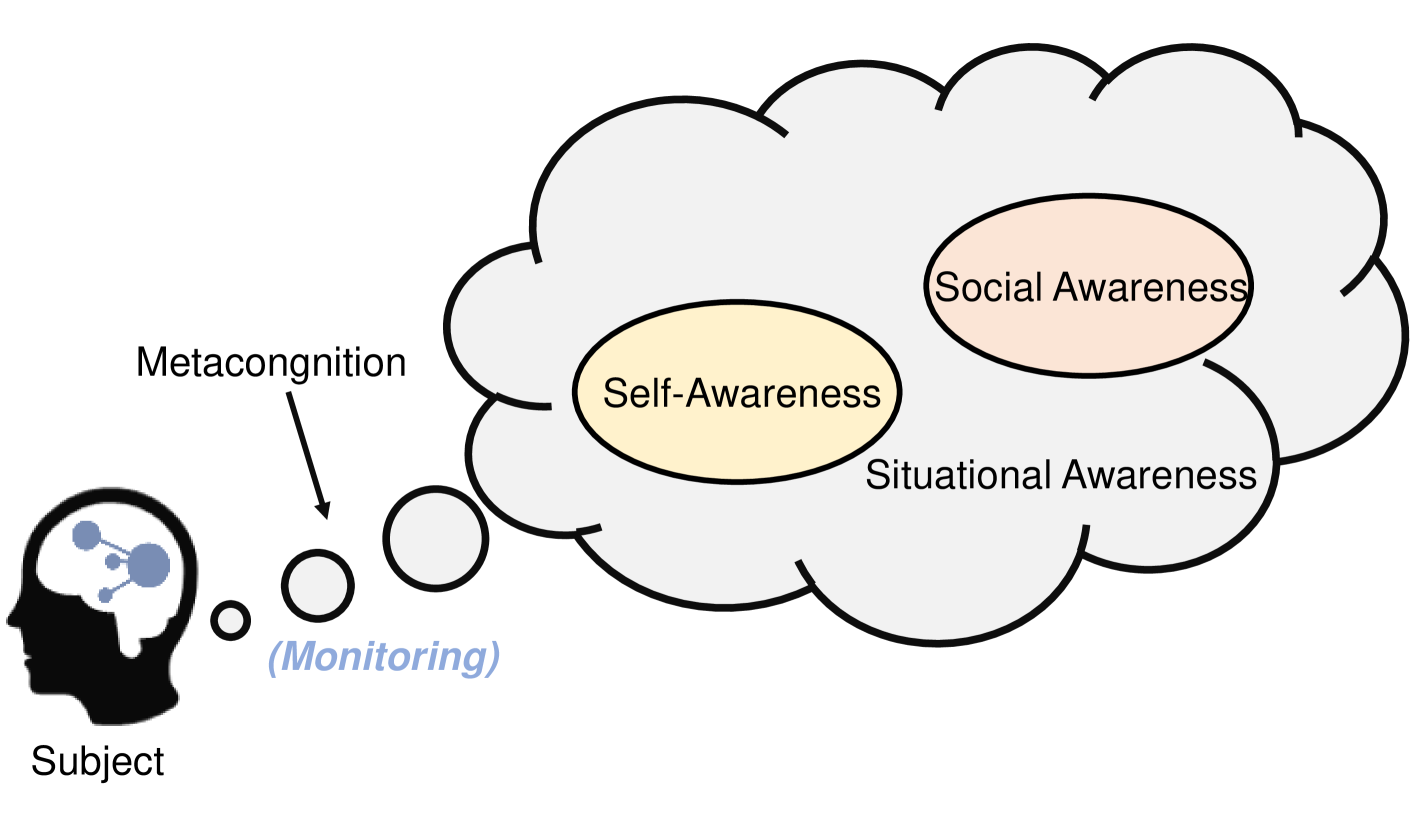
This image is a conceptual diagram illustrating the relationship between a subject, metacognition, and different forms of awareness. It uses a thought-bubble metaphor to depict cognitive processes.
### Components/Axes
The diagram is composed of several distinct visual elements arranged from left to right:
1. **Subject (Bottom-Left):** A black silhouette of a human head in profile, facing left. Inside the head is a white brain shape containing a network of blue nodes and connecting lines, symbolizing neural or cognitive activity.
2. **Thought Bubbles (Center-Left):** A series of three empty, white circles of increasing size, emanating from the subject's head, leading towards a larger cloud shape.
3. **Metacognition Label & Arrow (Center-Left):** The text "**Metacongnition**" (note: likely a typo for "Metacognition") is positioned above the thought bubbles. A black arrow points from this text down to the middle thought bubble.
4. **Monitoring Label (Center-Left):** The text "**(Monitoring)**" is written in blue italics below the thought bubbles.
5. **Awareness Cloud (Right):** A large, light-grey cloud shape with a black outline, representing the content of thought or awareness. Inside this cloud are three labeled ovals:
* **Self-Awareness:** A yellow oval positioned in the lower-left area of the cloud.
* **Social Awareness:** A light pink/peach oval positioned in the upper-right area of the cloud.
* **Situational Awareness:** This text is not enclosed in an oval but is placed directly within the cloud, below the "Social Awareness" oval and to the right of the "Self-Awareness" oval.
### Detailed Analysis
* **Spatial Relationships:** The diagram flows from the subject (source of cognition) via thought bubbles to the cloud of awareness. The "Metacongnition" label and arrow explicitly point to the thought process itself, suggesting it is an overseeing or monitoring function, as reinforced by the "(Monitoring)" text.
* **Component Hierarchy:** The large cloud contains all three awareness types, suggesting they are sub-components or facets of a broader conscious or cognitive state. "Situational Awareness" appears as a foundational or encompassing concept within the cloud, while "Self-Awareness" and "Social Awareness" are highlighted as distinct, colored sub-categories.
* **Visual Metaphor:** The brain nodes inside the subject imply an underlying computational or network-based process. The thought bubbles transitioning into a cloud is a common metaphor for internal thought, reflection, or mental models.
### Key Observations
1. **Typographical Error:** The label "Metacongnition" is misspelled. The correct term is "Metacognition."
2. **Color Coding:** Only "Self-Awareness" (yellow) and "Social Awareness" (pink) are given distinct colored backgrounds within the cloud. "Situational Awareness" is presented as plain text, which may indicate it is a broader category or a different type of construct in this model.
3. **Process Indication:** The combination of the arrow from "Metacongnition" and the label "(Monitoring)" strongly implies that metacognition is the active process of monitoring one's own thought bubbles (cognitive processes), which in turn generate or contain the various awareness states.
### Interpretation
This diagram presents a model of cognitive architecture where **metacognition** acts as a monitoring function over a subject's internal thought processes. These processes, in turn, give rise to a unified field of awareness that comprises three key domains:
* **Self-Awareness:** Understanding one's own internal states, traits, and mechanisms.
* **Social Awareness:** Understanding the states, intentions, and dynamics of others.
* **Situational Awareness:** Understanding the broader context and environment.
The model suggests that effective cognition isn't just about having these awarenesses, but about the higher-order process of *monitoring* how they are generated and interact. This framework could be relevant to fields like psychology, artificial intelligence (particularly in designing agents with theory of mind), and human-computer interaction, where understanding the layers of awareness and self-monitoring is crucial. The placement of "Situational Awareness" as text within the cloud, rather than in a colored oval, might imply it is the overarching context within which self and social awareness operate.