## Diagram: Cognitive Awareness Framework
### Overview
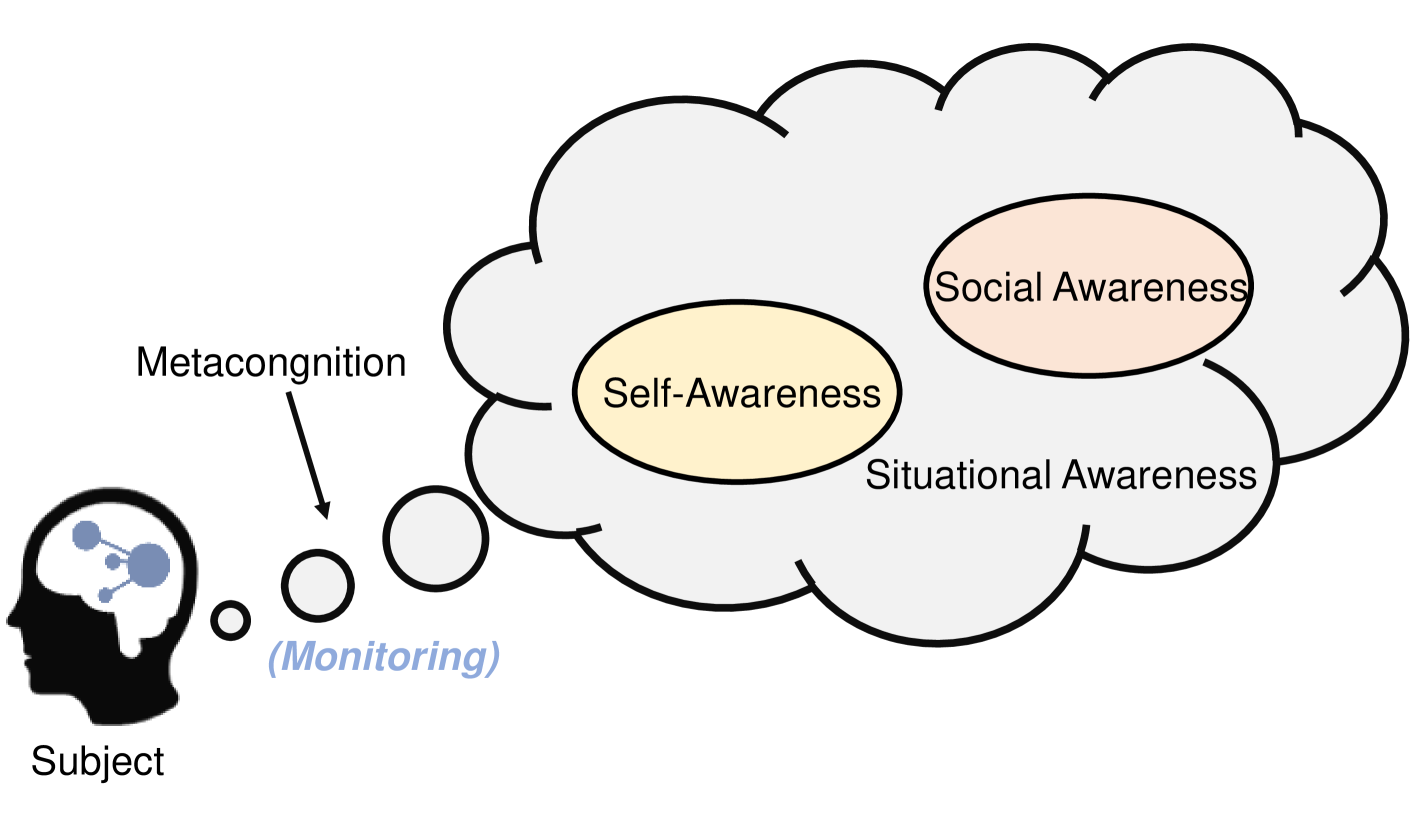
The diagram illustrates a conceptual model of cognitive processes, depicting the flow from metacognition to three distinct types of awareness: self-awareness, social awareness, and situational awareness. It uses visual metaphors (e.g., a thought bubble) to represent abstract mental states.
### Components/Axes
- **Subject**: A silhouette of a human head with three interconnected blue circles inside, symbolizing neural activity or brain regions.
- **Metacognition**: A labeled arrow pointing from the subject to a series of three progressively larger circles.
- **Monitoring**: The three circles are annotated with "(Monitoring)" in parentheses, suggesting a hierarchical or layered process.
- **Thought Bubble**: A large cloud-shaped element connected to the final monitoring circle, containing three ovals:
- **Self-Awareness** (yellow oval)
- **Social Awareness** (pink oval)
- **Situational Awareness** (gray oval)
### Detailed Analysis
- **Color Coding**:
- Blue: Neural activity (brain regions) within the subject.
- Yellow: Self-Awareness (personal introspection).
- Pink: Social Awareness (interpersonal dynamics).
- Gray: Situational Awareness (environmental context).
- **Flow**:
1. **Subject** → **Metacognition** (arrow) → **Monitoring** (three circles).
2. **Monitoring** → **Thought Bubble** (cloud) → **Three Awareness Types** (ovals).
- **Spatial Grounding**:
- The subject is positioned on the far left.
- The thought bubble dominates the right side, with ovals arranged horizontally.
- No explicit legend, but colors are used to differentiate awareness types.
### Key Observations
- The diagram emphasizes **metacognition** as the driver of awareness processes.
- The three awareness types are distinct but interconnected, nested within a single cognitive framework.
- No numerical data or quantitative trends are present; the focus is on conceptual relationships.
### Interpretation
This model suggests that metacognition (self-reflective thinking) enables monitoring of internal and external states, which then manifests as three interrelated forms of awareness:
1. **Self-Awareness** (yellow): Focus on internal states, emotions, and identity.
2. **Social Awareness** (pink): Understanding social cues, relationships, and group dynamics.
3. **Situational Awareness** (gray): Perception of environmental context and external stimuli.
The use of a thought bubble implies these awareness types are products of conscious thought, while the brain’s neural network (blue circles) represents the subconscious or automatic processes underpinning metacognition. The absence of quantitative data suggests this is a theoretical framework rather than an empirical study.