## Line Chart: Test Accuracy vs. Communication Round
### Overview
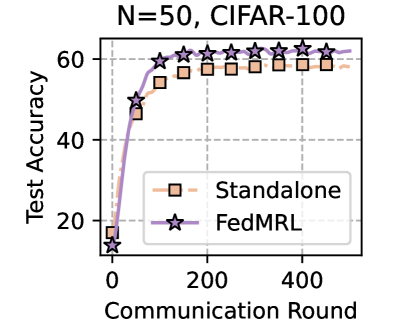
The image is a line chart comparing the test accuracy of two methods, "Standalone" and "FedMRL," over a number of communication rounds. The chart displays the performance of these methods on the CIFAR-100 dataset with N=50.
### Components/Axes
* **Title:** N=50, CIFAR-100
* **X-axis:** Communication Round
* Scale: 0 to 500, with visible markers at 0, 200, and 400.
* **Y-axis:** Test Accuracy
* Scale: 0 to 60, with visible markers at 20, 40, and 60.
* **Legend:** Located in the center-right of the chart.
* Standalone: Light orange line with square markers.
* FedMRL: Purple line with star markers.
* Gridlines: Dashed gray lines at intervals of 20 on the Y-axis.
### Detailed Analysis
* **Standalone:**
* Trend: The light orange line with square markers represents the "Standalone" method. It starts at approximately 15% accuracy at round 0, rises sharply to about 55% by round 100, and then plateaus around 58-60% for the remaining rounds.
* Data Points:
* Round 0: ~15%
* Round 100: ~55%
* Round 200: ~58%
* Round 300: ~59%
* Round 400: ~59%
* Round 500: ~58%
* **FedMRL:**
* Trend: The purple line with star markers represents the "FedMRL" method. It starts at approximately 14% accuracy at round 0, rises sharply to about 50% by round 50, and then continues to increase, surpassing the "Standalone" method. It plateaus around 62-64% for the remaining rounds.
* Data Points:
* Round 0: ~14%
* Round 50: ~50%
* Round 100: ~59%
* Round 200: ~62%
* Round 300: ~63%
* Round 400: ~63%
* Round 500: ~62%
### Key Observations
* Both methods show a rapid increase in test accuracy in the initial communication rounds.
* FedMRL consistently outperforms Standalone after approximately 100 communication rounds.
* Both methods plateau in accuracy after a certain number of rounds, indicating diminishing returns from further communication.
### Interpretation
The chart demonstrates that the FedMRL method achieves higher test accuracy compared to the Standalone method when trained on the CIFAR-100 dataset with N=50. The initial rapid increase in accuracy for both methods suggests that the models quickly learn from the data. The plateauing effect indicates that the models eventually reach a point where further communication rounds do not significantly improve performance. The FedMRL method's superior performance suggests that it is a more effective approach for this particular task and dataset.