\n
## Diagram: Evolution of Agentic Systems
### Overview
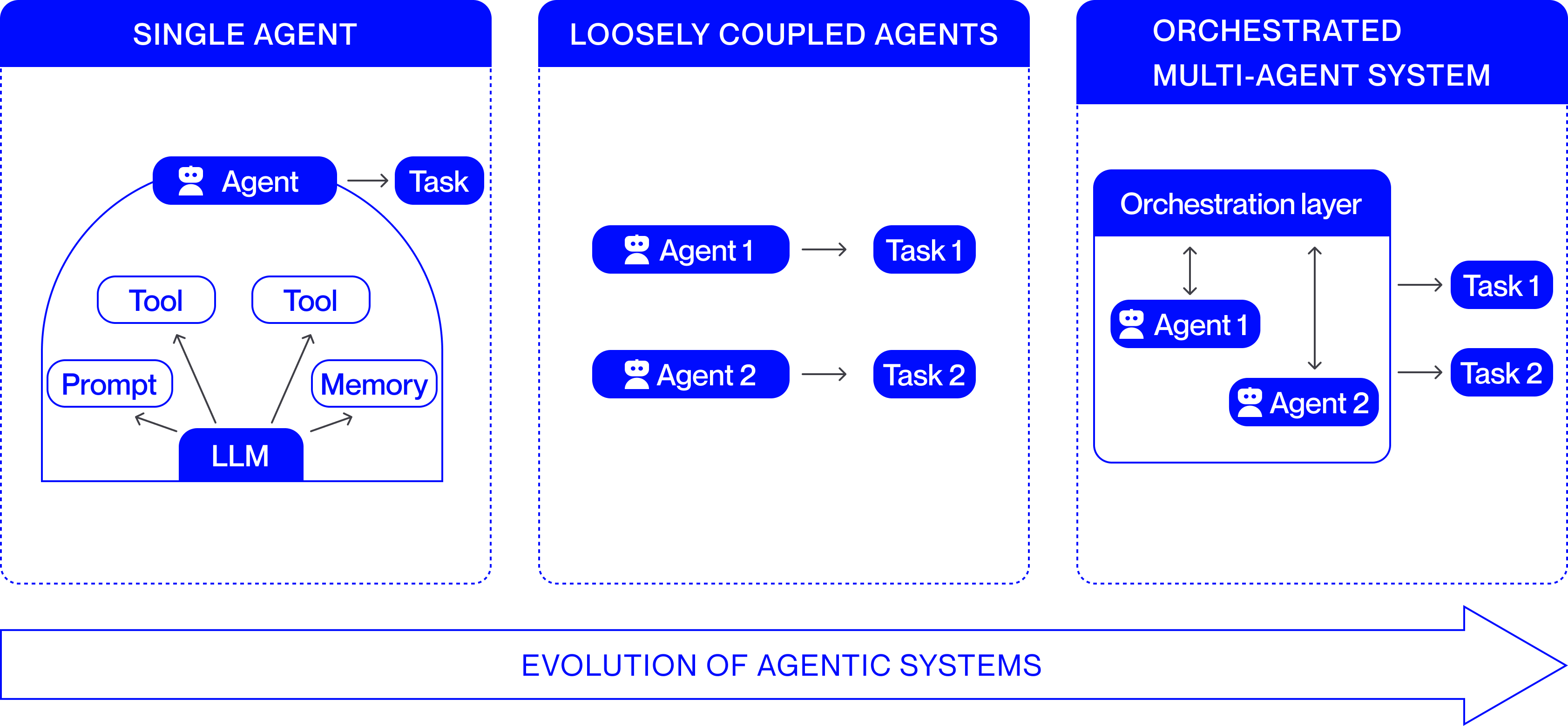
The image is a diagram illustrating the evolution of agentic systems, progressing from a single agent to loosely coupled agents, and finally to an orchestrated multi-agent system. It visually represents the increasing complexity and coordination within these systems. The diagram is divided into three distinct sections, each representing a stage in this evolution.
### Components/Axes
The diagram consists of three main sections, arranged horizontally:
1. **Single Agent:** Depicted in a blue rectangle.
2. **Loosely Coupled Agents:** Depicted in a light gray rectangle.
3. **Orchestrated Multi-Agent System:** Depicted in a blue rectangle.
Each section contains visual elements representing the components of the agentic system at that stage. These include:
* **Agent:** Represented by a robot head icon.
* **Task:** Represented by a rectangular box.
* **Tool:** Represented by a wrench icon.
* **Prompt:** Represented by a speech bubble icon.
* **Memory:** Represented by a memory chip icon.
* **LLM:** Represented by a rectangular box labeled "LLM".
* **Orchestration Layer:** Represented by a rectangular box labeled "Orchestration layer".
Arrows indicate the flow of information or interaction between these components. The entire diagram is labeled "EVOLUTION OF AGENTIC SYSTEMS" at the bottom.
### Detailed Analysis or Content Details
**1. Single Agent:**
* A single "Agent" is connected to a "Task" via an arrow.
* The "Agent" interacts with two "Tool" components.
* The "Agent" receives a "Prompt".
* The "Agent" utilizes "Memory".
* All these components are connected to and powered by an "LLM" (Large Language Model).
**2. Loosely Coupled Agents:**
* Two "Agent 1" and "Agent 2" are present.
* "Agent 1" is connected to "Task 1" via an arrow.
* "Agent 2" is connected to "Task 2" via an arrow.
* There is no direct interaction between the agents or a central coordinating component.
**3. Orchestrated Multi-Agent System:**
* Two "Agent 1" and "Agent 2" are present.
* "Agent 1" is connected to "Task 1" via an arrow.
* "Agent 2" is connected to "Task 2" via an arrow.
* Both agents are connected to an "Orchestration layer" via bidirectional arrows, indicating communication and control.
* The "Orchestration layer" manages the interaction between the agents and their respective tasks.
The diagram uses arrows to show the direction of influence or interaction. The arrows are gray and white. The overall flow is from left to right, representing the evolution of the system.
### Key Observations
* The complexity of the system increases from left to right.
* The single agent system is self-contained, relying on internal components.
* The loosely coupled system lacks central coordination.
* The orchestrated system introduces a central "Orchestration layer" for managing interactions.
* The use of color (blue for the single agent and orchestrated systems, gray for the loosely coupled system) may indicate a distinction in functionality or maturity.
### Interpretation
The diagram illustrates a progression in agentic system design. It suggests that as systems become more complex, the need for coordination and management increases. The evolution from a single agent to a multi-agent system highlights the benefits of distributing tasks among multiple agents, but also emphasizes the importance of a central orchestration layer to ensure effective collaboration and achieve desired outcomes. The diagram implies that the "Orchestration layer" is crucial for harnessing the power of multiple agents, preventing chaos and maximizing efficiency. The LLM is the core component in the single agent system, and its role is not explicitly shown in the later stages, suggesting that the orchestration layer takes over some of its functions in the multi-agent context. The diagram is a conceptual representation and does not provide specific data or numerical values, but rather a qualitative overview of the evolution of agentic systems.