## Diagram: Evolution of Agentic Systems
### Overview
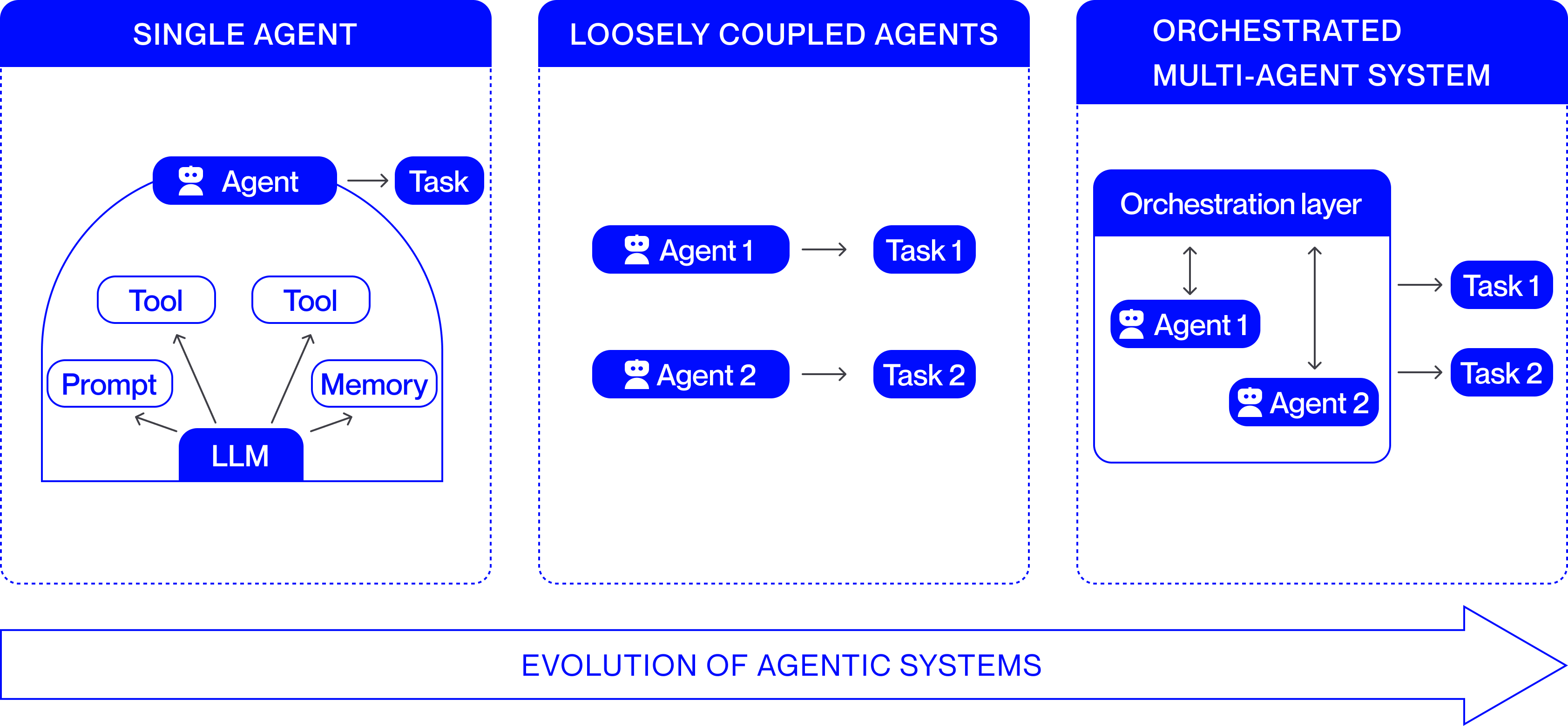
The image is a conceptual diagram illustrating three stages in the development of AI agent architectures. It is divided into three vertical panels, each representing a distinct model, arranged from left to right to indicate progression. A large arrow at the bottom reinforces this directional evolution.
### Components/Axes
The diagram is structured into three main panels, each with a blue header:
1. **Left Panel: "SINGLE AGENT"**
* **Central Component:** A large, semi-circular container.
* **Core Engine:** A blue box labeled **"LLM"** (Large Language Model) at the bottom center of the container.
* **Inputs/Components:** Three white boxes with blue borders feed into the LLM:
* **"Prompt"** (left)
* **"Tool"** (center-left)
* **"Tool"** (center-right)
* **"Memory"** (right)
* **Agent & Output:** A blue box with a robot icon labeled **"Agent"** sits atop the container. An arrow points from this Agent box to a blue box labeled **"Task"**.
2. **Center Panel: "LOOSELY COUPLED AGENTS"**
* **Structure:** Two independent, parallel agent-task pairs.
* **First Pair:** A blue box with a robot icon labeled **"Agent 1"** has an arrow pointing to a blue box labeled **"Task 1"**.
* **Second Pair:** A blue box with a robot icon labeled **"Agent 2"** has an arrow pointing to a blue box labeled **"Task 2"**.
* **Relationship:** There is no visual connection or communication line between Agent 1 and Agent 2.
3. **Right Panel: "ORCHESTRATED MULTI-AGENT SYSTEM"**
* **Orchestration Layer:** A large, light-blue container with a dark blue header labeled **"Orchestration layer"**.
* **Agents within Layer:** Inside this container are two blue boxes with robot icons:
* **"Agent 1"** (left)
* **"Agent 2"** (right)
* **Internal Coordination:** Double-headed vertical arrows connect the Orchestration layer header to both Agent 1 and Agent 2, indicating bidirectional communication and control.
* **Output:** Arrows point from the Orchestration layer container to two external blue boxes:
* **"Task 1"** (top)
* **"Task 2"** (bottom)
4. **Bottom Element:**
* A large, horizontal, right-pointing arrow spans the width of the diagram.
* Text inside the arrow reads: **"EVOLUTION OF AGENTIC SYSTEMS"**.
### Detailed Analysis
* **Single Agent Model:** This is a monolithic architecture. A single LLM core is directly augmented with specific capabilities (Tools, Memory) and a Prompt. This unified agent is responsible for executing a single Task.
* **Loosely Coupled Agents Model:** This represents a simple multi-agent setup. Multiple agents (Agent 1, Agent 2) operate independently, each dedicated to its own specific task (Task 1, Task 2). There is no mechanism for coordination or shared context between them.
* **Orchestrated Multi-Agent System Model:** This is a coordinated architecture. A central **Orchestration layer** manages multiple agents (Agent 1, Agent 2). The agents communicate with the orchestration layer (indicated by double-headed arrows), which likely assigns work, manages state, and coordinates their efforts. The system's output (Task 1, Task 2) is a result of this managed collaboration.
### Key Observations
1. **Increasing Complexity:** The diagram shows a clear progression from a single, self-contained unit to multiple independent units, and finally to a managed system of interdependent units.
2. **Introduction of Coordination:** The critical differentiator in the third stage is the **Orchestration layer**. This component is absent in the first two models and is the key enabler for managing complexity and enabling collaboration.
3. **Shift in Responsibility:** In the Single Agent model, the agent is directly responsible for the task. In the Orchestrated model, the agents' primary relationship is with the orchestration layer, which then interfaces with the tasks.
4. **Visual Language:** The use of consistent icons (robot for Agent) and colors (blue for active components) creates clear visual parallels across the three stages, making the evolution easy to follow.
### Interpretation
This diagram illustrates a fundamental trend in the design of AI systems: the move from singular, general-purpose agents toward specialized, collaborative multi-agent systems. The progression suggests that as the complexity of problems or workflows increases, a single agent becomes insufficient. The "Loosely Coupled" stage is a naive multi-agent approach that lacks synergy. The final "Orchestrated" stage represents a mature architecture where a supervisory layer (the Orchestration layer) introduces necessary coordination, communication, and possibly resource management. This allows the system to tackle more complex, multi-faceted tasks (Task 1 & Task 2) that require the combined, coordinated efforts of specialized agents. The diagram argues that orchestration is the key architectural pattern for scaling agentic AI capabilities.