## Diagram: Evolution of Agentic Systems
### Overview
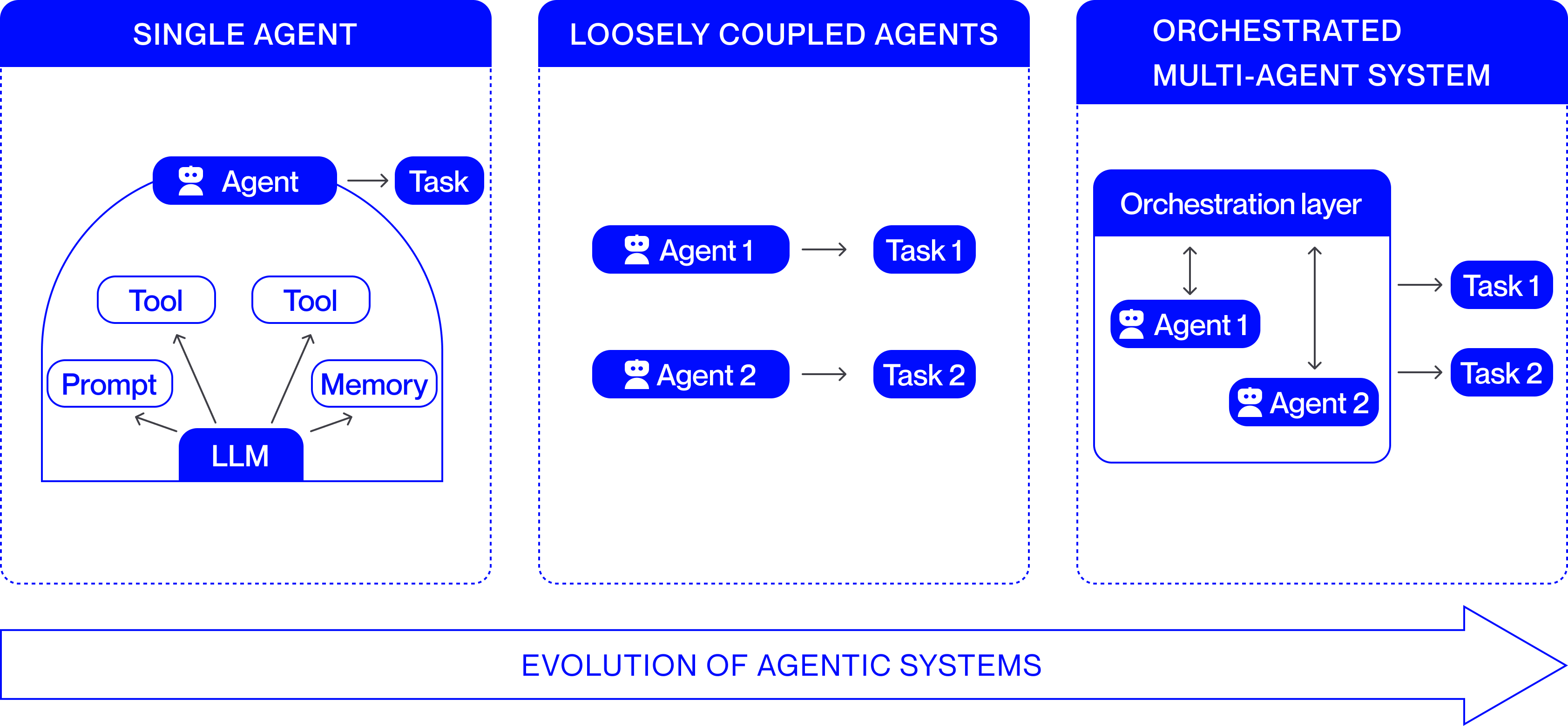
The diagram illustrates the progression of agentic systems from a single-agent architecture to increasingly complex multi-agent systems. It uses three interconnected sections to represent this evolution, with directional arrows indicating system complexity and interaction patterns.
### Components/Axes
1. **SINGLE AGENT**
- Central Agent node connected to:
- Task (output)
- LLM (Language Learning Model) hub
- LLM connected to:
- Prompt (input)
- Memory (context storage)
- Two Tool nodes (external capabilities)
2. **LOOSELY COUPLED AGENTS**
- Two independent Agent nodes (Agent 1, Agent 2)
- Each agent directly connected to separate tasks (Task 1, Task 2)
- No inter-agent connections
3. **ORCHESTRATED MULTI-AGENT SYSTEM**
- Orchestration Layer (central control)
- Two Agent nodes (Agent 1, Agent 2) connected to:
- Each other (bidirectional)
- Orchestration Layer (bidirectional)
- Shared Task 1 and Task 2 nodes
- Task nodes receive input from both agents via orchestration
### Detailed Analysis
- **Single Agent Architecture**:
- Linear flow: Prompt → LLM → Tool/Memory → Agent → Task
- LLM acts as central processor with memory and tool integration
- No external dependencies beyond basic inputs/outputs
- **Loosely Coupled System**:
- Parallel processing: Two agents handle separate tasks independently
- No shared resources or communication channels
- Tasks remain isolated despite multiple agents
- **Orchestrated System**:
- Centralized coordination through Orchestration Layer
- Bidirectional agent-agent communication enables collaboration
- Shared task execution with coordinated resource allocation
- Increased complexity through:
- Multi-agent interaction
- Centralized task management
- Distributed processing with coordination
### Key Observations
1. **Complexity Progression**: Each section shows increasing architectural complexity
2. **Interaction Patterns**:
- Single agent: No inter-agent communication
- Loosely coupled: Parallel but isolated processing
- Orchestrated: Coordinated collaboration with shared resources
3. **Control Mechanisms**:
- Single agent: Self-contained operation
- Orchestrated system: Centralized control with distributed execution
4. **Resource Utilization**:
- Single agent: Limited to internal memory/tools
- Multi-agent systems: Expanded capabilities through agent collaboration
### Interpretation
The diagram demonstrates a clear trajectory toward more sophisticated AI systems:
1. **From Autonomy to Collaboration**: The evolution moves from isolated decision-making to coordinated teamwork
2. **Orchestration as Enabler**: The central layer in the final architecture suggests that effective multi-agent systems require:
- Coordination mechanisms
- Resource management
- Task prioritization
3. **Memory and Tools**: The persistent presence of memory and tools across all architectures indicates their fundamental role in agentic systems
4. **Task Specialization**: The progression shows increasing specialization - from single-task focus to multi-task coordination
This visual progression aligns with current AI research trends toward developing more complex, collaborative systems that can handle increasingly sophisticated tasks through coordinated agent interactions.