\n
## Diagram: Visual Representation of Contextual Understanding
### Overview
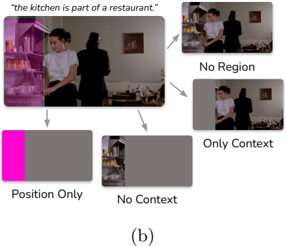
The image presents a diagram illustrating different approaches to visual understanding, specifically focusing on how a system might interpret an image based on position, context, or a combination of both. The central image depicts two people in what appears to be a kitchen or restaurant setting. This image is then processed in three different ways, resulting in three modified images and one textual statement.
### Components/Axes
The diagram consists of:
* **Original Image:** A color photograph of two people in a kitchen/restaurant.
* **Textual Statement:** “the kitchen is part of a restaurant.” located at the top-left.
* **Processed Images:** Four smaller images derived from the original, each representing a different processing method.
* "No Region" - The original image.
* "Only Context" - The original image.
* "Position Only" - The left portion of the image is colored bright pink, the rest is gray.
* "No Context" - The image is entirely gray.
* **Label (b):** Located at the bottom-center, indicating this is part of a larger figure.
### Detailed Analysis or Content Details
The diagram demonstrates how different aspects of an image contribute to understanding.
* **Original Image:** Shows two people, one standing near a cabinet filled with items, and another standing further back. The environment suggests a kitchen or restaurant.
* **Textual Statement:** Provides a semantic relationship between "kitchen" and "restaurant."
* **"No Region"**: This image is identical to the original, implying that no specific region of the image was isolated for analysis.
* **"Only Context"**: This image is also identical to the original, suggesting that only contextual information was used.
* **"Position Only"**: This image highlights the left portion of the original image in bright pink, while the rest is grayed out. This indicates that only the positional information of the left side of the image was considered.
* **"No Context"**: This image is entirely gray, indicating that no contextual information was used.
### Key Observations
The diagram highlights the importance of both positional and contextual information in visual understanding. The "Position Only" image demonstrates that focusing solely on position can isolate specific elements, while the "No Context" image shows that removing context can render the image uninterpretable. The "No Region" and "Only Context" images suggest that using the entire image and its inherent context can provide a complete understanding.
### Interpretation
This diagram likely illustrates a concept in computer vision or artificial intelligence, specifically related to scene understanding and object recognition. It demonstrates how a system might process an image by focusing on different aspects: the position of objects, the context of the scene, or a combination of both. The textual statement provides a semantic understanding that complements the visual information. The diagram suggests that a robust understanding of an image requires integrating both positional and contextual information. The different processing methods (Position Only, No Context) represent simplified approaches that may be useful in specific scenarios but are insufficient for complete scene understanding. The diagram is a visual aid for explaining the complexities of visual perception and the challenges of building intelligent systems that can "see" and understand the world like humans do.