\n
## Box Plots: Build Duration Comparison
### Overview
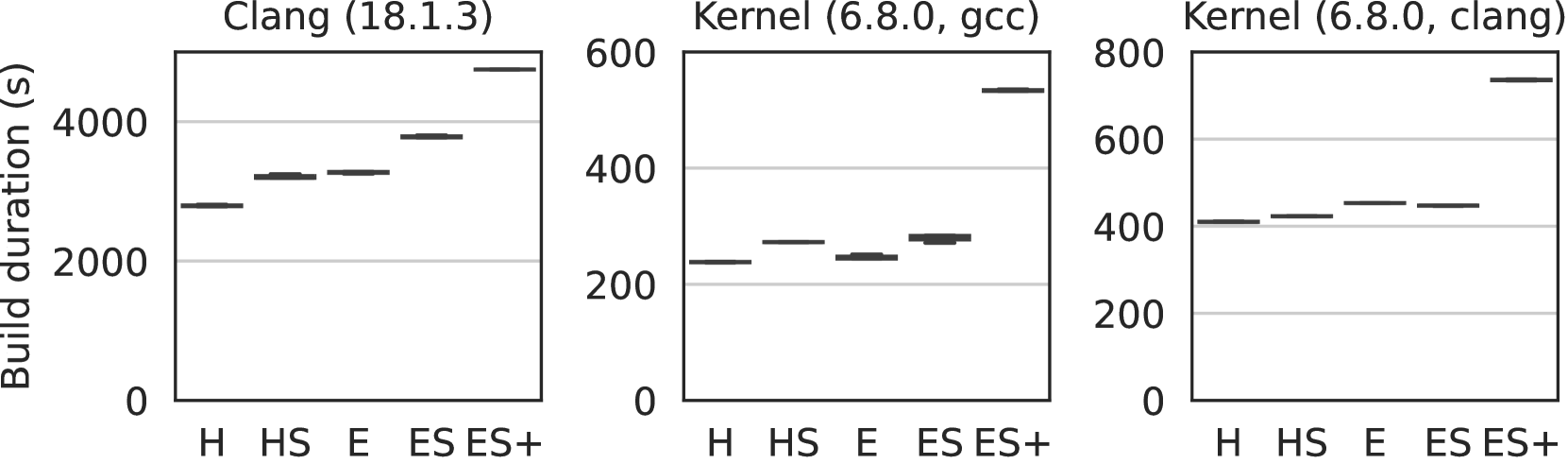
The image presents three box plots comparing build durations (in seconds) for different configurations. Each plot represents a different compiler/build system combination. The x-axis represents build configurations (H, HS, E, ES, ES+), and the y-axis represents the build duration in seconds.
### Components/Axes
* **Y-axis Label:** "Build duration (s)" - indicating the vertical axis represents build time in seconds. Scale ranges from 0 to 800 (varying between plots).
* **X-axis Labels:** "H", "HS", "E", "ES", "ES+" - representing different build configurations.
* **Plot Titles:**
* "Clang (18.1.3)"
* "Kernel (6.8.0, gcc)"
* "Kernel (6.8.0, clang)"
* **Box Plot Components:** Each box plot displays the median, quartiles, and potential outliers for build durations. The box represents the interquartile range (IQR), the line inside the box represents the median, and the whiskers extend to the minimum and maximum values within 1.5 times the IQR. Points beyond the whiskers are considered outliers.
### Detailed Analysis
**Plot 1: Clang (18.1.3)**
* **H:** Median build duration is approximately 3200s. IQR ranges from roughly 2800s to 3600s.
* **HS:** Median build duration is approximately 3400s. IQR ranges from roughly 3000s to 3800s.
* **E:** Median build duration is approximately 3700s. IQR ranges from roughly 3400s to 4000s.
* **ES:** Median build duration is approximately 3800s. IQR ranges from roughly 3500s to 4100s.
* **ES+:** Median build duration is approximately 4100s. IQR ranges from roughly 3800s to 4400s.
* Trend: Build duration generally increases as the build configuration progresses from H to ES+.
**Plot 2: Kernel (6.8.0, gcc)**
* **H:** Median build duration is approximately 180s. IQR ranges from roughly 150s to 220s.
* **HS:** Median build duration is approximately 220s. IQR ranges from roughly 180s to 260s.
* **E:** Median build duration is approximately 230s. IQR ranges from roughly 200s to 270s.
* **ES:** Median build duration is approximately 250s. IQR ranges from roughly 220s to 290s.
* **ES+:** Median build duration is approximately 480s. IQR ranges from roughly 400s to 550s.
* Trend: Build duration increases steadily from H to ES, then jumps significantly for ES+.
**Plot 3: Kernel (6.8.0, clang)**
* **H:** Median build duration is approximately 420s. IQR ranges from roughly 380s to 460s.
* **HS:** Median build duration is approximately 440s. IQR ranges from roughly 400s to 480s.
* **E:** Median build duration is approximately 450s. IQR ranges from roughly 410s to 490s.
* **ES:** Median build duration is approximately 460s. IQR ranges from roughly 420s to 500s.
* **ES+:** Median build duration is approximately 750s. IQR ranges from roughly 650s to 800s.
* Trend: Build duration increases steadily from H to ES, then jumps significantly for ES+.
### Key Observations
* Build durations are significantly longer when using Clang (18.1.3) compared to Kernel with either gcc or clang.
* The ES+ configuration consistently results in the longest build times across all compiler/build system combinations.
* The jump in build duration for ES+ is more pronounced for Kernel builds than for Clang builds.
* The spread of build times (as indicated by the IQR) is relatively consistent across configurations for Clang, but varies more for Kernel builds.
### Interpretation
The data suggests that the choice of compiler and build system significantly impacts build duration. Clang appears to be substantially slower than gcc for the Kernel builds. The ES+ configuration introduces a significant overhead, likely due to increased complexity or additional build steps. The consistent increase in build time with more complex configurations (H -> HS -> E -> ES -> ES+) indicates a growing computational cost associated with each added feature or optimization. The larger IQR for Kernel builds suggests greater variability in build times, potentially due to factors like system load or caching effects. The jump in build time for ES+ is a critical observation, indicating a potential bottleneck or area for optimization within the build process. This data could be used to inform decisions about compiler selection, build configuration, and resource allocation to minimize build times.