## [Chart Type]: Comparative Box Plots of Build Durations
### Overview
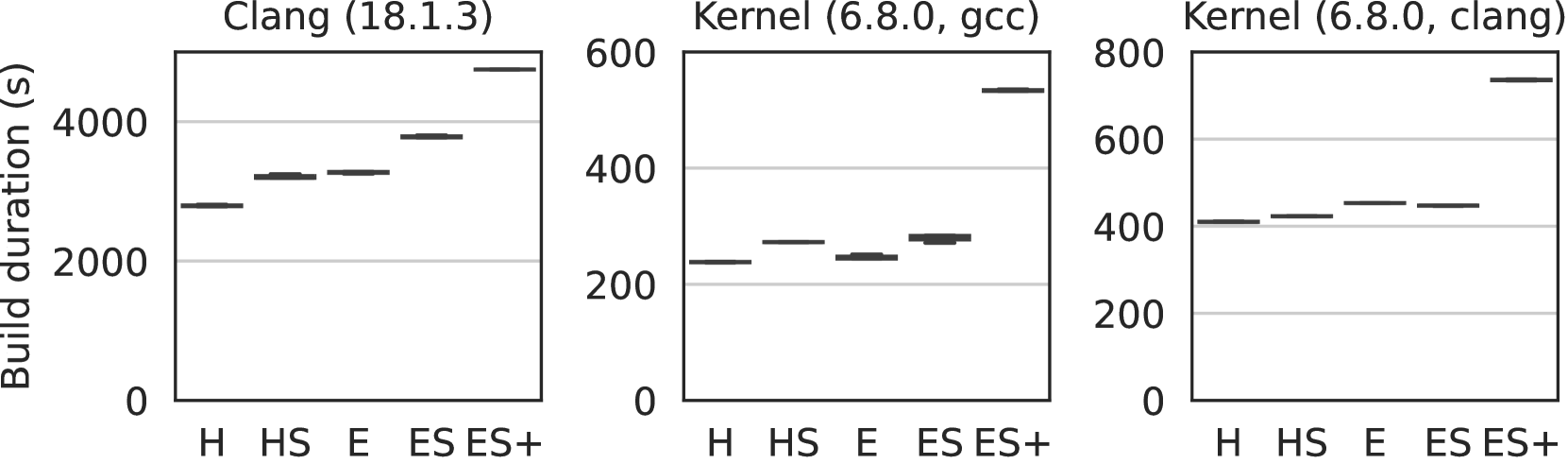
The image displays three separate box plots arranged horizontally, comparing the build duration (in seconds) for different software components under various configurations. The plots share a common x-axis category set but have different y-axis scales. The overall visual suggests an analysis of how build times vary across compiler types and optimization levels.
### Components/Axes
**Common Elements:**
* **X-axis Categories (All Plots):** Five discrete categories labeled: `H`, `HS`, `E`, `ES`, `ES+`. These likely represent different build configurations or optimization levels.
* **Y-axis Label (Leftmost Plot):** "Build duration (s)". This label applies to all three plots.
* **Plot Titles (Top of each plot):**
* Left Plot: `Clang (18.1.3)`
* Middle Plot: `Kernel (6.8.0, gcc)`
* Right Plot: `Kernel (6.8.0, clang)`
* **Visual Encoding:** Each category is represented by a horizontal box plot (a thick central line with thinner lines extending left and right, likely representing median and range/quartiles). All plots use the same dark gray color.
**Individual Plot Axes:**
1. **Left Plot (Clang 18.1.3):**
* **Y-axis Scale:** Linear, from 0 to over 4000. Major tick marks at `0`, `2000`, `4000`.
2. **Middle Plot (Kernel 6.8.0, gcc):**
* **Y-axis Scale:** Linear, from 0 to 600. Major tick marks at `0`, `200`, `400`, `600`.
3. **Right Plot (Kernel 6.8.0, clang):**
* **Y-axis Scale:** Linear, from 0 to 800. Major tick marks at `0`, `200`, `400`, `600`, `800`.
### Detailed Analysis
**Trend Verification & Data Points (Approximate Values):**
* **Left Plot - Clang (18.1.3):**
* **Trend:** Build duration shows a clear, stepwise increasing trend from category `H` to `ES+`.
* **Data Points (Median approx.):**
* `H`: ~2800 s
* `HS`: ~3200 s
* `E`: ~3300 s
* `ES`: ~3800 s
* `ES+`: ~4800 s (This is the highest value in the entire image).
* **Middle Plot - Kernel (6.8.0, gcc):**
* **Trend:** Build duration is relatively flat for the first four categories (`H` to `ES`), with a sharp, significant increase for `ES+`.
* **Data Points (Median approx.):**
* `H`: ~240 s
* `HS`: ~280 s
* `E`: ~250 s
* `ES`: ~280 s
* `ES+`: ~540 s
* **Right Plot - Kernel (6.8.0, clang):**
* **Trend:** Similar to the middle plot, showing a gradual, slight increase from `H` to `ES`, followed by a large jump for `ES+`.
* **Data Points (Median approx.):**
* `H`: ~410 s
* `HS`: ~420 s
* `E`: ~450 s
* `ES`: ~440 s
* `ES+`: ~740 s
### Key Observations
1. **Dominant Outlier:** The `ES+` configuration results in a dramatically higher build duration across all three scenarios compared to the other four configurations.
2. **Scale Disparity:** The absolute build times for the `Clang (18.1.3)` compiler (left plot) are an order of magnitude higher (thousands of seconds) than for the `Kernel` builds (hundreds of seconds).
3. **Compiler Comparison for Kernel:** When building the same Kernel (6.8.0), using `clang` (right plot) results in consistently longer build times than using `gcc` (middle plot) for all configurations. The difference is approximately 170-200 seconds for the `H` through `ES` categories.
4. **Configuration Sensitivity:** The `Clang` compiler's build time appears more sensitive to configuration changes, showing a steady increase from `H` to `ES+`. The `Kernel` builds are less sensitive until the `ES+` configuration is applied.
### Interpretation
This data visualizes the performance impact of different build configurations (`H`, `HS`, `E`, `ES`, `ES+`) on compilation time. The `ES+` configuration is a clear performance bottleneck, incurring a severe time penalty. This suggests `ES+` enables significantly more intensive processing (e.g., deeper optimizations, extensive instrumentation, or additional validation steps).
The comparison between the middle and right plots isolates the effect of the compiler (`gcc` vs. `clang`) on building the same Linux Kernel version (6.8.0). `Clang` is consistently slower, which could be due to differences in compiler architecture, default optimization levels, or the maturity of the kernel's build system support for `clang` at the time of this test.
The leftmost plot shows that building the `Clang` compiler itself (version 18.1.3) is a much more time-consuming task than building the kernel, which is expected given the complexity of a modern compiler codebase. The steady increase in its build time with configuration changes implies that each successive configuration (`H` -> `HS` -> `E` -> `ES` -> `ES+`) adds incremental, compounding work to the compiler's own build process.
**In summary, the key takeaway is the disproportionate cost of the `ES+` configuration, and the secondary observation of `clang`'s slower performance compared to `gcc` for kernel builds.**