## Diagram: The Gnomon and its Shadow
### Overview
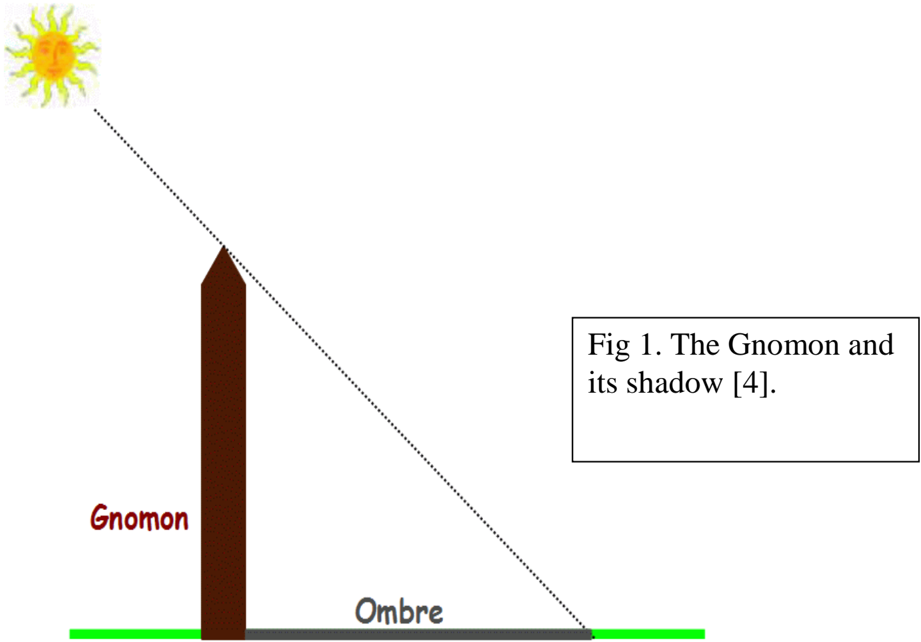
This image is a technical diagram illustrating the fundamental principle of a gnomon—a vertical object that casts a shadow—and its relationship with a light source (the sun). The diagram is designed to show the geometric relationship between the sun's position, the gnomon, and the resulting shadow on the ground. It is labeled as "Fig 1" and includes a citation marker "[4]".
### Components/Axes
The diagram consists of several distinct visual components, each with specific labels and positioning:
1. **Light Source (Sun):**
* **Position:** Top-left corner of the image.
* **Description:** A stylized, yellow sun with radiating rays.
* **Function:** Represents the source of light.
2. **Gnomon:**
* **Position:** Center-left of the image, standing vertically on the ground line.
* **Label:** The word "**Gnomon**" is written in a red, sans-serif font to the left of the object.
* **Description:** A tall, vertical, brown rectangular pillar with a pointed top. It is the object casting the shadow.
3. **Shadow (Ombre):**
* **Position:** Extends horizontally to the right from the base of the gnomon along the ground line.
* **Label:** The word "**Ombre**" is written in a gray, sans-serif font above the shadow.
* **Language Note:** "Ombre" is a word from Italian or French meaning "shadow." The English translation is "shadow."
* **Description:** A dark gray, horizontal bar representing the area where light from the sun is blocked by the gnomon.
4. **Ground Line:**
* **Position:** A horizontal line at the bottom of the diagram.
* **Description:** A bright green line representing the surface on which the gnomon stands and the shadow falls.
5. **Light Ray:**
* **Position:** A dotted black line connecting the sun to the tip of the gnomon and continuing to the far end of the shadow.
* **Description:** This line visually demonstrates the straight-line path of light. It shows that the tip of the shadow is defined by the point where a light ray from the sun, tangent to the top of the gnomon, intersects the ground.
6. **Caption Box:**
* **Position:** Centered vertically on the right side of the image.
* **Content:** The text "**Fig 1. The Gnomon and its shadow [4].**" is enclosed in a black-bordered rectangle.
* **Function:** Provides a figure number, a descriptive title, and a citation reference "[4]".
### Detailed Analysis
The diagram is a geometric abstraction, not a data chart. Therefore, it does not contain numerical data points, axes, or trends to extract. Its information is conveyed through the spatial relationships and labels of its components.
* **Spatial Relationship:** The diagram establishes a clear cause-and-effect relationship. The sun (cause) emits light, which is obstructed by the gnomon (object), resulting in the shadow (effect).
* **Geometric Principle:** The dotted line is critical. It illustrates that the length of the shadow is determined by the angle of the sun's rays relative to the height of the gnomon. A lower sun angle (sun closer to the horizon) would result in a longer shadow, while a higher sun angle would result in a shorter shadow.
* **Labeling:** All key components are explicitly labeled. The use of different colors (red for "Gnomon", gray for "Ombre") helps differentiate the object from its effect.
### Key Observations
1. **Educational Purpose:** The diagram is clearly designed for instructional or explanatory purposes, likely within a scientific, astronomical, or historical text about sundials or solar observation.
2. **Simplified Model:** It presents an idealized scenario: a perfectly vertical gnomon on a perfectly flat surface, with the sun as a point source. Real-world conditions (irregular ground, atmospheric refraction) are not represented.
3. **Citation:** The marker "[4]" indicates this figure is referenced from or based on source number 4 in a bibliography, confirming its use in a formal document.
### Interpretation
This diagram serves as a foundational visual explanation for the function of a gnomon. It demonstrates the core principle behind sundials and ancient methods for telling time or determining latitude.
* **What it Demonstrates:** The image visually proves that the shadow's length and direction are direct functions of the sun's position in the sky. By measuring the shadow of a gnomon of known height, one can calculate the sun's altitude angle.
* **Relationship Between Elements:** The sun, gnomon, and shadow form a right-angled triangle. The gnomon is the vertical side, the shadow is the horizontal side, and the light ray is the hypotenuse. This geometric relationship is the basis for all gnomonic calculations.
* **Notable Absence:** The diagram does not show time markings or compass directions, which would be necessary for it to function as a complete sundial. It isolates and explains only the primary shadow-casting mechanism.
* **Underlying Concept:** The diagram encapsulates the Peircean concept of a **diagram** as an iconic representation that allows for the exploration of relationships. By manipulating the mental model (e.g., imagining the sun moving), one can deduce how the shadow will change, making it a powerful tool for reasoning about solar motion.