## Diagram: The Gnomon and its Shadow
### Overview
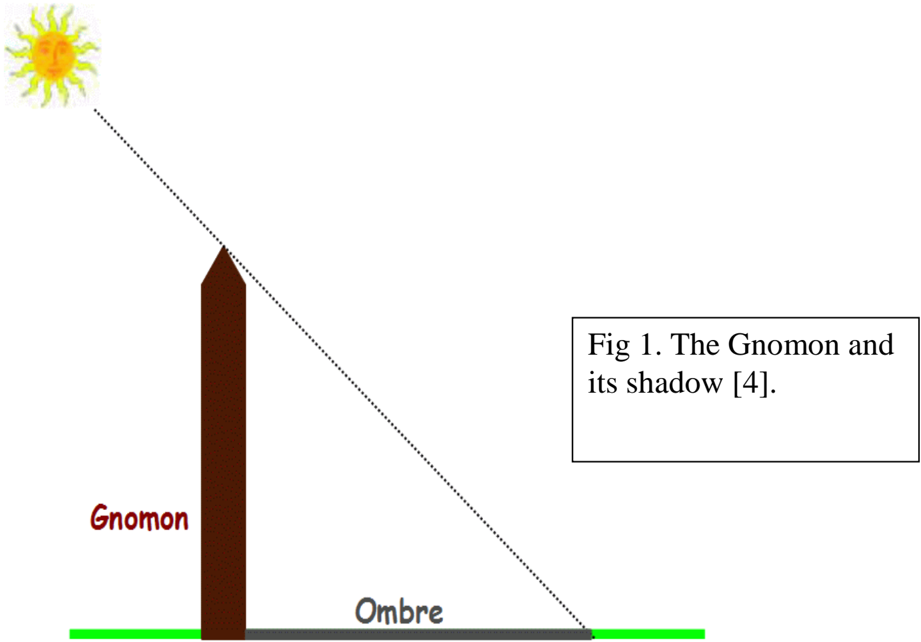
The diagram illustrates the relationship between a vertical gnomon (a vertical object) and its shadow under sunlight. A dotted line represents sunlight rays originating from a stylized sun icon in the top-left corner, casting a shadow labeled "Ombre" (French for "shadow") extending horizontally to the right. The gnomon is labeled in red text, and the shadow is labeled in black text. A text box in the top-right corner identifies the diagram as "Fig 1. The Gnomon and its shadow [4]."
### Components/Axes
- **Gnomon**: A vertical brown line labeled "Gnomon" in red text, positioned on the left side of the diagram.
- **Shadow (Ombre)**: A horizontal gray line labeled "Ombre" in black text, extending from the base of the gnomon to the right edge of the diagram.
- **Sunlight**: Represented by a dotted line connecting the sun icon (top-left) to the tip of the gnomon.
- **Text Box**: Contains the title "Fig 1. The Gnomon and its shadow [4]" in black text, positioned in the top-right quadrant.
### Detailed Analysis
- **Gnomon**: The vertical object is depicted as a simple brown line with no explicit height measurement. Its position is fixed at the left edge of the diagram.
- **Shadow (Ombre)**: The shadow is a horizontal line starting at the base of the gnomon and extending to the right. Its length is proportional to the angle of the sunlight, as indicated by the dotted line from the sun to the gnomon's tip.
- **Sunlight**: The dotted line suggests the sun is at an angle, creating a diagonal relationship between the gnomon and its shadow. The sun icon is stylized with radiating yellow rays.
- **Text**: The French term "Ombre" is used for the shadow, with no English translation provided in the diagram. The figure number "[4]" is included in the text box, likely referencing a source or footnote.
### Key Observations
1. The shadow's length is not quantified, but its direction and proportionality to the gnomon's height are implied by the dotted sunlight line.
2. The use of "Ombre" (French) instead of "Shadow" (English) suggests a bilingual or culturally specific context.
3. The diagram lacks numerical data, scales, or explicit measurements, focusing instead on geometric relationships.
### Interpretation
The diagram demonstrates the principle of shadow formation based on the sun's angle relative to a vertical object (gnomon). The shadow's length increases as the sun's elevation decreases, a relationship visually represented by the dotted line's slope. The inclusion of "Ombre" (French) may indicate a pedagogical or regional context where French terminology is preferred. The absence of numerical values limits quantitative analysis but emphasizes the conceptual relationship between light angle and shadow geometry. The simplicity of the diagram prioritizes clarity over complexity, making it suitable for educational purposes.