## Prolog Conversion Example
### Overview
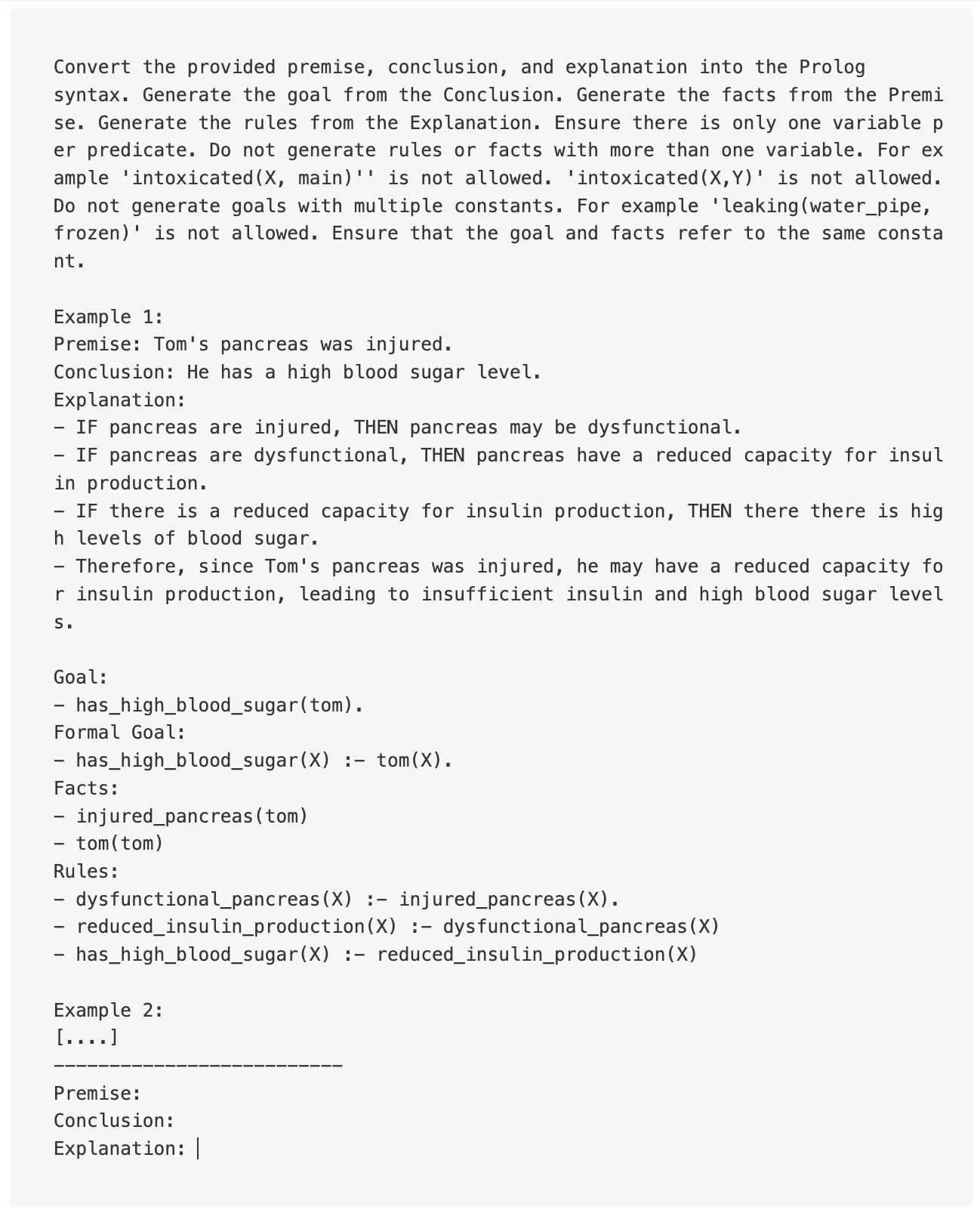
The image presents instructions and an example of converting a premise, conclusion, and explanation into Prolog syntax. It provides guidelines for generating goals, facts, and rules, along with specific constraints on variable usage and constant usage. It then gives a concrete example related to Tom's health condition and its representation in Prolog. Finally, it sets up a template for a second example.
### Components/Axes
* **Instructions:** A block of text explaining the conversion process and constraints.
* **Example 1:**
* **Premise:** "Tom's pancreas was injured."
* **Conclusion:** "He has a high blood sugar level."
* **Explanation:** A series of "IF...THEN..." statements and a concluding statement linking the premise to the conclusion.
* **Goal:** `has_high_blood_sugar(tom).`
* **Formal Goal:** `has_high_blood_sugar(X) :- tom(X).`
* **Facts:**
* `injured_pancreas(tom)`
* `tom(tom)`
* **Rules:**
* `dysfunctional_pancreas(X) :- injured_pancreas(X).`
* `reduced_insulin_production(X) :- dysfunctional_pancreas(X)`
* `has_high_blood_sugar(X) :- reduced_insulin_production(X)`
* **Example 2:**
* **Premise:** (Blank)
* **Conclusion:** (Blank)
* **Explanation:** (Blank)
### Detailed Analysis or ### Content Details
**Instructions:**
The instructions specify the following:
* Convert premise, conclusion, and explanation to Prolog syntax.
* Generate the goal from the conclusion.
* Generate facts from the premise.
* Generate rules from the explanation.
* Use only one variable per predicate.
* Do not generate rules or facts with more than one variable.
* Examples of disallowed constructs: `'intoxicated(X, main)'`, `'intoxicated(X, Y)'`, `'leaking(water_pipe, frozen)'`.
* Goals and facts must refer to the same constant.
**Example 1 Breakdown:**
* **Premise:** Tom's pancreas was injured.
* **Conclusion:** He has a high blood sugar level.
* **Explanation:**
* IF pancreas are injured, THEN pancreas may be dysfunctional.
* IF pancreas are dysfunctional, THEN pancreas have a reduced capacity for insulin production.
* IF there is a reduced capacity for insulin production, THEN there is high levels of blood sugar.
* Therefore, since Tom's pancreas was injured, he may have a reduced capacity for insulin production, leading to insufficient insulin and high blood sugar levels.
* **Prolog Representation:**
* **Goal:** `has_high_blood_sugar(tom).` This states the goal is to prove Tom has high blood sugar.
* **Formal Goal:** `has_high_blood_sugar(X) :- tom(X).` This is likely incorrect, as it states that for all X, if X is Tom, then X has high blood sugar.
* **Facts:**
* `injured_pancreas(tom).` This states that Tom's pancreas is injured.
* `tom(tom).` This is likely incorrect, as it states that Tom is Tom.
* **Rules:**
* `dysfunctional_pancreas(X) :- injured_pancreas(X).` If X's pancreas is injured, then X's pancreas is dysfunctional.
* `reduced_insulin_production(X) :- dysfunctional_pancreas(X).` If X's pancreas is dysfunctional, then X has reduced insulin production.
* `has_high_blood_sugar(X) :- reduced_insulin_production(X).` If X has reduced insulin production, then X has high blood sugar.
**Example 2:**
This section provides a template for a second example, with placeholders for the premise, conclusion, and explanation.
### Key Observations
* The instructions emphasize the conversion of natural language statements into Prolog syntax.
* The example demonstrates how a simple medical scenario can be represented using Prolog facts and rules.
* The example highlights the importance of using appropriate constants and variables in Prolog.
* The "Formal Goal" and `tom(tom)` fact in Example 1 seem logically flawed.
### Interpretation
The image provides a basic introduction to representing knowledge in Prolog. The example demonstrates how to translate a simple causal chain (injured pancreas -> dysfunctional pancreas -> reduced insulin production -> high blood sugar) into Prolog rules. The instructions aim to guide users in constructing valid Prolog code by emphasizing the use of single variables per predicate and consistent use of constants. The example, while illustrative, contains potential logical errors in the "Formal Goal" and the `tom(tom)` fact, which could lead to incorrect inferences if used as is. The overall purpose is to teach the fundamentals of knowledge representation in Prolog using a relatable medical scenario.