\n
## Text Document: Prolog Syntax Examples
### Overview
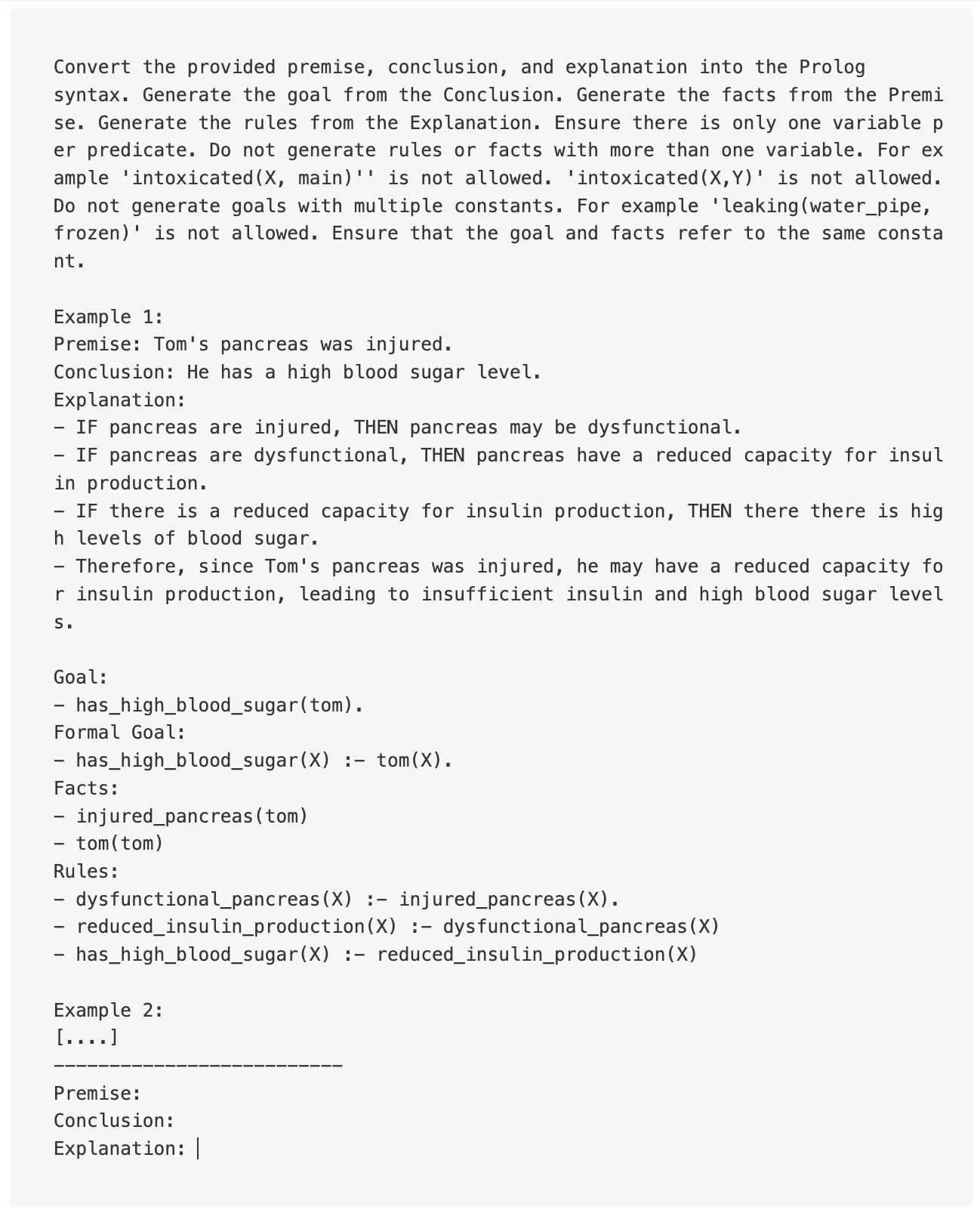
The image contains a text document demonstrating the conversion of premises, conclusions, and explanations into Prolog syntax. It provides two examples illustrating how to generate goals from conclusions, facts from premises, and rules from explanations, adhering to specific constraints regarding variable usage.
### Content Details
The document is structured with "Example" headings, followed by "Premise", "Conclusion", and "Explanation" sections. Below these sections are "Goal", "Formal Goal", "Facts", and "Rules" sections, presenting the Prolog code generated from the preceding text.
**Example 1:**
* **Premise:** Tom's pancreas was injured.
* **Conclusion:** He has a high blood sugar level.
* **Explanation:**
* IF pancreas are injured, THEN pancreas may be dysfunctional.
* IF pancreas are dysfunctional, THEN pancreas have a reduced capacity for insulin production.
* IF there is a reduced capacity for insulin production, THEN there are high levels of blood sugar.
* Therefore, since Tom's pancreas was injured, he may have a reduced capacity for insulin production, leading to insufficient insulin and high blood sugar levels.
* **Goal:**
* `has_high_blood_sugar(tom).`
* **Formal Goal:**
* `has_high_blood_sugar(X) :- tom(X).`
* **Facts:**
* `injured_pancreas(tom)`
* `tom(tom)`
* **Rules:**
* `dysfunctional_pancreas(X) :- injured_pancreas(X).`
* `reduced_insulin_production(X) :- dysfunctional_pancreas(X).`
* `has_high_blood_sugar(X) :- reduced_insulin_production(X).`
**Example 2:**
* **Premise:** [Text is truncated and unreadable]
* **Conclusion:** [Text is truncated and unreadable]
* **Explanation:** [Text is truncated and unreadable]
### Key Observations
The document emphasizes the importance of using only one variable per predicate in the generated Prolog code. It also highlights the need to ensure that goals and facts refer to the same constant. The second example is incomplete due to truncation.
### Interpretation
The document serves as a tutorial or guide for translating logical arguments into Prolog code. It demonstrates a systematic approach to representing knowledge and reasoning in a declarative programming paradigm. The examples illustrate how to break down complex statements into simpler facts and rules, enabling Prolog to infer new knowledge based on the provided information. The constraints imposed on variable usage likely aim to simplify the logic and avoid ambiguity in the Prolog program. The truncation of the second example limits a full understanding of its intended demonstration. The document is a pedagogical tool for learning Prolog.