## Textual Content Extraction: Prolog Syntax Conversion Guidelines
### Overview
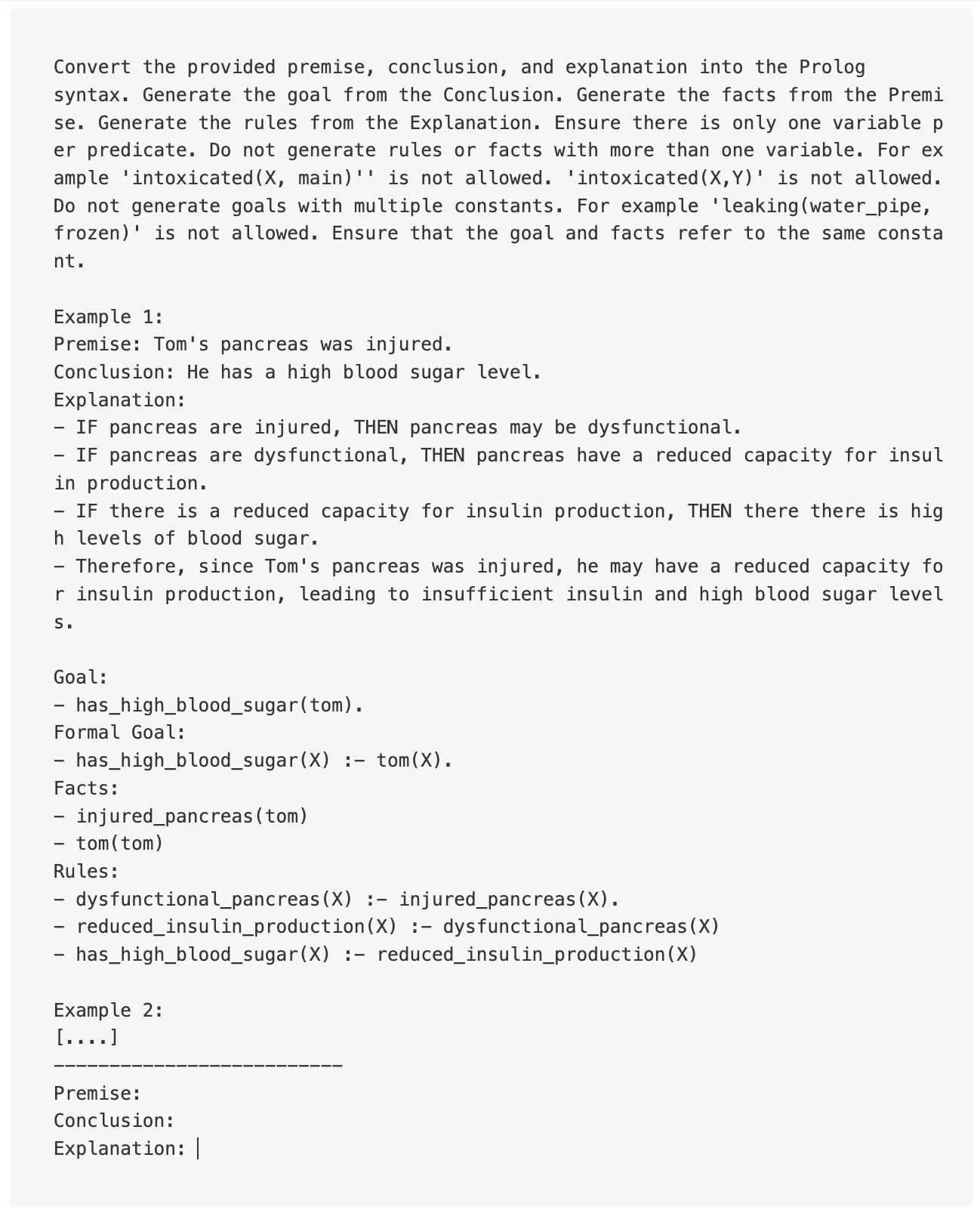
The image contains technical instructions for converting natural language premises, conclusions, and explanations into Prolog syntax. It includes formatting rules, examples, and constraints for logical representation.
### Components/Axes
1. **Instructions Section**
- Directives for converting premises, conclusions, and explanations into Prolog syntax
- Rules for goal generation, fact extraction, and rule derivation
- Constraints on variable usage and predicate structure
2. **Example 1**
- **Premise**: "Tom's pancreas was injured."
- **Conclusion**: "He has a high blood sugar level."
- **Explanation**: Logical steps connecting pancreas injury to insulin dysfunction and blood sugar levels
- **Goal**: `has_high_blood_sugar(tom)`
- **Formal Goal**: `has_high_blood_sugar(X) :- tom(X)`
- **Facts**:
- `injured_pancreas(tom)`
- `tom(tom)`
- **Rules**:
- `dysfunctional_pancreas(X) :- injured_pancreas(X)`
- `reduced_insulin_production(X) :- dysfunctional_pancreas(X)`
- `has_high_blood_sugar(X) :- reduced_insulin_production(X)`
3. **Example 2**
- Incomplete placeholder marked with `[....]`
### Detailed Analysis
- **Syntax Constraints**:
- Single-variable predicates only (e.g., `intoxicated(X)` invalid, `intoxicated(X, main)` invalid)
- No multiple constants in goals (e.g., `leaking(water_pipe, frozen)` invalid)
- Consistent variable referencing across goals and facts
- **Logical Flow in Example 1**:
1. **Premise** → `injured_pancreas(tom)`
2. **Rule Application**:
- `dysfunctional_pancreas(tom)` (from `injured_pancreas(tom)`)
- `reduced_insulin_production(tom)` (from `dysfunctional_pancreas(tom)`)
3. **Conclusion** → `has_high_blood_sugar(tom)` (from `reduced_insulin_production(tom)`)
- **Formalization**:
- Natural language statements mapped to Prolog predicates with explicit variable binding (e.g., `tom(X)` links "Tom" to variable `X`).
### Key Observations
- **Rule Hierarchy**:
- Injuries → Dysfunction → Reduced insulin → High blood sugar (causal chain).
- **Placeholder in Example 2**:
- Indicates incomplete or reserved space for additional examples.
- **Variable Binding**:
- All facts and rules use consistent variable naming (e.g., `X` in `has_high_blood_sugar(X)`).
### Interpretation
The document outlines a formal method for translating medical reasoning into Prolog logic. The constraints ensure syntactic validity, while the examples demonstrate how causal relationships (e.g., pancreas injury → blood sugar levels) are structured as logical rules. The incomplete Example 2 suggests potential expansion for further scenarios. The emphasis on single-variable predicates and consistent variable usage aligns with Prolog's unification mechanism, enabling automated inference from premises to conclusions.