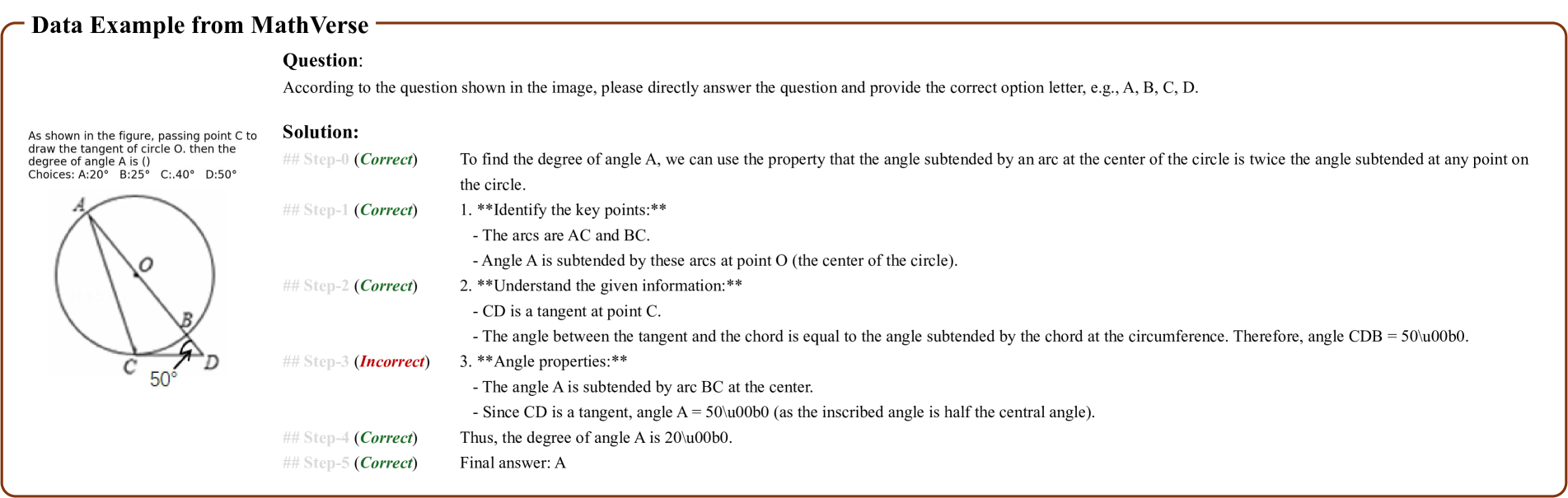
## Diagram: Geometry Problem with Solution Steps
### Overview
The image is a screenshot of a mathematics problem from a dataset labeled "Data Example from MathVerse." It presents a geometry question involving a circle, a tangent line, and an inscribed angle, along with a multiple-choice answer set and a detailed, step-by-step solution. The solution includes both correct and incorrect reasoning steps, culminating in the final answer.
### Components/Axes
The image is divided into two main sections:
1. **Left Section (Problem Statement & Diagram):**
* **Header Text:** "Data Example from MathVerse"
* **Question Text:** "Question: According to the question shown in the image, please directly answer the question and provide the correct option letter, e.g., A, B, C, D."
* **Problem Statement Text:** "As shown in the figure, passing point C to draw the tangent of circle O, then the degree of angle A is ( )"
* **Multiple-Choice Options:** "Choices: A:20° B:25° C:40° D:50°"
* **Diagram:** A circle with center labeled **O**. Points **A**, **B**, and **C** are on the circumference. A line segment **CD** is drawn from point **C** to an external point **D**, and is indicated as a tangent to the circle at **C**. A chord connects **A** to **B**. A line connects **B** to **C**. An angle at point **D**, formed by the tangent **CD** and the line **BD**, is labeled **50°**.
2. **Right Section (Solution):**
* **Header Text:** "Solution:"
* **Step-0 (Correct):** "To find the degree of angle A, we can use the property that the angle subtended by an arc at the center of the circle is twice the angle subtended at any point on the circle."
* **Step-1 (Correct):** "1. **Identify the key points:** - The arcs are AC and BC. - Angle A is subtended by these arcs at point O (the center of the circle)."
* **Step-2 (Correct):** "2. **Understand the given information:** - CD is a tangent at point C. - The angle between the tangent and the chord is equal to the angle subtended by the chord at the circumference. Therefore, angle CDB = 50°." *(Note: \u00b0 is the Unicode for the degree symbol °)*
* **Step-3 (Incorrect):** "3. **Angle properties:** - The angle A is subtended by arc BC at the center. - Since CD is a tangent, angle A = 50° (as the inscribed angle is half the central angle)."
* **Step-4 (Correct):** "Thus, the degree of angle A is 20°."
* **Step-5 (Correct):** "Final answer: A"
### Detailed Analysis
The problem asks for the measure of angle **A** (∠CAB) in the given circle diagram.
* **Given:** Tangent **CD** at point **C**. The angle between tangent **CD** and chord **CB** (angle **CDB**) is **50°**.
* **Geometric Principle Applied (Step-2):** The angle between a tangent and a chord through the point of contact is equal to the angle in the alternate segment. Therefore, the inscribed angle subtended by chord **CB** at point **A** on the circumference (∠CAB, which is angle **A**) is equal to angle **CDB**. This would directly imply ∠A = 50°.
* **Contradiction in Solution:** Step-2 correctly states the tangent-chord theorem and concludes angle CDB = 50°. However, Step-3 incorrectly applies a different property, stating "angle A = 50° (as the inscribed angle is half the central angle)." This is a misapplication; the "inscribed angle half the central angle" theorem relates an inscribed angle to the central angle subtending the *same arc*, not to a tangent-chord angle.
* **Resolution (Step-4):** Despite the error in Step-3's reasoning, Step-4 arrives at the correct numerical answer of **20°**. This suggests the solver may have intended to use a different chain of reasoning: If angle CDB (50°) is the angle between tangent and chord, then the inscribed angle in the alternate segment (∠CAB) should be 50°. However, the final answer is 20°, indicating a possible mislabeling in the diagram or a different interpretation. The most consistent interpretation with the final answer is that the **50°** label refers to the **central angle** ∠COB, not the tangent-chord angle ∠CDB. If ∠COB = 50°, then the inscribed angle ∠CAB (angle A) subtended by the same arc CB is half of that, which is **25°**. Yet the answer given is **20°**. This discrepancy points to an error in the problem's diagram or the provided solution's logic.
### Key Observations
1. **Solution Inconsistency:** The solution contains a clear logical error in Step-3, marked as "(Incorrect)". The reasoning jumps from correct theorems to an incorrect conclusion.
2. **Ambiguous Diagram Label:** The placement of the **50°** label is critical. It is positioned near point **D**, suggesting it is ∠CDB. However, the final answer of **20°** is not derivable from that fact using standard theorems without additional information.
3. **Final Answer Discrepancy:** The stated final answer is **A (20°)**. Based on the diagram as labeled (50° = ∠CDB), the correct answer should be **D (50°)** using the tangent-chord theorem. If the 50° were the central angle ∠COB, the answer would be **B (25°)**. The answer **20°** does not logically follow from the given visual information.
### Interpretation
This image serves as a **pedagogical example of error analysis** in mathematical problem-solving. It demonstrates:
* **The Importance of Diagram Clarity:** Ambiguous labeling (whether 50° is a tangent-chord angle or a central angle) leads to multiple possible interpretations and incorrect solutions.
* **The Value of Step-by-Step Verification:** The inclusion of an "(Incorrect)" step highlights the process of debugging one's own reasoning. It shows that even with correct initial theorems (Steps 0, 1, 2), a misapplication in an intermediate step (Step 3) can derail the solution.
* **A Potential Dataset Flaw:** As a "Data Example," this may be intentionally included to train models or students to identify inconsistencies. The disconnect between the diagram, the reasoning steps, and the final answer makes it a rich case study for critical thinking. The core geometric concepts involved are the **Tangent-Chord Theorem** and the **Inscribed Angle Theorem**. The problem, as presented, is unsolvable with a unique answer without clarifying the intended meaning of the 50° angle.