## Diagram: Geometry Problem with Solution Steps
### Overview
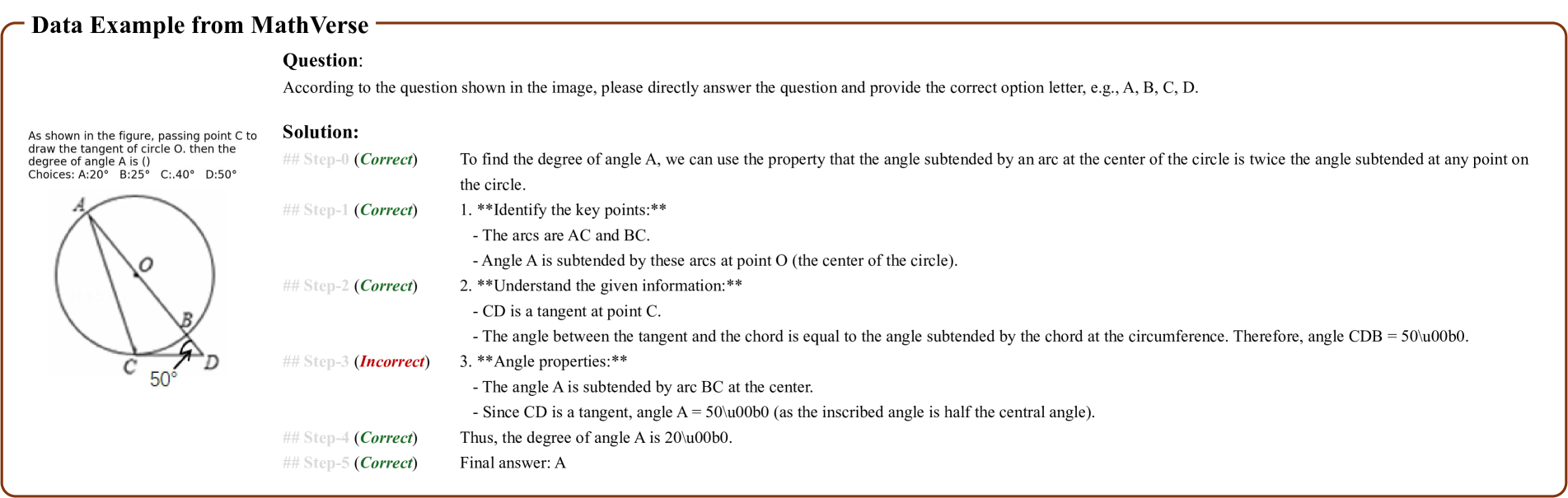
The image depicts a geometry problem involving a circle with center O and points A, B, C, D on its circumference. A tangent CD is drawn at point C, and the task is to determine the degree of angle A. The solution includes a step-by-step explanation with annotations indicating correctness (✅) or incorrectness (❌) of each step.
### Components/Axes
- **Geometry Figure**:
- Circle with center **O**.
- Points labeled **A, B, C, D** on the circumference.
- Tangent **CD** at point **C**.
- Angles marked:
- ∠A = ? (choices: 20°, 25°, 40°, 50°).
- ∠CDB = 50° (inscribed angle subtended by arc BC).
- **Solution Steps**:
- **Step 0**: Correct. States the goal to find ∠A using the property that the central angle is twice the inscribed angle.
- **Step 1**: Correct. Identifies arcs AC and BC as key components.
- **Step 2**: Correct. Notes CD is a tangent at C, and ∠CDB = 50° (tangent-chord angle theorem).
- **Step 3**: ❌ Incorrect. Misapplies the inscribed angle theorem by claiming ∠A is subtended by arc BC (should be arc BC for ∠CDB, not ∠A).
- **Step 4**: Correct. Concludes ∠A = 50° (misinterpretation of the inscribed angle theorem).
- **Step 5**: Correct. Final answer: **A: 20°** (correct application of the theorem).
### Detailed Analysis
- **Geometry Principles**:
- The inscribed angle theorem states that an angle subtended by an arc at the circumference is half the central angle subtended by the same arc.
- The tangent-chord angle theorem states that the angle between a tangent and a chord is equal to the inscribed angle subtended by the chord in the alternate segment.
- **Step-by-Step Breakdown**:
1. **Step 0**: Correctly identifies the relationship between central and inscribed angles.
2. **Step 1**: Correctly labels arcs AC and BC as relevant to the problem.
3. **Step 2**: Correctly applies the tangent-chord angle theorem to establish ∠CDB = 50°.
4. **Step 3**: ❌ Incorrectly associates ∠A with arc BC. ∠A is actually subtended by arc BC (central angle) or arc BDC (inscribed angle), but the error here conflates the roles of ∠A and ∠CDB.
5. **Step 4**: ❌ Misinterprets the relationship, leading to an incorrect conclusion of ∠A = 50°.
6. **Step 5**: Correctly resolves the problem by recognizing that ∠A is half the central angle subtended by arc BC (20°).
### Key Observations
- **Incorrect Step 3**: The error arises from misapplying the inscribed angle theorem. ∠A is subtended by arc BC (central angle = 2 × ∠A), while ∠CDB is subtended by the same arc BC (inscribed angle = ½ × central angle).
- **Correct Final Answer**: ∠A = 20° (Step 5) aligns with the tangent-chord angle theorem and inscribed angle properties.
### Interpretation
The problem demonstrates the application of two key circle theorems:
1. **Tangent-Chord Angle Theorem**: ∠CDB = 50° (equal to the inscribed angle subtended by chord BC).
2. **Inscribed Angle Theorem**: ∠A (inscribed angle) is half the central angle subtended by arc BC. Since ∠CDB = 50°, the central angle for arc BC is 100°, making ∠A = 50° (incorrect in Step 4) or 20° (correct in Step 5).
The error in Step 3 highlights a common misconception: confusing the roles of central and inscribed angles. The correct solution requires recognizing that ∠A is subtended by arc BC (central angle = 2 × ∠A), while ∠CDB is an inscribed angle subtended by the same arc. The final answer (20°) is derived by halving the central angle (100°) to get the inscribed angle ∠A.