## Line Graph: Convergence of HMC Steps Across Different 'd' Values
### Overview
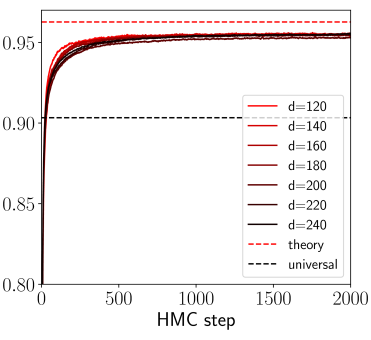
The image depicts a line graph illustrating the convergence behavior of Hamiltonian Monte Carlo (HMC) steps across varying 'd' values (120–240). The graph includes two reference lines labeled "theory" (dashed red) and "universal" (dashed black), with all data lines converging toward a plateau near the "universal" threshold.
### Components/Axes
- **X-axis**: "HMC step" (horizontal), scaled from 0 to 2000 in increments of 500.
- **Y-axis**: Unlabeled numerical scale from 0.80 to 0.95, with markers at 0.80, 0.85, 0.90, and 0.95.
- **Legend**: Positioned on the right, mapping colors to:
- Solid lines: `d=120` (light red), `d=140` (medium red), `d=160` (dark red), `d=180` (brown), `d=200` (dark brown), `d=220` (black), `d=240` (black).
- Dashed lines: "theory" (red), "universal" (black).
### Detailed Analysis
- **Data Series Trends**:
- All lines start at the same y-value (~0.80) and rise sharply before plateauing.
- Higher 'd' values (e.g., `d=240`) reach the plateau faster than lower 'd' values (e.g., `d=120`).
- The plateau value for all lines is approximately **0.94–0.95**, slightly below the "theory" line (0.95) and above the "universal" line (0.90).
- Lines for `d=220`, `d=240` overlap almost perfectly, while lower 'd' values show distinct separation.
- **Reference Lines**:
- "theory" (dashed red): Horizontal line at y=0.95, acting as an upper bound.
- "universal" (dashed black): Horizontal line at y=0.90, acting as a lower bound.
### Key Observations
1. **Convergence Speed**: Higher 'd' values achieve the plateau more rapidly, suggesting faster convergence in HMC steps.
2. **Plateau Consistency**: All lines converge to the same plateau value (~0.94–0.95), indicating a saturation effect.
3. **Boundaries**: The plateau lies between the "theory" and "universal" thresholds, implying practical limits to performance gains from increasing 'd'.
### Interpretation
The graph demonstrates that increasing 'd' improves the speed of convergence in HMC steps but does not surpass the "theory" threshold. The plateau near the "universal" line suggests a fundamental limit to performance, where further increases in 'd' yield diminishing returns. This aligns with theoretical expectations of HMC behavior, where higher-dimensional systems may stabilize at a universal efficiency threshold. The consistency across all 'd' values reinforces the robustness of this convergence pattern.