## Diagram: Iterative Process
### Overview
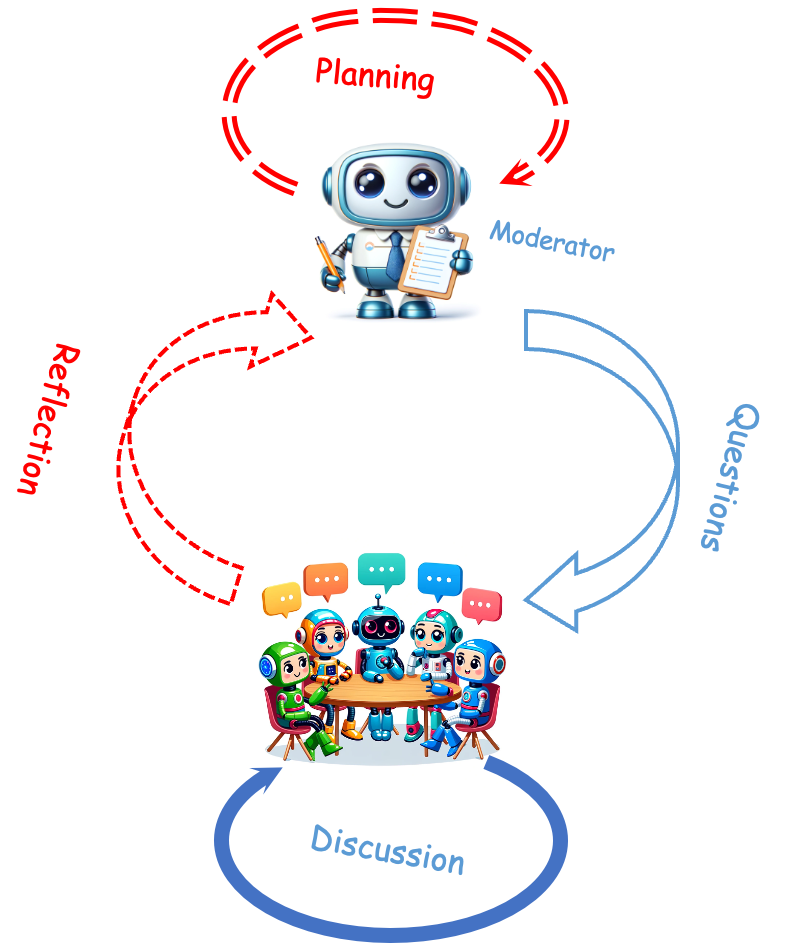
The image depicts an iterative process involving planning, moderation, questions, discussion, and reflection. It is represented visually with a circular flow and cartoon-style robots.
### Components/Axes
* **Elements:**
* A robot figure labeled "Moderator" at the top.
* A group of robots sitting around a table, engaged in discussion at the bottom.
* Curved arrows indicating the flow between the elements.
* **Labels:**
* "Planning" (top, red dashed arrow)
* "Moderator" (top-right, light blue)
* "Questions" (right side, light blue arrow)
* "Discussion" (bottom, dark blue arrow)
* "Reflection" (left side, red dashed arrow)
### Detailed Analysis
The diagram illustrates a cyclical process.
1. **Planning:** A red dashed arrow originates from the "Moderator" robot and curves upwards, labeled "Planning." The arrow indicates the moderator initiates the planning phase.
2. **Moderator:** The "Moderator" robot is depicted holding a clipboard and pencil, suggesting a role in organizing and guiding the process.
3. **Questions:** A light blue arrow leads from the "Moderator" down to the group of robots, labeled "Questions." This suggests the moderator poses questions to the group.
4. **Discussion:** A dark blue arrow curves from the group of robots upwards, labeled "Discussion." This indicates the group engages in discussion.
5. **Reflection:** A red dashed arrow leads from the group of robots back to the "Moderator," labeled "Reflection." This suggests the group's reflection informs the moderator's planning.
### Key Observations
* The diagram emphasizes the iterative nature of the process through the circular flow.
* The "Moderator" robot appears to play a central role in initiating and guiding the process.
* The use of different colored arrows (red dashed and light blue) may indicate different types of actions or feedback loops.
### Interpretation
The diagram represents a cyclical process of planning, moderation, questioning, discussion, and reflection. The moderator initiates the process with planning and questions, which leads to discussion among the group. The group's reflection then informs the moderator's subsequent planning, creating a continuous feedback loop. The diagram suggests a collaborative and iterative approach to problem-solving or decision-making, where the moderator facilitates the process and the group actively participates in discussion and reflection.