## Diagram: Collaborative Process Flow
### Overview
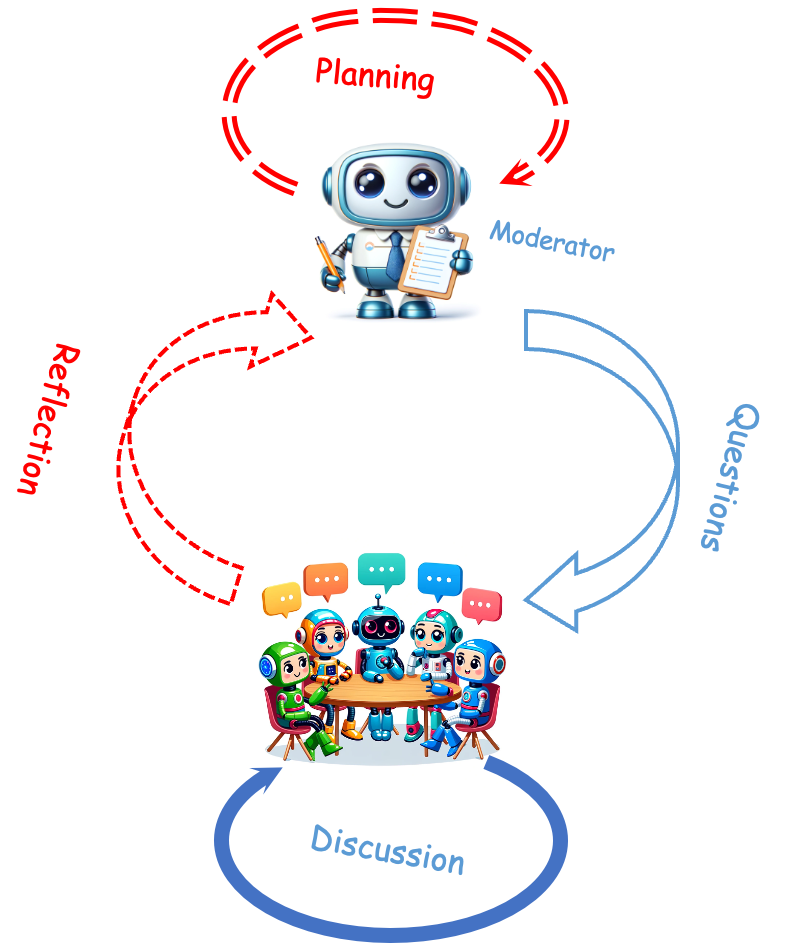
This diagram illustrates a cyclical collaborative process involving a moderator robot and a group of participant robots. The process is divided into four key stages: Planning, Moderator, Questions, Discussion, and Reflection, depicted by arrows indicating the flow and relationships between these stages.
### Components/Axes
The diagram does not have traditional axes or scales. The components are:
* **Moderator Robot:** A stylized, friendly robot character positioned at the top-center of the diagram. It is holding a pencil in its right hand and a clipboard with a document in its left hand, suggesting a role in organization and guidance.
* **Participant Robots:** A group of five smaller, colorful robot characters seated around a table, engaged in discussion. They are depicted with speech bubbles above their heads, indicating communication.
* **Labels:**
* "Planning": Located above the Moderator Robot, enclosed in a dashed red oval with double red lines forming the outer boundary, indicating a phase.
* "Moderator": Located to the right of the Moderator Robot, with a blue arrow originating from it.
* "Questions": Located to the right of the Moderator Robot, with a blue arrow pointing towards the participant robots.
* "Discussion": Located below the participant robots, enclosed in a solid blue circle with an arrow indicating a continuous process.
* "Reflection": Located to the left of the participant robots, with a dashed red arrow originating from the discussion phase and pointing towards the planning phase.
### Detailed Analysis or Content Details
The diagram depicts a workflow with the following sequence and interactions:
1. **Planning:** Represented by the dashed red oval and text at the top. This phase appears to be initiated or overseen by the Moderator Robot.
2. **Moderator:** The Moderator Robot is shown in a central position, implying its role in facilitating or initiating the next steps. A blue arrow labeled "Moderator" points from the Moderator Robot towards the "Questions" phase.
3. **Questions:** A blue arrow labeled "Questions" originates from the vicinity of the Moderator Robot and points towards the group of participant robots. This suggests the moderator poses questions to the group.
4. **Discussion:** A solid blue circular arrow labeled "Discussion" encircles the group of participant robots. This indicates an ongoing interactive process among the participants.
5. **Reflection:** A dashed red arrow labeled "Reflection" originates from the "Discussion" phase (or the participant robots) and curves upwards and to the left, pointing towards the "Planning" phase. This signifies that insights or outcomes from the discussion lead back to planning.
The overall flow is a cycle: Planning -> Moderator -> Questions -> Discussion -> Reflection -> Planning.
### Key Observations
* The process is cyclical, suggesting continuous improvement or iterative collaboration.
* The Moderator Robot appears to be a central facilitator, initiating and guiding the process.
* The use of different arrow styles (solid blue for Discussion, dashed red for Reflection) and colors (blue for Moderator/Questions, red for Planning/Reflection) may denote different types of actions or phases. Solid blue might represent direct interaction or a core activity, while dashed red might represent a feedback loop or a preparatory/concluding phase.
* Speech bubbles above the participant robots visually reinforce the "Discussion" and "Questions" phases.
### Interpretation
This diagram illustrates a structured approach to collaborative problem-solving or project development, likely within an AI or robotics context given the characters. The process emphasizes a balance between structured guidance (Moderator, Planning, Questions) and organic interaction (Discussion). The inclusion of "Reflection" as a feedback loop from "Discussion" back to "Planning" highlights the importance of learning and adaptation. This cyclical model suggests that outcomes from one iteration inform and refine the next, leading to continuous improvement. The Moderator Robot's role is crucial in initiating and directing the flow, ensuring that the group's discussions are productive and lead to actionable insights for future planning. The visual representation is clear and intuitive, effectively conveying a dynamic and iterative collaborative workflow.