## Process Diagram: Collaborative AI Moderation Cycle
### Overview
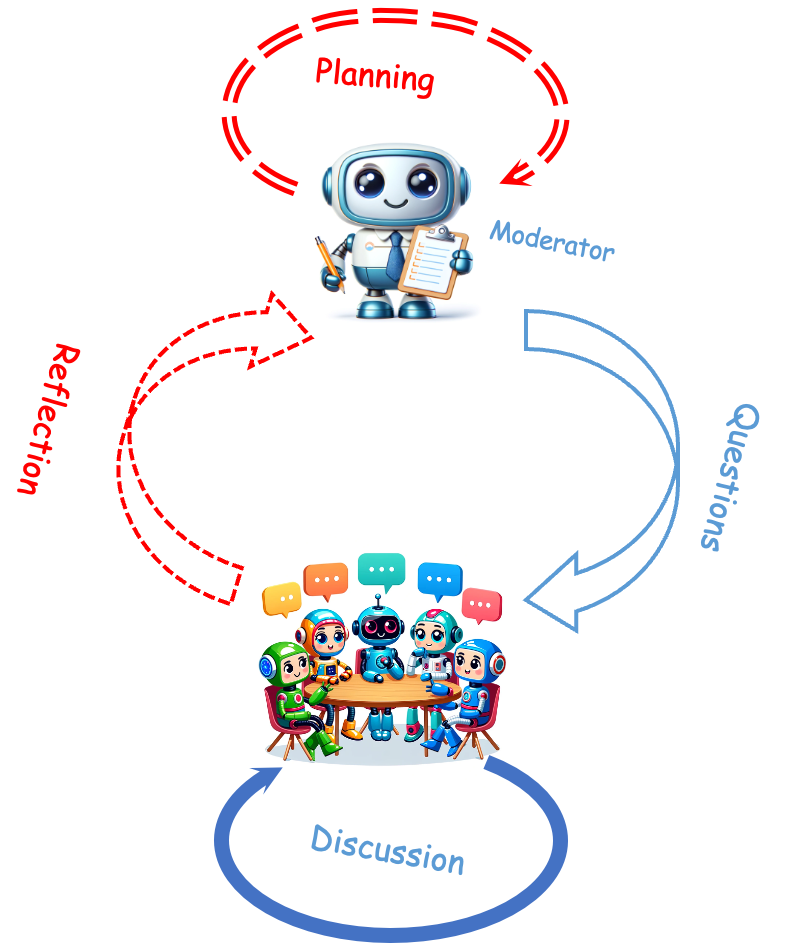
The image is a conceptual process diagram illustrating a cyclical, four-stage collaborative workflow involving an AI "Moderator" and a group of AI agents. The diagram uses cartoon-style robots, directional arrows, and text labels to depict a continuous loop of planning, questioning, discussion, and reflection.
### Components/Axes
The diagram is composed of two primary visual entities and four labeled process stages connected by arrows.
1. **Central Moderator (Top-Center):**
* A single, friendly-looking robot with a blue and white color scheme.
* It holds a pencil in its right hand and a clipboard with a checklist in its left hand.
* The label **"Moderator"** is placed to its right in blue text.
2. **Discussion Group (Bottom-Center):**
* A group of five distinct, colorful robots (green, orange, blue, teal, and red) seated around a brown table.
* Above the group are five speech bubbles in corresponding colors (yellow, orange, teal, blue, pink), each containing an ellipsis ("..."), indicating ongoing conversation.
* This group is encircled by a solid blue arrow labeled **"Discussion"** at the bottom.
3. **Process Flow Arrows & Labels:**
* **Planning:** A red, dashed, circular arrow originates from and returns to the Moderator, forming a loop above it. The label **"Planning"** is inside this loop in red text.
* **Questions:** A solid blue arrow curves downward from the Moderator to the Discussion Group. The label **"Questions"** is placed along the right side of this arrow in blue text.
* **Discussion:** A solid blue circular arrow encircles the Discussion Group from below. The label **"Discussion"** is inside this loop in blue text.
* **Reflection:** A red, dashed arrow curves upward from the Discussion Group back to the Moderator. The label **"Reflection"** is placed along the left side of this arrow in red text.
### Detailed Analysis
The diagram outlines a clear, sequential, and cyclical workflow:
1. **Stage 1 - Planning (Moderator-Centric):** The process begins with the Moderator in a self-contained planning phase, represented by the red dashed loop. This suggests internal preparation or strategy formulation.
2. **Stage 2 - Questions (Moderator to Group):** The Moderator initiates interaction with the group by sending "Questions," visualized by the solid blue arrow flowing downward.
3. **Stage 3 - Discussion (Group-Centric):** The group engages in a collaborative "Discussion," represented by the solid blue loop around them and the speech bubbles. This is the core interactive phase.
4. **Stage 4 - Reflection (Group to Moderator):** Insights or outcomes from the discussion are fed back to the Moderator via the "Reflection" stage, shown by the red dashed arrow curving upward.
5. **Cycle Repeats:** The Reflection arrow leads back to the Moderator, implying that the insights inform the next "Planning" phase, thus closing the loop and starting the cycle anew.
**Visual Coding:**
* **Color & Line Style:** Red dashed lines/arrows are associated with the Moderator's internal processes (Planning) and the feedback to it (Reflection). Solid blue lines/arrows are associated with external, interactive processes between the Moderator and the group (Questions, Discussion).
* **Spatial Layout:** The Moderator is positioned authoritatively at the top, initiating and receiving information. The Discussion Group is at the bottom, as the active, collaborative unit.
### Key Observations
* The process is explicitly **cyclical and iterative**, not linear.
* There is a clear **division of labor**: the Moderator plans, questions, and reflects, while the Group discusses.
* The **speech bubbles with ellipses** effectively convey ongoing, multi-party communication without specifying content.
* The **different robot designs** in the group may symbolize diversity of perspective or specialization among the collaborating agents.
### Interpretation
This diagram models a structured framework for AI-assisted or AI-driven collaborative problem-solving, deliberation, or learning. It suggests a system where a central, possibly more advanced or specialized, AI (the Moderator) orchestrates a process involving a panel of other AIs.
The data demonstrates a **Peircean investigative cycle**:
1. **Planning (Hypothesis Formation):** The Moderator formulates a plan or initial query.
2. **Questions (Abduction):** It poses targeted questions to elicit information.
3. **Discussion (Induction/Deduction):** The group collaboratively processes the questions, likely generating and testing ideas.
4. **Reflection (Evaluation & Learning):** The outcomes are analyzed, and lessons are fed back to refine the Moderator's understanding and future plans.
The separation of "Questions" (from Moderator) and "Discussion" (within Group) is notable. It implies the Moderator sets the agenda or scope, but the detailed exploration is decentralized among the group. The use of dashed red lines for Planning and Reflection may indicate these are internal, cognitive, or less "visible" processes compared to the solid blue, interactive exchanges.
This model could be applied to scenarios like multi-agent AI systems for research, complex decision-making support, or automated tutoring systems where a tutor AI guides a group of student AIs. The cyclical nature emphasizes continuous improvement and adaptation based on the outcomes of each collaborative round.