## Flowchart: Collaborative Process Cycle
### Overview
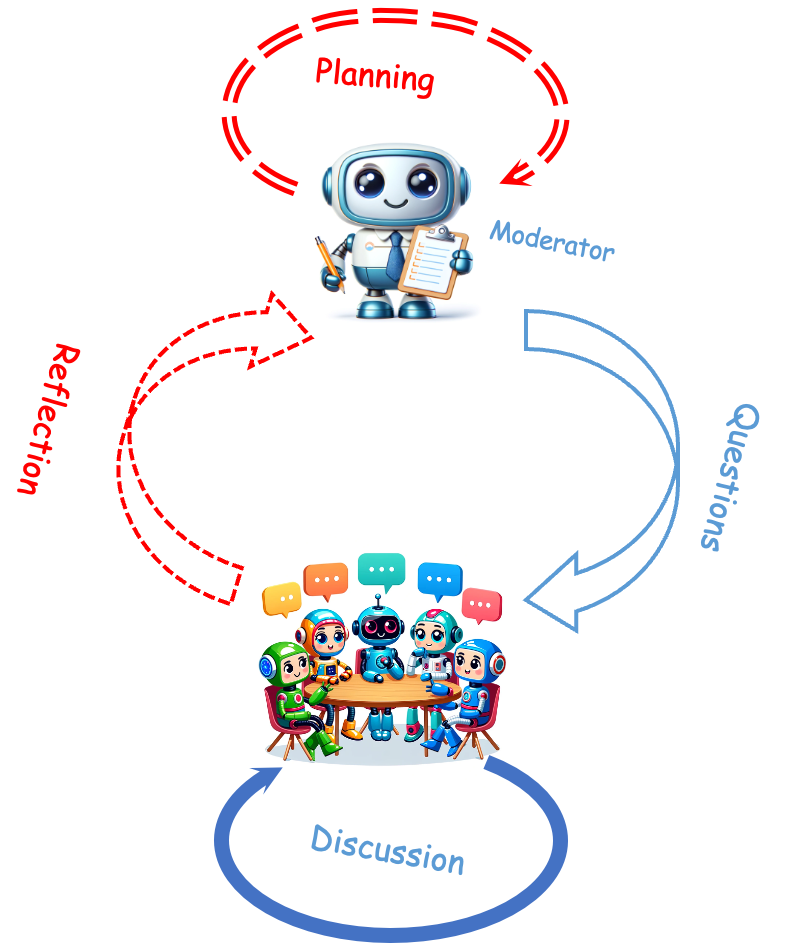
The image depicts a cyclical process diagram with three interconnected stages: **Planning**, **Discussion**, and **Reflection**. Arrows indicate directional flow, with color-coded pathways (red and blue) and labeled roles (e.g., "Moderator"). The diagram emphasizes iterative collaboration among robotic agents, with feedback loops between stages.
---
### Components/Axes
1. **Stages**:
- **Planning**: Top section with a red dashed circular arrow.
- **Discussion**: Bottom section with a solid blue circular arrow.
- **Reflection**: Left side, connected via a red dashed arrow from Planning.
2. **Roles**:
- **Moderator**: A robot labeled "Moderator" in the Planning stage, holding a clipboard and pencil.
- **Robotic Participants**: Five robots in the Discussion stage, each with speech bubbles (colors: yellow, orange, teal, blue, red).
3. **Arrows**:
- **Red Dashed Arrow**: Connects Planning → Reflection.
- **Blue Solid Arrow**: Connects Moderator → Questions → Discussion → Planning (loop).
---
### Detailed Analysis
1. **Planning Stage**:
- Central robot labeled "Moderator" initiates the cycle.
- Arrows suggest planning leads to both Reflection (dashed red) and Questions (solid blue).
2. **Discussion Stage**:
- Five robots engage in dialogue, represented by colored speech bubbles.
- Blue arrow loops Discussion back to Planning, indicating iterative refinement.
3. **Reflection Stage**:
- Dashed red arrow from Planning to Reflection implies post-planning evaluation.
---
### Key Observations
- **Color Coding**: Red arrows (Planning → Reflection) may signify individual/analytical phases, while blue arrows (Moderator → Discussion) represent collaborative/iterative phases.
- **Moderator Role**: Positioned at the start, the Moderator bridges Planning and Discussion, acting as a facilitator.
- **Feedback Loops**: Both stages (Planning and Discussion) feed into Reflection, which then informs the next Planning cycle.
---
### Interpretation
This flowchart illustrates a **collaborative, iterative workflow** where:
1. **Planning** is the foundational phase, guided by a Moderator.
2. **Discussion** involves collective input from multiple agents, generating questions that refine the process.
3. **Reflection** evaluates outcomes, closing the loop to improve future Planning.
- The use of dashed vs. solid arrows may differentiate between *individual reflection* (red) and *group-driven iteration* (blue).
- The cyclical nature emphasizes continuous improvement, with no terminal endpoint, suggesting an adaptive system.
---
### Notes
- No numerical data or quantitative values are present; the diagram focuses on process flow and roles.
- Speech bubble colors in Discussion lack explicit labels but may represent diverse perspectives or topics.