## Cognitive Architecture Diagram
### Overview
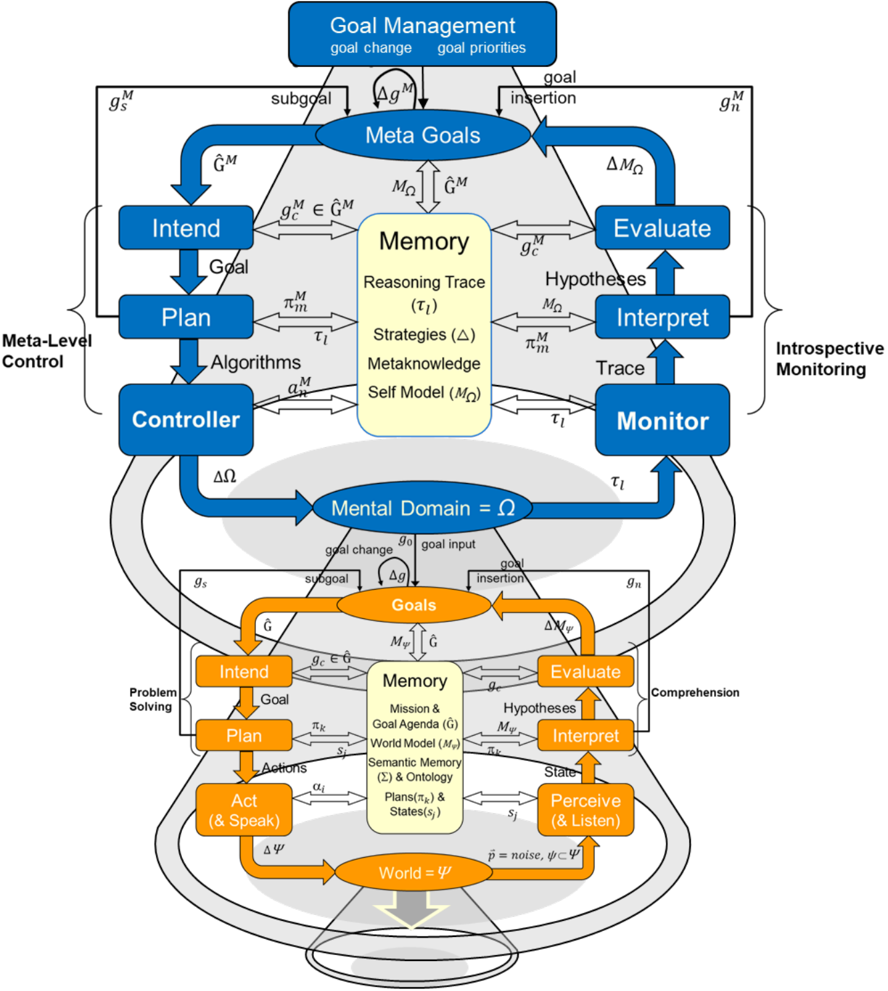
The image presents a cognitive architecture diagram, illustrating the flow of information and processes within a cognitive system. It depicts two levels of processing: a meta-level control and a problem-solving level, along with introspective monitoring. The diagram uses boxes to represent cognitive modules, arrows to indicate the flow of information, and labels to describe the processes and data involved.
### Components/Axes
The diagram is structured around two main processing loops: Meta-Level Control (top, in blue) and Problem Solving (bottom, in orange). Introspective Monitoring is shown on the right side.
**Key Components:**
* **Goal Management:** Located at the top-center, with inputs "goal change" and "goal priorities".
* **Meta Goals:** A central node in the meta-level control loop.
* **Intend (Meta-Level):** A module in the meta-level control loop.
* **Plan (Meta-Level):** A module in the meta-level control loop.
* **Controller:** A module in the meta-level control loop.
* **Mental Domain = Ω:** A central node connecting the meta-level and problem-solving loops.
* **Goals:** A central node in the problem-solving loop.
* **Intend (Problem-Solving):** A module in the problem-solving loop.
* **Plan (Problem-Solving):** A module in the problem-solving loop.
* **Act (& Speak):** A module in the problem-solving loop.
* **World = Ψ:** The external environment.
* **Memory (Meta-Level):** Contains "Reasoning Trace (τl)", "Strategies (Δ)", "Metaknowledge", and "Self Model (MΩ)".
* **Memory (Problem-Solving):** Contains "Mission & Goal Agenda (Ĝ)", "World Model (Mψ)", "Semantic Memory (Σ) & Ontology", and "Plans(πk) & States(sj)".
* **Evaluate (Meta-Level):** A module in the meta-level control loop.
* **Interpret (Meta-Level):** A module in the meta-level control loop.
* **Monitor:** A module for introspective monitoring.
* **Evaluate (Problem-Solving):** A module in the problem-solving loop.
* **Interpret (Problem-Solving):** A module in the problem-solving loop.
* **Perceive (& Listen):** A module in the problem-solving loop.
**Arrows and Labels:**
* Arrows indicate the direction of information flow.
* Labels on arrows describe the type of information being passed (e.g., "goal", "algorithms", "actions", "hypotheses", "trace").
* Variables are used to represent specific data or states (e.g., gM, ΔgM, MΩ, τl, πk, Ψ).
### Detailed Analysis or ### Content Details
**Meta-Level Control Loop (Blue):**
1. **Goal Management** feeds into **Meta Goals**.
2. **Meta Goals** sends information to **Intend**.
3. **Intend** passes a "Goal" to **Plan**.
4. **Plan** generates "Algorithms" for the **Controller**.
5. **Controller** influences the **Mental Domain = Ω** via ΔΩ.
6. **Meta Goals** exchanges information with **Memory (Meta-Level)** via G^M.
7. **Memory (Meta-Level)** sends information to **Evaluate**.
8. **Evaluate** passes "Hypotheses" to **Interpret**.
9. **Interpret** sends "Trace" to **Monitor**.
10. **Monitor** sends τl back to **Memory (Meta-Level)**.
**Problem-Solving Loop (Orange):**
1. **Mental Domain = Ω** influences **Goals**.
2. **Goals** sends information to **Intend**.
3. **Intend** passes a "Goal" to **Plan**.
4. **Plan** generates "Actions" for **Act (& Speak)**.
5. **Act (& Speak)** interacts with the **World = Ψ** via ΔΨ.
6. **Goals** exchanges information with **Memory (Problem-Solving)** via G.
7. **Memory (Problem-Solving)** sends information to **Evaluate**.
8. **Evaluate** passes "Hypotheses" to **Interpret**.
9. **Interpret** sends "State" to **Perceive (& Listen)**.
10. **Perceive (& Listen)** interacts with the **World = Ψ** via p = noise, ψ ⊂ Ψ.
**Introspective Monitoring (Right Side):**
* The **Monitor** receives "Trace" from **Interpret (Meta-Level)**.
* The **Monitor** sends τl to **Memory (Meta-Level)**.
### Key Observations
* The diagram highlights the interaction between meta-level control and problem-solving processes.
* Memory plays a crucial role in both loops, storing information and influencing decision-making.
* The Mental Domain acts as a bridge between the two levels.
* Introspective monitoring allows the system to reflect on its own processes.
* The World represents the external environment, which the system interacts with through perception and action.
### Interpretation
This cognitive architecture diagram illustrates a hierarchical cognitive system capable of both problem-solving and meta-level reasoning. The meta-level control loop allows the system to manage its goals, strategies, and knowledge, while the problem-solving loop focuses on interacting with the environment and achieving specific tasks. The introspective monitoring component enables the system to evaluate its own performance and adapt its strategies accordingly.
The diagram suggests a system that can learn and improve over time by reflecting on its experiences and updating its internal models. The interaction between the different modules and levels of processing allows for flexible and adaptive behavior. The inclusion of "noise" in the interaction with the "World" acknowledges the uncertainty and complexity of real-world environments.