TECHNICAL ASSET FINGERPRINT
cf6c1da7ae87f1f40303fccb
Click to view fullscreen
Press ESC or click to close
FOUND IN PAPERS
EXPERT: gemini-2.5-flash-free VERSION 1
RUNTIME: google-free/gemini-2.5-flash
INTEL_VERIFIED
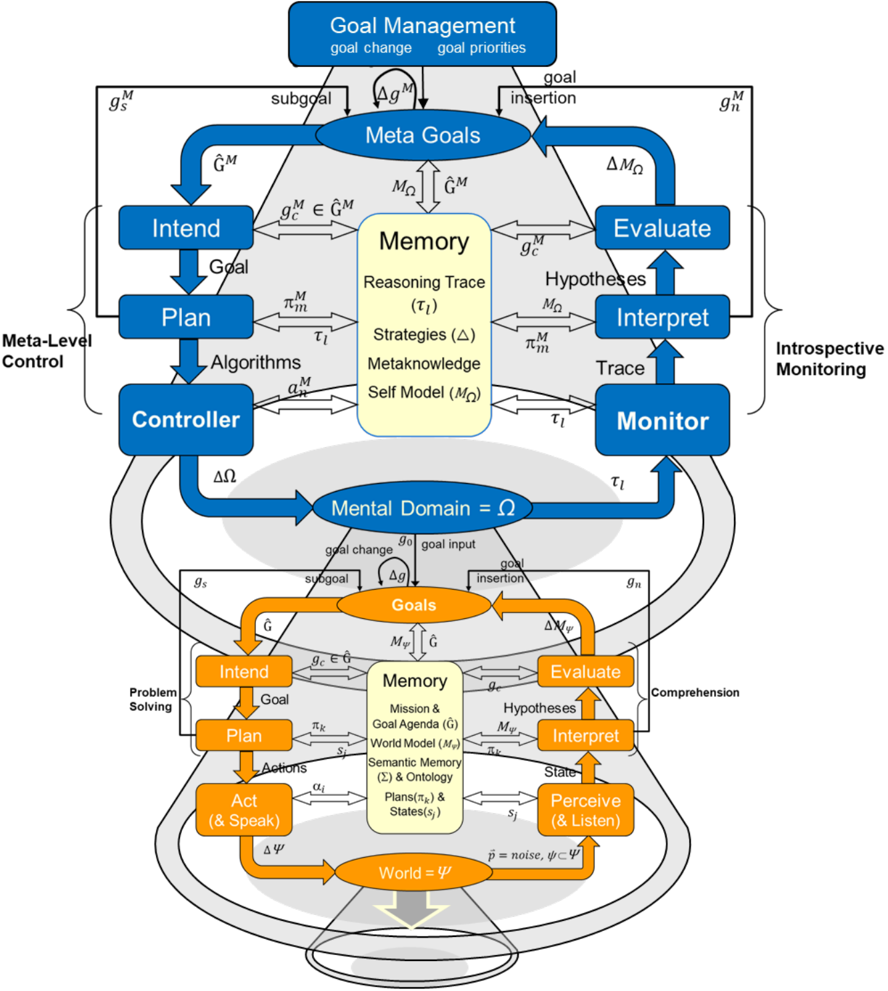
## Diagram Type: Hierarchical Cognitive Architecture for Intelligent Agents
### Overview
This image presents a complex, hierarchical diagram illustrating a cognitive architecture, likely for an intelligent agent or system. It depicts two main levels of control: a "Meta-Level Control" (top, blue components) responsible for managing meta-goals and introspection, and a "Problem Solving" level (bottom, orange components) that interacts with the "World" and handles specific tasks. A "Mental Domain = Ω" acts as an intermediary, connecting these two levels. Central to both levels are "Memory" components (yellow) that store various forms of knowledge and data. The diagram emphasizes feedback loops, goal management, and the interplay between internal cognitive processes and external interaction.
### Components/Axes
The diagram does not have traditional axes or a legend in the sense of a chart, but it uses distinct colors and shapes to denote different types of components and processes.
**Color Coding:**
* **Blue Rectangles/Ovals:** Represent processes and states within the "Meta-Level Control" and "Goal Management".
* **Orange Rectangles/Ovals:** Represent processes and states within the "Problem Solving" level and "World" interaction.
* **Yellow Rectangles:** Represent "Memory" components at both levels.
* **Gray Ovals/Shaded Areas:** Represent overarching domains or states ("Meta Goals", "Mental Domain", "Goals", "World").
* **White Rectangles/Ovals:** Used for labels and specific data points within memory.
**Main Components and Labels (from top to bottom, left to right):**
**Top Section: Goal Management & Meta-Level Control**
* **Goal Management (Top-center, blue rectangle):**
* Labels: "goal change", "goal priorities".
* **Meta Goals (Below Goal Management, gray oval):**
* Receives "subgoal" and "goal insertion" from Goal Management.
* Sends "Δgᴹ" (goal change) to Goal Management.
* Receives "gₙᴹ" from Evaluate.
* Sends "gₛᴹ" to Intend.
* **Meta-Level Control (Left-side bracket):** Encompasses Intend, Plan, Controller, Monitor, Interpret, Evaluate, and the Meta Goals and Memory.
* **Intend (Left, blue rectangle):
* Receives "gₛᴹ" from Meta Goals.
* Sends "Goal" to Plan.
* Interacts with Memory via "gᶜᴹ ∈ Ĝᴹ" (bidirectional).
* **Plan (Left, blue rectangle):**
* Receives "Goal" from Intend.
* Sends "Algorithms" to Controller.
* Interacts with Memory via "π_mᴹ" (bidirectional) and "τ_L" (bidirectional).
* **Controller (Left, blue rectangle):**
* Receives "Algorithms" from Plan.
* Sends "ΔΩ" to Mental Domain.
* Receives "a_kᴹ" from Memory.
* **Memory (Center, yellow rectangle):**
* Contents:
* "Reasoning Trace (τ_L)"
* "Strategies (Δ)"
* "Metaknowledge"
* "Self Model (M_Q)"
* Interactions:
* "gᶜᴹ ∈ Ĝᴹ" with Intend.
* "π_mᴹ" and "τ_L" with Plan.
* "a_kᴹ" with Controller.
* "M_Q" and "Ĝᴹ" with Meta Goals (bidirectional).
* "gᶜᴹ" with Evaluate.
* "M_Q" and "π_mᴹ" with Interpret.
* **Introspective Monitoring (Right-side bracket):** Encompasses Monitor, Interpret, Evaluate.
* **Monitor (Right, blue rectangle):**
* Receives "τ_L" from Mental Domain.
* Sends "Trace" to Interpret.
* **Interpret (Right, blue rectangle):**
* Receives "Trace" from Monitor.
* Sends "Hypotheses" to Evaluate.
* Interacts with Memory via "M_Q" and "π_mᴹ".
* **Evaluate (Right, blue rectangle):**
* Receives "Hypotheses" from Interpret.
* Sends "ΔM_Q" to Meta Goals.
* Sends "gₙᴹ" to Meta Goals.
* Interacts with Memory via "gᶜᴹ".
**Middle Section: Mental Domain**
* **Mental Domain = Ω (Center, gray oval):**
* Receives "ΔΩ" from Controller.
* Sends "τ_L" to Monitor.
* Receives "g₀ goal input" from Goals.
* Receives "goal change" and "goal insertion" from Goals.
**Bottom Section: Problem Solving & World Interaction**
* **Goals (Below Mental Domain, orange oval):**
* Receives "subgoal" and "Δg" from Mental Domain.
* Sends "g₀ goal input", "goal change", "goal insertion" to Mental Domain.
* Receives "gₙ" from Evaluate.
* Sends "gₛ" to Intend.
* **Problem Solving (Left-side bracket):** Encompasses Intend, Plan, Act (& Speak).
* **Intend (Left, orange rectangle):**
* Receives "gₛ" from Goals.
* Sends "Goal" to Plan.
* Interacts with Memory via "g_c ∈ Ĝ" (bidirectional).
* **Plan (Left, orange rectangle):**
* Receives "Goal" from Intend.
* Sends "Actions" to Act (& Speak).
* Interacts with Memory via "π_k" (bidirectional) and "s_j" (bidirectional).
* **Act (& Speak) (Left, orange rectangle):**
* Receives "Actions" from Plan.
* Sends "α_i" to World.
* Sends "ΔΨ" to World.
* **Memory (Center, yellow rectangle):**
* Contents:
* "Mission & Goal Agenda (Ĝ)"
* "World Model (M_Ψ)"
* "Semantic Memory (Σ) & Ontology"
* "Plans(π_k) & States(s_j)"
* Interactions:
* "g_c ∈ Ĝ" with Intend.
* "π_k" and "s_j" with Plan.
* "M_Ψ" and "Ĝ" with Goals (bidirectional).
* "g_c" with Evaluate.
* "M_Ψ" and "π_k" with Interpret.
* "s_j" with Perceive (& Listen).
* **Comprehension (Right-side bracket):** Encompasses Perceive (& Listen), Interpret, Evaluate.
* **Perceive (& Listen) (Right, orange rectangle):**
* Receives "s_j" from World.
* Sends "State" to Interpret.
* Interacts with Memory via "s_j".
* **Interpret (Right, orange rectangle):**
* Receives "State" from Perceive (& Listen).
* Sends "Hypotheses" to Evaluate.
* Interacts with Memory via "M_Ψ" and "π_k".
* **Evaluate (Right, orange rectangle):**
* Receives "Hypotheses" from Interpret.
* Sends "ΔM_Ψ" to Goals.
* Sends "gₙ" to Goals.
* Interacts with Memory via "g_c".
**Bottom-most Section: World**
* **World = Ψ (Bottom-center, orange oval):**
* Receives "α_i" and "ΔΨ" from Act (& Speak).
* Sends "s_j" to Perceive (& Listen).
* Label: "p̂ = noise, Ψ ⊂ Ψ" (This appears to be a typo, likely intended as "p̂ = noise, Ψ ⊆ Ψ" or "p̂ = noise, Ψ ⊂ World" or similar, indicating noise in perception or the world state itself).
### Detailed Analysis
The diagram illustrates a dual-loop cognitive architecture.
**Meta-Level Control (Blue Path):**
* **Goal Management** sets high-level "goal change" and "goal priorities", feeding into "Meta Goals".
* The **Meta Goals** are processed by the "Intend" -> "Plan" -> "Controller" sequence, which represents the proactive generation of "Algorithms" and "ΔΩ" (changes to the Mental Domain). This is the "Meta-Level Control" loop.
* The "Memory" at this level stores "Reasoning Trace (τ_L)", "Strategies (Δ)", "Metaknowledge", and a "Self Model (M_Q)". It's central to all meta-level processes, providing context and storing learned behaviors.
* The "Monitor" -> "Interpret" -> "Evaluate" sequence forms the "Introspective Monitoring" loop. It observes "τ_L" (trace from Mental Domain), generates "Hypotheses", and evaluates them against the "Self Model (M_Q)" and "Metaknowledge" in Memory. This evaluation leads to "ΔM_Q" (changes to the Self Model) and "gₙᴹ" (new meta-goals or goal adjustments) fed back to "Meta Goals".
**Mental Domain (Ω):**
* This gray oval acts as a buffer or interface between the meta-level and the problem-solving level.
* "ΔΩ" from the Controller influences it, and it provides "τ_L" (trace) for meta-level monitoring.
* It also mediates "goal change", "goal input", and "goal insertion" between the "Goals" of the problem-solving level and the meta-level.
**Problem Solving (Orange Path):**
* **Goals** are managed, receiving "subgoal" and "Δg" from the Mental Domain and feeding "g₀ goal input", "goal change", "goal insertion" back.
* The "Intend" -> "Plan" -> "Act (& Speak)" sequence represents the agent's interaction with the "World". This is the "Problem Solving" loop. "Actions" (α_i) and "ΔΨ" (changes to the World) are outputs.
* The "Memory" at this level stores "Mission & Goal Agenda (Ĝ)", "World Model (M_Ψ)", "Semantic Memory (Σ) & Ontology", and "Plans(π_k) & States(s_j)". This memory is crucial for understanding the environment and executing tasks.
* The "Perceive (& Listen)" -> "Interpret" -> "Evaluate" sequence forms the "Comprehension" loop. It receives "s_j" (states) from the "World", generates "Hypotheses", and evaluates them against the "World Model (M_Ψ)" and "Semantic Memory" in Memory. This leads to "ΔM_Ψ" (changes to the World Model) and "gₙ" (new goals or goal adjustments) fed back to "Goals".
**World (Ψ):**
* The "World = Ψ" is the external environment with which the agent interacts.
* It receives "α_i" (actions) and "ΔΨ" (changes) from the agent.
* It provides "s_j" (states) to the agent, which are subject to "p̂ = noise".
**Key Information Flows:**
* **Top-Down Control:** Goal Management influences Meta Goals, which in turn influence the Mental Domain, and then the lower-level Goals.
* **Bottom-Up Feedback:** Information from the World (s_j) is processed by the Problem Solving level, leading to updates in its Memory (ΔM_Ψ) and adjustments to Goals (gₙ). Similarly, the Mental Domain's trace (τ_L) informs the Meta-Level's Introspective Monitoring, leading to updates in its Memory (ΔM_Q) and adjustments to Meta Goals (gₙᴹ).
* **Memory as Central Hub:** Both Memory blocks are extensively connected to all functional components within their respective levels, highlighting their role in storing, retrieving, and updating knowledge essential for operation.
* **Bidirectional Arrows:** Many connections are bidirectional, indicating constant interaction and feedback between components (e.g., Memory and Intend, Plan, Interpret, Evaluate at both levels).
### Key Observations
* **Hierarchical Structure:** Clear distinction between meta-level (blue) and base-level (orange) processing, connected by the "Mental Domain".
* **Dual Feedback Loops:** Both levels exhibit similar "Intend -> Plan -> Act/Control" (proactive) and "Perceive/Monitor -> Interpret -> Evaluate" (reactive/introspective) loops.
* **Specialized Memory:** Each level has its own "Memory" with distinct contents tailored to its function (e.g., "Self Model" and "Metaknowledge" at meta-level; "World Model" and "Semantic Memory" at problem-solving level).
* **Goal-Driven Behavior:** Goals are central to both levels, driving intentions and plans, and being updated based on evaluation.
* **Introspection and Comprehension:** Dedicated loops for "Introspective Monitoring" (meta-level) and "Comprehension" (problem-solving level) highlight the system's ability to reflect on its own processes and understand the environment.
* **Interaction with World:** The "Act (& Speak)" and "Perceive (& Listen)" components are the direct interface with the external "World".
* **Noise in Perception:** The label "p̂ = noise" explicitly acknowledges that sensory input from the World can be imperfect.
### Interpretation
This diagram describes a sophisticated cognitive architecture designed for an intelligent agent capable of both acting in the world and reflecting on its own internal states and processes.
The **Meta-Level Control** acts as a supervisor, managing the agent's overall objectives ("Meta Goals") and its internal cognitive resources. It monitors the agent's "Mental Domain" (its internal state and activity) through "Introspective Monitoring" to ensure its strategies and self-model are effective. This allows the agent to learn, adapt, and improve its own cognitive processes over time. For example, if the agent consistently fails at a task, the meta-level might adjust its "Strategies" or "Metaknowledge" stored in its Memory.
The **Problem Solving** level is responsible for the agent's direct interaction with the environment ("World"). It takes high-level "Goals" (derived from meta-goals) and translates them into "Plans" and "Actions". Through "Perceive (& Listen)", it gathers information from the world, which is then processed by "Comprehension" to update its "World Model" and "Semantic Memory". This allows the agent to understand its surroundings, make informed decisions, and execute tasks effectively.
The **Mental Domain = Ω** serves as a critical bridge, allowing the meta-level to influence the base-level's goals and providing the meta-level with a "trace" of the base-level's activity for introspection. This bidirectional flow ensures coherence between the agent's high-level objectives and its concrete actions.
The two distinct **Memory** components underscore the idea that different types of knowledge are required for different levels of cognitive processing. The meta-level needs "Metaknowledge" and a "Self Model" to reason about its own reasoning, while the problem-solving level needs a "World Model" and "Semantic Memory" to reason about the external environment.
In essence, this architecture suggests an agent that is not only reactive to its environment but also proactive in setting and managing its own goals, and introspective in monitoring and improving its own cognitive functions. The explicit inclusion of "noise" in perception highlights a realistic approach to agent design, acknowledging the imperfections of real-world data. This model could be applied to autonomous robots, AI systems, or even as a theoretical framework for understanding human cognition.
DECODING INTELLIGENCE...