\n
## Diagram: Cognitive Architecture - Mental Domain & Meta-Level Control
### Overview
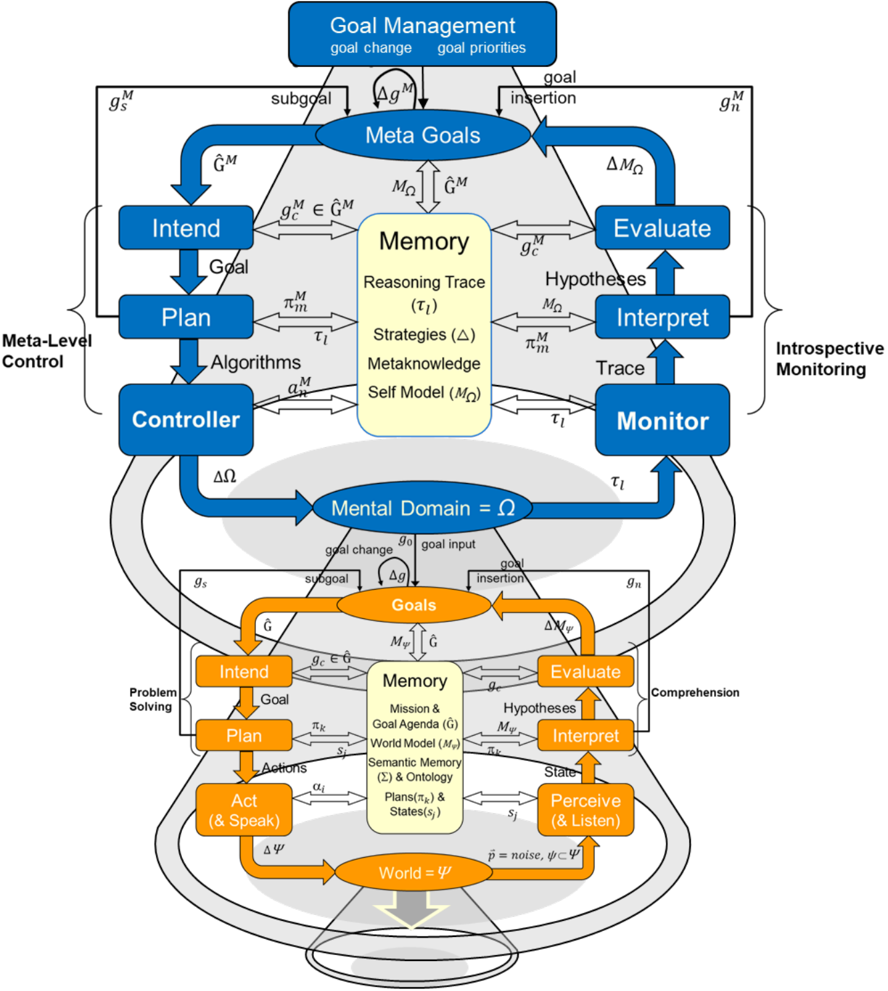
The image depicts a cognitive architecture diagram illustrating the interaction between a "Mental Domain" (Ω) and a "Meta-Level Control" layer. The diagram uses a circular flow to represent cognitive processes like intending, planning, acting, perceiving, evaluating, and interpreting. It highlights the flow of information, goals, and states between different components within the system. The diagram is divided into two main sections: the upper section representing Meta-Level Control, and the lower section representing the Mental Domain.
### Components/Axes
The diagram contains the following key components:
* **Meta-Level Control (Blue):** Encompasses "Goal Management", "Intend", "Plan", "Controller", "Monitor", "Evaluate", and "Interpret".
* **Mental Domain (Ω) (Yellow/Orange/Green):** Includes "Goals", "Memory", "Interpret", "Evaluate", "Perceive (& Listen)", "Act (& Speak)", and "World".
* **Flow Arrows:** Indicate the direction of information and control flow between components.
* **Labels:** Numerous labels describe the processes, data, and relationships within the system. These include terms like "goal change", "goal insertion", "reasoning trace", "hypotheses", "actions", "state", "noise", etc.
* **Mathematical Notation:** Variables like g<sub>s</sub><sup>M</sup>, g<sub>c</sub><sup>M</sup>, ΔΩ, τ<sub>l</sub>, ψ, etc., are used to represent specific parameters or values.
* **Text Blocks:** Descriptions within components like "Mission & Goal Agenda (g)", "World Model (M<sub>w</sub>)", "Semantic Memory (Σ) & Ontology", "Plans(π<sub>l</sub>) & States(s)".
### Detailed Analysis or Content Details
**Meta-Level Control (Blue):**
* **Goal Management (Top):** Receives "goal change" and "goal priorities" and outputs "subgoal" (Ag<sup>M</sup>) and "goal insertion" (g<sub>h</sub><sup>M</sup>).
* **Intend:** Receives "subgoal" (Ag<sup>M</sup>) and outputs "Goal" (g<sup>M</sup>).
* **Plan:** Receives "Goal" (g<sup>M</sup>) and outputs "π<sub>l</sub><sup>M</sup>" and "τ<sub>l</sub>".
* **Controller:** Receives "Algorithms" (α<sup>M</sup>) and outputs "ΔΩ".
* **Monitor:** Receives "ΔΩ" and outputs "τ<sub>l</sub>".
* **Evaluate:** Receives "g<sub>c</sub><sup>M</sup>" and outputs "ΔM<sub>Ω</sub>".
* **Interpret:** Receives "M<sub>Ω</sub>" and outputs "Hypotheses" (M<sub>ψ</sub>).
**Mental Domain (Ω) (Yellow/Orange/Green):**
* **Goals (Top-Left):** Receives "goal change" (g<sub>0</sub>) and "goal input" and outputs "subgoal" (Ag) and "goal insertion" (g<sub>h</sub>).
* **Memory (Center-Left):** Contains "Mission & Goal Agenda (g)", "World Model (M<sub>w</sub>)", "Semantic Memory (Σ) & Ontology", "Plans(π<sub>l</sub>) & States(s)". Outputs "g<sub>c</sub>" and "M<sub>ψ</sub>".
* **Interpret (Top-Right):** Receives "M<sub>ψ</sub>" and outputs "Hypotheses" (M<sub>ψ</sub>).
* **Evaluate (Center-Right):** Receives "Hypotheses" (M<sub>ψ</sub>) and outputs "ΔM<sub>ψ</sub>".
* **Perceive (& Listen) (Bottom-Right):** Receives "State" (s<sub>l</sub>) and outputs "ψ".
* **Act (& Speak) (Bottom-Left):** Outputs "Actions" and receives "ψ".
* **World (Bottom):** Receives "Δψ" and outputs "noise" (ψ = ψ').
**Flow and Connections:**
* A circular flow exists between "Intend", "Plan", "Act (& Speak)", "Perceive (& Listen)", "Evaluate", and "Interpret" within the Mental Domain.
* The "Controller" in the Meta-Level Control influences the "Mental Domain" through "ΔΩ".
* The "Monitor" receives feedback from the "Mental Domain" via "τ<sub>l</sub>".
* The "Evaluate" and "Interpret" components in both layers exchange information.
**Mathematical Notation:**
* g<sub>s</sub><sup>M</sup>: Goal state (Meta-Level)
* g<sub>c</sub><sup>M</sup>: Goal control (Meta-Level)
* ΔΩ: Change in the Mental Domain
* τ<sub>l</sub>: Time constant
* ψ: Perception/Noise
* g<sub>0</sub>: Initial Goal
* g<sub>h</sub>: Goal Hypothesis
### Key Observations
* The diagram emphasizes a hierarchical control structure, with the Meta-Level Control overseeing and modulating the Mental Domain.
* The circular flow within the Mental Domain suggests a continuous cycle of perception, action, and evaluation.
* The use of mathematical notation indicates a formal, computational approach to modeling cognition.
* The diagram is highly interconnected, with numerous feedback loops and information pathways.
* The "World" component is positioned as the external environment influencing the system through noise.
### Interpretation
This diagram represents a computational cognitive architecture, likely intended to model human-like intelligence. The separation of Meta-Level Control and the Mental Domain suggests a distinction between conscious control and subconscious processing. The Meta-Level Control acts as a supervisory system, setting goals, monitoring progress, and adjusting strategies. The Mental Domain represents the core cognitive processes involved in perception, action, and reasoning.
The circular flow within the Mental Domain highlights the iterative nature of cognition, where actions lead to perceptions, which inform future actions. The inclusion of "noise" in the "World" component acknowledges the inherent uncertainty and imperfection of real-world perception.
The mathematical notation suggests that this architecture is designed to be implemented as a computational model, allowing for quantitative analysis and simulation of cognitive processes. The diagram is a high-level representation, and further details would be needed to understand the specific algorithms and data structures used within each component. The diagram is a conceptual model, and the relationships between the components are likely more complex in reality. The diagram is a representation of a theoretical framework for understanding cognition, and it is not necessarily a complete or accurate model of the human mind.