## Diagram: Cognitive Architecture with Meta-Level Control and Problem Solving
### Overview
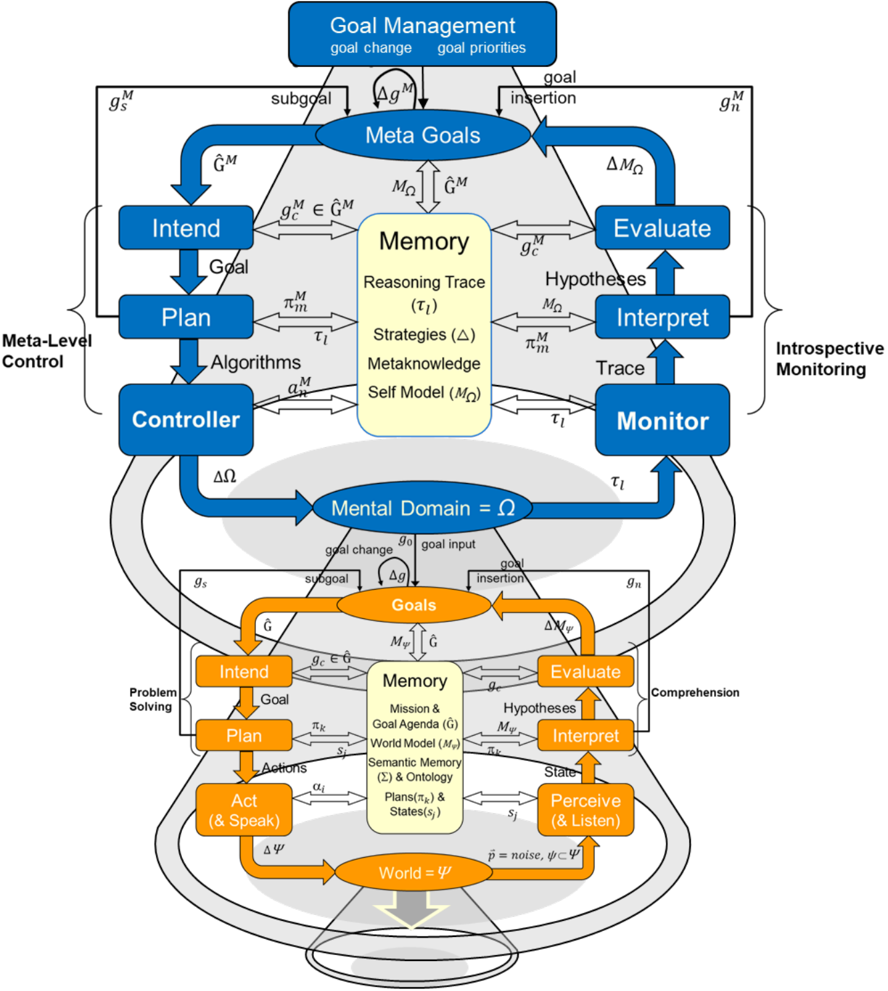
The image is a detailed technical diagram illustrating a two-level cognitive architecture. It depicts a hierarchical system where a **Meta-Level Control** layer (blue components) oversees and regulates a **Problem Solving** layer (orange components). The architecture is characterized by goal-directed cycles, memory systems, and continuous monitoring and evaluation loops. The diagram uses color-coding, labeled components, and directional arrows to show information flow and control relationships.
### Components/Axes
The diagram is divided into two primary, interconnected loops:
1. **Meta-Level Control (Blue Components - Top Half):**
* **Goal Management:** A top-level block managing "goal change" and "goal priorities."
* **Meta Goals:** A central oval receiving "subgoal" and "goal insertion" inputs.
* **Core Process Cycle (Blue Boxes):** Intend → Plan → Controller → (to Mental Domain) and Monitor → Interpret → Evaluate → (back to Meta Goals).
* **Memory (Yellow Box):** Contains "Reasoning Trace (τₗ)", "Strategies (Δ)", "Metaknowledge", and "Self Model (MΩ)".
* **Mental Domain (Ω):** A central oval representing the internal state or workspace of the meta-level.
2. **Problem Solving (Orange Components - Bottom Half):**
* **Goals:** A central oval receiving "goal change", "subgoal", and "goal insertion" inputs.
* **Core Process Cycle (Orange Boxes):** Intend → Plan → Act (& Speak) → (to World) and Perceive (& Listen) → Interpret → Evaluate → (back to Goals).
* **Memory (Yellow Box):** Contains "Mission & Goal Agenda (Ĝ)", "World Model (Mψ)", "Semantic Memory (Σ) & Ontology", and "Plans(πₖ) & States(sₖ)".
* **World (Ψ):** A central oval representing the external environment.
**Key Connecting Elements & Labels:**
* **Arrows with Labels:** Numerous arrows connect components, labeled with symbols representing data/control flow (e.g., `gₛᴹ`, `πₘᴹ`, `τₗ`, `ΔΩ`, `gₛ`, `πₖ`, `sⱼ`, `ΔΨ`).
* **Brackets:** Labels "Meta-Level Control" and "Introspective Monitoring" bracket the blue loop. "Problem Solving" and "Comprehension" bracket the orange loop.
* **Mathematical Notation:** The diagram heavily uses Greek letters (Ω, Ψ, Δ, Σ, τ, π) and subscripts/superscripts (e.g., `MΩ`, `gₙᴹ`, `πₘᴹ`) to denote specific variables, models, and states within the architecture.
### Detailed Analysis
**Flow and Relationships:**
1. **Hierarchical Control:** The Meta-Level (blue) influences the Problem-Solving level (orange) primarily through the `ΔΩ` arrow from the Controller to the Mental Domain (Ω), which then interfaces with the Goals of the lower level.
2. **Cyclical Processing:** Both levels operate on a similar cycle:
* **Top-Down (Blue):** Intend → Plan → Controller (acting on Mental Domain).
* **Bottom-Up (Blue):** Monitor → Interpret → Evaluate (feeding back to Meta Goals).
* **Top-Down (Orange):** Intend → Plan → Act (acting on World).
* **Bottom-Up (Orange):** Perceive → Interpret → Evaluate (feeding back to Goals).
3. **Memory Integration:** Each level has a dedicated Memory block that interacts with multiple components in its cycle. The Meta-Level Memory focuses on reasoning traces and self-models, while the Problem-Solving Memory focuses on world models, semantic knowledge, and action plans.
4. **World Interaction:** The Problem-Solving layer directly interacts with the external "World (Ψ)" via `Act (& Speak)` and `Perceive (& Listen)`. The perception arrow is labeled `p̃ = noise, ψ ⊂ Ψ`, indicating noisy perception of a subset of the world.
5. **Goal Management:** Goals are central to both levels. The Meta-Level manages "Meta Goals," which likely govern the strategy and priorities of the lower-level "Goals." Both goal systems accept inputs for change, subgoals, and insertion.
### Key Observations
* **Symmetry of Process:** The architecture exhibits a striking symmetry between the meta-cognitive and problem-solving layers, suggesting a fractal or recursive design principle where similar processes operate at different levels of abstraction.
* **Central Role of Memory:** Memory is not a passive store but an active component integrated into every phase of both cycles, providing context, models, and traces.
* **Closed-Loop Systems:** Both levels form closed feedback loops, emphasizing continuous adaptation, evaluation, and goal updating rather than linear execution.
* **Explicit Modeling of Self and World:** The inclusion of a "Self Model (MΩ)" in meta-memory and a "World Model (Mψ)" in problem-solving memory indicates the architecture's capacity for self-reflection and environmental modeling.
* **Noise Acknowledgment:** The label `p̃ = noise` on the perception pathway explicitly accounts for imperfect information from the environment.
### Interpretation
This diagram represents a sophisticated model of an intelligent agent, likely for artificial general intelligence (AGI) or advanced cognitive robotics research. It proposes that robust intelligence requires two interacting layers:
1. A **meta-cognitive layer** that doesn't solve problems directly but manages *how* problems are solved—setting strategies, monitoring performance, and adjusting goals and self-models.
2. A **problem-solving layer** that executes tasks in the world based on the guidance and constraints set by the meta-layer.
The architecture suggests that learning and adaptation occur through the continuous interplay between action/perception in the world and introspective evaluation at the meta-level. The heavy use of formal notation implies this is a theoretical framework intended for mathematical or computational implementation. The core insight is that true autonomy and flexibility arise not just from executing plans, but from a system that can introspect on its own reasoning processes and dynamically reconfigure its own goals and strategies.