## 3D Surface Plots: Dual-Orientation Visualization
### Overview
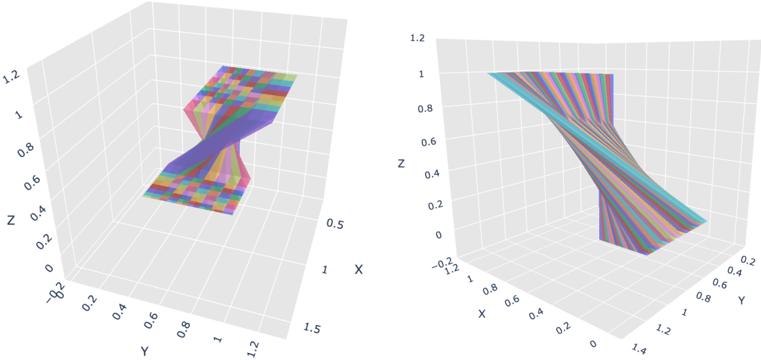
The image displays two separate 3D surface plots positioned side-by-side. Both plots visualize a complex, twisted surface within a 3D coordinate system, but from different camera angles and with distinct surface patterning. The left plot features a checkered or tiled pattern, while the right plot features a striped pattern. The surfaces appear to represent the same or a very similar mathematical function or dataset.
### Components/Axes
**Left Plot (Checkered Pattern):**
* **Axes:** Three orthogonal axes labeled X, Y, and Z.
* **X-Axis:** Located on the right side of the plot's floor. Ticks and labels visible: `0.5`, `1`, `1.5`. The axis extends from approximately 0 to 1.5.
* **Y-Axis:** Located on the front-left side of the plot's floor. Ticks and labels visible: `0`, `0.2`, `0.4`, `0.6`, `0.8`, `1`, `1.2`. The axis extends from approximately 0 to 1.2.
* **Z-Axis:** The vertical axis on the left. Ticks and labels visible: `0`, `0.2`, `0.4`, `0.6`, `0.8`, `1`, `1.2`. The axis extends from approximately 0 to 1.2.
* **Surface:** A 3D surface with a complex, saddle-like twist. It is colored with a multi-colored checkered pattern (tiles of blue, purple, pink, yellow, green). The pattern appears to be mapped onto the surface geometry.
**Right Plot (Striped Pattern):**
* **Axes:** Three orthogonal axes labeled X, Y, and Z.
* **X-Axis:** Located on the front-left side of the plot's floor. Ticks and labels visible: `0`, `0.2`, `0.4`, `0.6`, `0.8`, `1`, `1.2`, `1.4`. The axis extends from approximately 0 to 1.4.
* **Y-Axis:** Located on the right side of the plot's floor. Ticks and labels visible: `0`, `0.2`, `0.4`, `0.6`, `0.8`, `1`, `1.2`. The axis extends from approximately 0 to 1.2.
* **Z-Axis:** The vertical axis on the left. Ticks and labels visible: `0`, `0.2`, `0.4`, `0.6`, `0.8`, `1`, `1.2`. The axis extends from approximately 0 to 1.2.
* **Surface:** A 3D surface with a similar twisted geometry to the left plot, appearing as a ribbon or folded plane. It is colored with a multi-colored striped pattern (stripes of cyan, purple, pink, yellow, green). The stripes run along the length of the surface.
**General Notes:**
* **Legend:** No explicit legend is present in either plot. The color patterns (checkers vs. stripes) are the primary visual differentiators.
* **Grid:** Both plots have a light gray grid on the "floor" (XY-plane) and the back walls (XZ and YZ planes) to aid in spatial orientation.
* **Background:** The background of both plots is a uniform light gray.
### Detailed Analysis
**Left Plot (Checkered):**
* **Trend/Shape:** The surface starts at a low Z-value near the origin (X≈0, Y≈0), rises to a peak or ridge, then descends into a valley before rising again towards the far corner (X≈1.5, Y≈1.2). The overall shape resembles a hyperbolic paraboloid or a saddle point that has been twisted.
* **Data Points (Approximate):**
* Minimum Z: ~0.2, located near (X=0.2, Y=0.2).
* Maximum Z: ~1.1, located near (X=1.0, Y=1.0).
* The surface appears to be defined over the domain X ∈ [0, 1.5], Y ∈ [0, 1.2].
**Right Plot (Striped):**
* **Trend/Shape:** The surface is viewed from a different angle, making the twist more apparent as a diagonal fold. It appears to descend from a high Z-value at the back-left (low X, high Y) to a low Z-value at the front-right (high X, low Y). The striped pattern emphasizes the flow and curvature along the surface.
* **Data Points (Approximate):**
* High Z-point: ~1.0, located near (X=0, Y=1.2).
* Low Z-point: ~0.2, located near (X=1.4, Y=0).
* The surface appears to be defined over the domain X ∈ [0, 1.4], Y ∈ [0, 1.2].
### Key Observations
1. **Dual Representation:** The core observation is the visualization of the same (or very similar) 3D surface geometry using two different texture mappings: checkered and striped.
2. **Viewpoint Dependency:** The two plots are rendered from significantly different camera perspectives. The left plot offers a more "corner-on" view, while the right plot offers a more "side-on" view, highlighting different aspects of the surface's topology.
3. **Pattern Function:** The patterns are not indicative of different data series but are likely applied to enhance the perception of the surface's 3D shape, curvature, and orientation. The checkered pattern helps visualize local deformation, while the striped pattern emphasizes global flow.
4. **Axis Range Discrepancy:** The X-axis range differs slightly between the plots (0-1.5 vs. 0-1.4), which could be due to the viewing angle cropping the data or a slight difference in the plotted domain.
### Interpretation
This image is a technical visualization, likely generated by mathematical software (e.g., MATLAB, Python's Matplotlib, Mathematica) to explore or present the properties of a 3D scalar field or parametric surface.
* **What it Demonstrates:** The plots show a non-linear, twisted surface where the Z-value is a function of X and Y. The saddle-like shape suggests the function has a critical point (like a minimax point) within the domain. The use of different patterns and views is a common technique in data visualization to aid human depth perception and understanding of complex 3D forms on a 2D screen.
* **Relationship Between Elements:** The axes provide the coordinate frame. The grid lines anchor the surface in that frame. The color patterns are mapped onto the surface geometry to reveal its contours. The two plots together provide a more complete mental model of the surface than a single view could.
* **Notable Anomalies:** There are no apparent data anomalies, as this appears to be a smooth, continuous mathematical surface. The primary "anomaly" for a viewer is the intentional use of two distinct, non-standard color mappings (checkers and stripes) instead of a continuous colormap, which is a deliberate pedagogical or presentational choice to highlight surface geometry over scalar value.
* **Potential Context:** Such visualizations are used in fields like multivariate calculus, optimization theory, computer graphics (for testing texture mapping), physics (for representing potential fields), or engineering (for stress/strain surfaces). The specific function being plotted is not labeled, but its characteristics (bounded, smooth, twisted) are clearly communicated.