## Diagram: Systema Tychonicum
### Overview
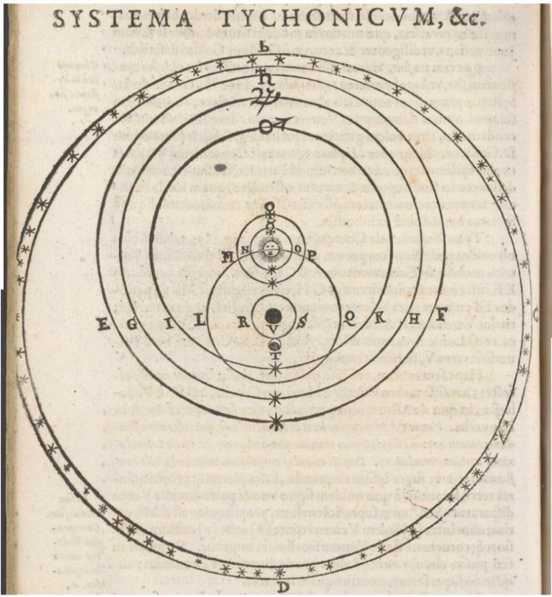
The image is a diagram of the Tychonic system, a model of the universe that combines geocentric and heliocentric elements. It depicts the Earth at the center, with the Sun and Moon orbiting it, and the other planets orbiting the Sun. The diagram is circular, with concentric rings representing the orbits of celestial bodies.
### Components/Axes
* **Title:** SYSTEMA TYCHONICVM, &c.
* **Central Body:** Earth (represented by a dark circle with the letter "V" inside)
* **Orbits:** Concentric circles representing the paths of celestial bodies.
* **Celestial Bodies:**
* Sun (represented by a circle with a face)
* Moon (represented by a crescent shape)
* Planets (represented by symbols and letters)
* **Outer Ring:** A ring with stars around the outside.
* **Labels:** Letters and symbols are used to label the celestial bodies and their orbits.
### Detailed Analysis
The diagram shows the Earth at the center, with the Moon and Sun orbiting it. The other planets (Mars, Jupiter, Saturn) orbit the Sun. The outermost ring is marked with stars.
* **Center:** A dark circle labeled "V" represents the Earth.
* **Inner Orbit:** The Moon orbits the Earth.
* **Second Orbit:** The Sun orbits the Earth.
* **Planetary Orbits:** The planets orbit the Sun. From the Sun outwards, the planets appear to be Mercury, Venus, Mars, Jupiter, and Saturn.
* **Labels:**
* "N", "O", "P" are near the Sun.
* "M" is near the Moon.
* "E", "G", "I", "L", "R", "S", "Q", "K", "H", "F" are around the planetary orbits.
* "T" is below the Earth.
* "D" is at the bottom of the outermost ring.
* "b" is at the top of the outermost ring.
* Symbols for Saturn and Jupiter are present.
* "24" is near Jupiter's symbol.
### Key Observations
* The Earth is at the center of the diagram.
* The Moon and Sun orbit the Earth.
* The planets orbit the Sun.
* The diagram is a representation of the Tychonic system.
### Interpretation
The diagram illustrates the Tychonic system, a compromise between the geocentric (Earth-centered) Ptolemaic system and the heliocentric (Sun-centered) Copernican system. Tycho Brahe proposed this model as an alternative to the Copernican system, which he found problematic due to the lack of observed stellar parallax. The Tychonic system allowed for the planets to orbit the Sun while maintaining a stationary Earth, thus addressing some of the observational and philosophical objections to heliocentrism at the time. The diagram reflects the understanding of the cosmos during the late 16th and early 17th centuries, before the widespread acceptance of the heliocentric model.