\n
## Diagram: Tycho Brahe's Geocentric Model (Systema Tychonicum)
### Overview
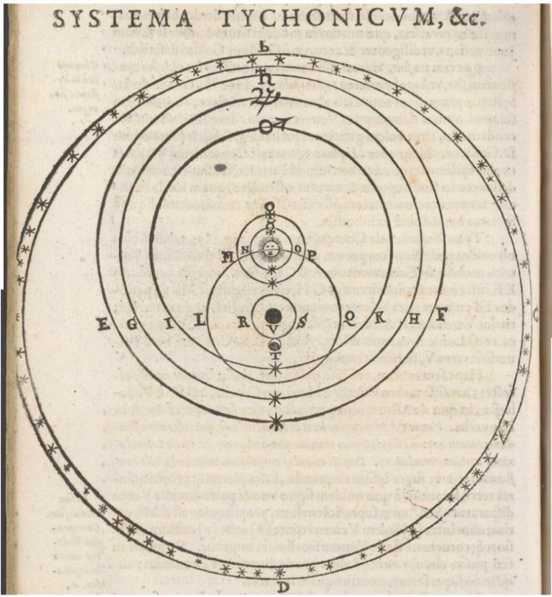
The image depicts a diagram of the Tychonic system, a model of the solar system proposed by Tycho Brahe in the late 16th century. It's a geocentric model, meaning the Earth is at the center, but with the planets orbiting the Sun, which in turn orbits the Earth. The diagram is rendered in a historical style, likely from an early printed book, with hand-drawn lines and lettering. The image appears to be a scan of an old document, with some discoloration and imperfections.
### Components/Axes
The diagram consists of a series of concentric circles representing the orbits of celestial bodies. The central point is occupied by the Earth. The following labels are present:
* **SYSTEMA TYCHONICVM, &c.** (Top-center): Title of the diagram, indicating the Tychonic system.
* **E, G, I, L, R, V, S, Q, K, H, F** (Around the orbits): Labels associated with specific orbits, likely representing different planets or celestial spheres.
* **M, N, O, P** (Near the Sun): Labels associated with the Sun and its immediate surroundings.
* **b, 27, 07** (Outside the outermost orbit): Labels positioned outside the outermost orbit, their meaning is unclear without further context.
* **D** (Bottom-center): Label at the bottom of the diagram, its meaning is unclear.
* Symbols resembling planets and the Sun are placed within their respective orbits.
* A small text block is visible at the bottom of the image, in a language other than English.
### Detailed Analysis / Content Details
The diagram shows the Earth (labeled as the central point) as stationary. The Sun orbits the Earth in a relatively small circle. The planets (labeled E, G, I, L, R, V, S, Q, K, H, F) orbit the Sun. The orbits are depicted as perfect circles.
The arrangement of the planets appears to follow a specific order, but without a key or further explanation, it's difficult to determine the exact correspondence between the labels and the planets.
The text block at the bottom of the image is in Latin. It reads:
“*In quo terra quiescit, sol circum terram, caetera vero planeta circa solem ambiunt.*”
English Translation:
“*In which the Earth is at rest, the sun revolves around the Earth, and all the other planets revolve around the sun.*”
### Key Observations
* The diagram clearly illustrates the geocentric nature of the Tychonic system.
* The Sun is not at the center, but it serves as a central point for the planetary orbits.
* The orbits are depicted as circular, which was a common assumption in astronomy at the time.
* The diagram is a visual representation of a complex astronomical model, intended to explain the observed movements of celestial bodies.
* The Latin text confirms the central tenets of the system.
### Interpretation
The diagram represents a compromise between the Ptolemaic geocentric model and the Copernican heliocentric model. Tycho Brahe, dissatisfied with the mathematical complexities of the Copernican system and unwilling to accept the idea of a moving Earth, proposed this hybrid model. It retained the Earth as the center of the universe, but placed the Sun and planets in orbit around it, resolving some of the observational challenges faced by earlier models.
The diagram is not a precise scientific representation in the modern sense. It's a conceptual model intended to convey the relationships between celestial bodies as understood at the time. The labels and symbols are mnemonic devices, helping astronomers remember the structure of the system. The Latin text provides a concise summary of the model's key features.
The diagram is a valuable historical artifact, providing insight into the development of astronomical thought and the challenges faced by scientists in understanding the universe. It demonstrates the ingenuity and creativity of Tycho Brahe in attempting to reconcile observation with prevailing philosophical beliefs. The imperfections in the image (discoloration, hand-drawn lines) add to its historical authenticity and remind us of the context in which it was created.