## [Diagram Type]: Tychonic Astronomical System Diagram
### Overview
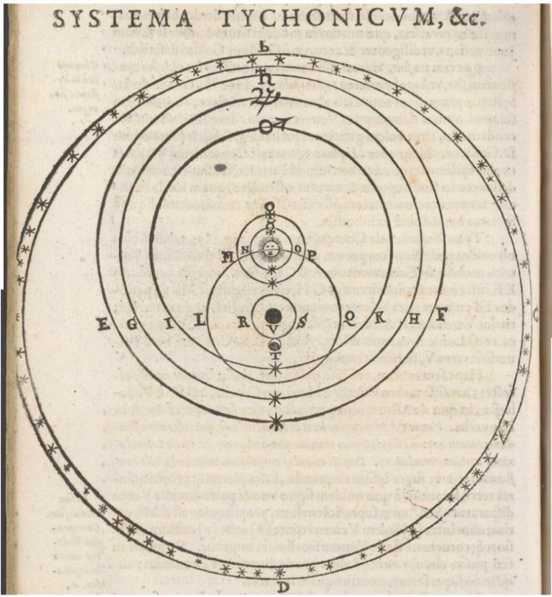
The image is a historical black-and-white (sepia-toned diagram titled **"SYSTEMA TYCHONICVM, &c."** (Tychonic System, etc.), illustrating the Tychonic geocentric astronomical model. It features concentric circular orbits, celestial symbols, and letter labels to represent the relative positions and motions of celestial bodies.
### Components/Axes
- **Title**: “SYSTEMA TYCHONICVM, &c.” is centered at the top.
- **Orbits**: Multiple concentric circles (orbits) with increasing radii from the center. The outermost orbit is lined with star symbols (★), representing the “sphere of fixed stars.”
- **Celestial Bodies & Symbols**:
- A central black circle (likely representing **Earth**).
- A smaller orbit around Earth with a star (★) and letters *M, N, O, P* (likely the **Moon’s orbit**).
- A larger orbit with a black circle (likely the **Sun**) and letters *R, S, T* (the Sun’s orbit around Earth).
- Outer orbits with labels *E, G, I, L* (left-side horizontal), *Q, K, H, F* (right-side horizontal), and *D* (bottom center) (orbits of planets: Mercury, Venus, Mars, Jupiter, Saturn, orbiting the Sun).
- Top-aligned astronomical symbols: ♄ (Saturn), ♃ (Jupiter), ♂ (Mars), ♀ (Venus), ☉ (Sun), ☽ (Moon) (indicating celestial bodies).
### Detailed Analysis
- **Orbit Structure**:
- Innermost orbit (around Earth): Contains a star (★) and letters *M, N, O, P* (Moon’s path).
- Middle orbit (around Earth): Contains a black circle (Sun) and letters *R, S, T* (Sun’s path around Earth).
- Outer orbits: Labeled *E, G, I, L* (left) and *Q, K, H, F* (right) (planetary orbits around the Sun).
- Outermost orbit: Lined with star symbols (★) (fixed stars).
- **Labeling**: Letters (*E, G, I, L, R, S, Q, K, H, F, D, M, N, O, P, T*) mark specific positions/orbits, likely for reference in accompanying text (not visible).
### Key Observations
- The diagram is a 16th–17th-century-style illustration of the **Tychonic system** (a geocentric model where Earth is stationary, the Sun orbits Earth, and planets orbit the Sun).
- Astronomical symbols (♄, ♃, ♂, ♀, ☉, ☽) and letter labels are used to identify celestial bodies and orbits.
- The outermost “fixed stars” orbit reflects pre-modern cosmological beliefs.
### Interpretation
This diagram represents the Tychonic system, a compromise between Ptolemaic (geocentric) and Copernican (heliocentric) models. Proposed by Tycho Brahe, it places Earth at the center, with the Moon orbiting Earth, the Sun orbiting Earth, and other planets orbiting the Sun. The concentric circles, symbols, and labels reflect 16th–17th-century efforts to reconcile observational accuracy with geocentric cosmology. The “fixed stars” on the outermost orbit embody the ancient view of a spherical universe with Earth at its center.