## Diagram: Tychonic System Model
### Overview
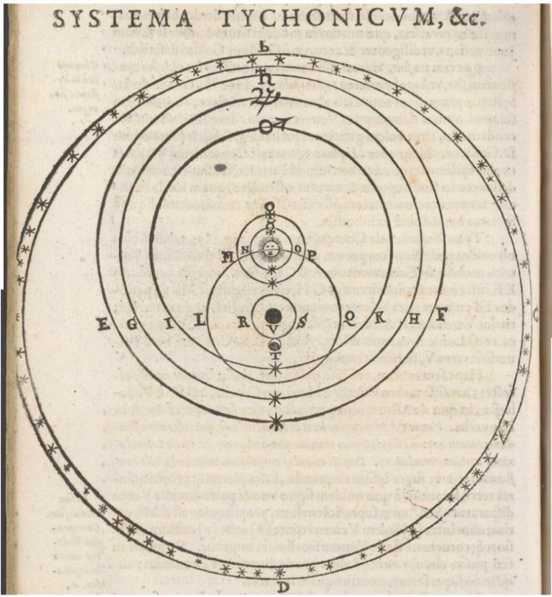
The image depicts a historical astronomical diagram titled **"SYSTEMA TYCHONICVM, &c."** (Latin for "Tychonic System"). It illustrates a geocentric model with concentric circles representing celestial orbits. The diagram includes labeled points, symbols, and nested circular paths, likely representing the motion of celestial bodies according to the Tychonic system, which combines elements of geocentrism and heliocentrism.
### Components/Axes
- **Title**: "SYSTEMA TYCHONICVM, &c." (Top of the diagram).
- **Circles**:
- **Outermost Circle**: Labeled **B** (top), with a star pattern.
- **Second Circle**: Labeled **H** (top), with a star pattern.
- **Third Circle**: Labeled **D** (bottom), with a star pattern.
- **Fourth Circle**: Labeled **O** (top), with a star pattern.
- **Fifth Circle**: Labeled **P** (top), with a star pattern.
- **Innermost Circle**: Contains labels **E, G, I, L, R, S, Q, K, F** arranged in a circular pattern.
- **Symbols**:
- Stars (**★**) and asterisks (**✩**) mark specific points on the circles.
- A central **●** (solid dot) and a **●** with a cross (**✡**) at the center.
- **Legend**: No explicit legend is present, but labels are directly embedded in the diagram.
### Detailed Analysis
- **Labels**:
- **B, H, D, O, P**: Positioned at the top or bottom of their respective circles, likely representing major celestial bodies or orbital paths.
- **E, G, I, L, R, S, Q, K, F**: Arranged in a smaller circle, possibly denoting planets or their orbits.
- **Symbols**:
- Stars and asterisks may indicate specific positions (e.g., aphelion, perihelion) or observational markers.
- The central **●** and **✡** could represent Earth and the Sun, respectively.
- **Flow**: The diagram suggests a hierarchical structure, with Earth at the center, the Sun orbiting Earth, and other planets orbiting the Sun.
### Key Observations
- The **Tychonic system** is a hybrid model where the Earth is stationary, the Sun orbits Earth, and other planets orbit the Sun. This is reflected in the nested circles.
- The **innermost circle** (with **E, G, I, L, R, S, Q, K, F**) may represent the orbits of planets (e.g., Mercury, Venus, Mars, etc.) around the Sun.
- The **outermost circles** (B, H, D, O, P) could correspond to the orbits of the Sun or other celestial bodies.
- The **central symbols** (● and ✡) likely denote Earth and the Sun, respectively.
### Interpretation
The diagram illustrates the **Tychonic system**, a geocentric model proposed by Tycho Brahe. It combines the Earth-centered framework of Ptolemaic astronomy with the heliocentric motion of the Sun and planets. The concentric circles represent the orbits of celestial bodies, with Earth at the center. The labels (e.g., B, H, D) and symbols (stars, asterisks) likely correspond to specific planets or orbital markers. The absence of a legend suggests the diagram relies on direct labeling for clarity. This model was historically significant as a compromise between geocentric and heliocentric theories, though it was later supplanted by the Copernican system.
**Note**: The diagram does not include numerical data or explicit trends, as it is a conceptual representation of a historical astronomical model.