## Diagram: Matrix Multiplication and Attention Mechanism Workflow
### Overview
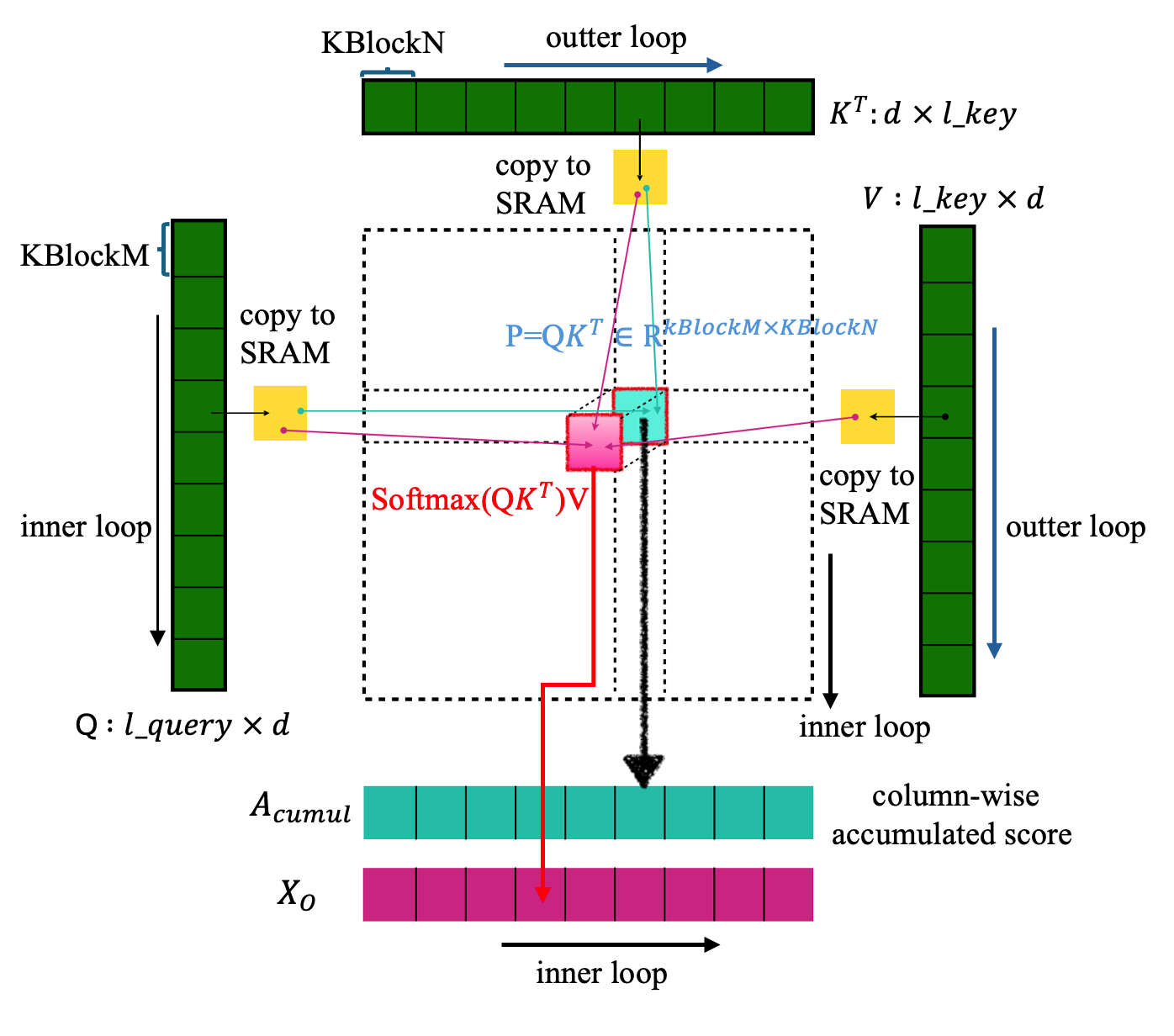
This diagram illustrates a block-wise matrix multiplication process with attention mechanisms, likely part of a neural network architecture. It shows data flow between memory blocks (KBlockM, KBlockN), query (Q), key (K<sup>T</sup>), value (V), and temporary storage (SRAM). The process involves outer and inner loops, with column-wise score accumulation.
### Components/Axes
- **Key Elements**:
- **KBlockM**: Green vertical block on the left (input keys).
- **KBlockN**: Green horizontal block at the top (transposed keys, K<sup>T</sup>: d × l_key).
- **Q**: Purple block at the bottom-left (queries: l_query × d).
- **V**: Green vertical block on the right (values: l_key × d).
- **SRAM**: Central yellow squares (temporary storage for intermediate data).
- **Softmax(QK<sup>T</sup>)V**: Central red/pink operation (attention score computation).
- **A_cumul**: Cyan horizontal block (column-wise accumulated scores).
- **X₀**: Pink horizontal block at the bottom (final output).
- **Loops**:
- **Outer Loop**: Blue arrow over KBlockN (iterates over K<sup>T</sup>).
- **Inner Loop**: Black arrow over KBlockM (iterates over KBlockM).
- **Data Flow**:
- Arrows indicate copying data to/from SRAM (yellow squares).
- Red/pink arrows show computation flow (Softmax and multiplication).
### Detailed Analysis
1. **Data Movement**:
- KBlockM (keys) is copied to SRAM via inner loop iterations.
- KBlockN (K<sup>T</sup>) is copied to SRAM via outer loop iterations.
- Queries (Q) and values (V) interact with SRAM data during computation.
2. **Computation**:
- **Softmax(QK<sup>T</sup>)V**:
- Q (l_query × d) is multiplied by K<sup>T</sup> (d × l_key) to compute attention scores.
- Softmax normalizes scores to probabilities.
- Result is multiplied by V (l_key × d) to produce output.
3. **Accumulation**:
- Column-wise scores (A_cumul) are accumulated iteratively (cyan block).
- Final output X₀ (pink block) aggregates all inner-loop results.
### Key Observations
- **Block-Wise Processing**: Data is split into blocks (KBlockM, KBlockN) to optimize memory usage.
- **SRAM as Temporary Storage**: Intermediate results (QK<sup>T</sup>, Softmax outputs) are stored in SRAM to reduce bandwidth.
- **Attention Mechanism**: Softmax(QK<sup>T</sup>) computes attention weights, critical for focus in transformer models.
- **Loop Structure**: Outer loop iterates over K<sup>T</sup> (l_key blocks), inner loop over KBlockM (d blocks).
### Interpretation
This diagram represents an optimized implementation of attention mechanisms, likely for transformer models. By splitting keys and values into blocks (KBlockM, KBlockN), the process reduces memory bandwidth requirements through SRAM reuse. The outer loop handles transposed keys (K<sup>T</sup>), while the inner loop processes query-key interactions. The final output X₀ aggregates column-wise scores, reflecting the cumulative effect of all key-value interactions.
**Notable Design Choices**:
- **Color Coding**: Green for memory blocks, yellow for SRAM, purple for queries, and pink for output.
- **Loop Hierarchy**: Outer loop (K<sup>T</sup>) governs the broader iteration, while the inner loop (KBlockM) handles finer-grained computations.
- **Efficiency**: Block-wise processing and SRAM usage suggest a focus on hardware-aware optimization for large-scale models.