## Line Graph: Accuracy of Pointwise Judge vs. Number of Episodes Used for User Profile
### Overview
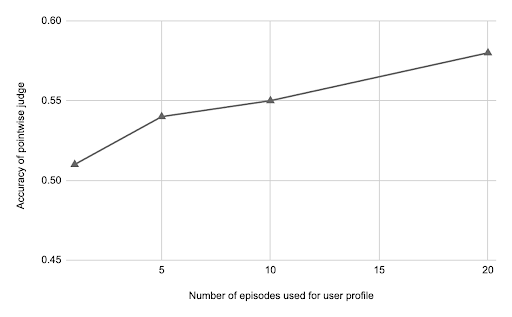
The image depicts a line graph illustrating the relationship between the accuracy of a pointwise judge and the number of episodes used to construct a user profile. The graph shows a positive trend, with accuracy increasing as more episodes are utilized. The data points are marked with black triangles, and the line is a solid black curve.
### Components/Axes
- **X-axis (Horizontal)**: "Number of episodes used for user profile" with discrete markers at 5, 10, 15, and 20.
- **Y-axis (Vertical)**: "Accuracy of pointwise judge" scaled from 0.45 to 0.60 in increments of 0.01.
- **Legend**: A single black line with a triangle marker, positioned in the top-right corner of the graph.
### Detailed Analysis
- **Data Points**:
- At 5 episodes: Accuracy ≈ 0.51
- At 10 episodes: Accuracy ≈ 0.55
- At 15 episodes: Accuracy ≈ 0.57
- At 20 episodes: Accuracy ≈ 0.58
- **Trend**: The line slopes upward consistently, indicating a positive correlation between the number of episodes and accuracy. The rate of increase slows slightly after 10 episodes, suggesting diminishing returns.
### Key Observations
1. **Positive Correlation**: Accuracy improves as more episodes are used, with a clear upward trajectory.
2. **Diminishing Returns**: The slope of the line flattens after 10 episodes, indicating that additional episodes yield smaller improvements in accuracy.
3. **Maximum Accuracy**: The highest recorded accuracy (0.58) is achieved at 20 episodes.
### Interpretation
The graph demonstrates that increasing the number of episodes used for user profile construction enhances the accuracy of the pointwise judge. However, the diminishing returns after 10 episodes suggest that there may be an optimal point (around 10–15 episodes) where further data collection provides minimal benefits. This could inform resource allocation strategies, balancing data quantity with computational or operational costs. The trend aligns with common machine learning principles, where more data generally improves model performance but with diminishing marginal gains.