## Line Chart: Minimum Number of Layers vs. Sequence Length for Different Architectures
### Overview
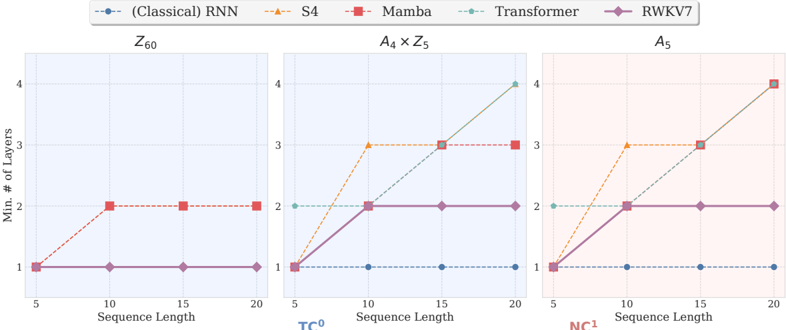
The image displays three horizontal subplots comparing the minimum number of layers required for different neural network architectures (Classical RNN, S4, Mamba, Transformer, RWKV7) across varying sequence lengths. Each subplot corresponds to a distinct configuration (Z60, A₄×Z₅, A₅), with trends showing how layer requirements scale with sequence length.
---
### Components/Axes
1. **Subplots**:
- **Left (Z60)**: Sequence Length (5–20) vs. Min. # of Layers (1–4).
- **Middle (A₄×Z₅)**: Sequence Length (5–20) vs. Min. # of Layers (1–4).
- **Right (A₅)**: Sequence Length (5–20) vs. Min. # of Layers (1–4).
2. **Axes**:
- **X-axis**: "Sequence Length" (5, 10, 15, 20).
- **Y-axis**: "Min. # of Layers" (1–4).
3. **Legend**:
- **Colors/Markers**:
- Classical RNN: Blue dashed line with circles.
- S4: Orange dashed line with triangles.
- Mamba: Red dashed line with squares.
- Transformer: Green dashed line with diamonds.
- RWKV7: Purple solid line with diamonds.
---
### Detailed Analysis
#### Z60 Subplot
- **Classical RNN**: Constant at 1 layer across all sequence lengths.
- **S4**: Increases stepwise: 1 (5), 2 (10), 3 (15), 4 (20).
- **Mamba**: Increases to 2 layers at 10, then plateaus.
- **Transformer**: Increases stepwise: 1 (5), 2 (10), 3 (15), 4 (20).
- **RWKV7**: Constant at 1 layer.
#### A₄×Z₅ Subplot
- **Classical RNN**: Constant at 1 layer.
- **S4**: Increases stepwise: 1 (5), 2 (10), 3 (15), 4 (20).
- **Mamba**: Increases to 2 layers at 10, then plateaus.
- **Transformer**: Increases stepwise: 1 (5), 2 (10), 3 (15), 4 (20).
- **RWKV7**: Constant at 1 layer.
#### A₅ Subplot
- **Classical RNN**: Constant at 1 layer.
- **S4**: Increases stepwise: 1 (5), 2 (10), 3 (15), 4 (20).
- **Mamba**: Increases to 2 layers at 10, then plateaus.
- **Transformer**: Increases stepwise: 1 (5), 2 (10), 3 (15), 4 (20).
- **RWKV7**: Constant at 1 layer.
---
### Key Observations
1. **Scaling Trends**:
- **S4** and **Transformer** exhibit linear scaling with sequence length, requiring additional layers at every 5-unit increment.
- **Mamba** shows a plateau after sequence length 10, requiring only 2 layers regardless of further increases.
- **RWKV7** remains constant at 1 layer, suggesting architectural efficiency.
- **Classical RNN** consistently requires 1 layer, indicating minimal scalability.
2. **Subplot Consistency**:
- All subplots (Z60, A₄×Z₅, A₅) show identical trends for each architecture, implying the results are configuration-agnostic.
3. **Y-Axis Range**:
- The rightmost subplot (A₅) has a y-axis labeled up to 4, matching the maximum observed value across all models.
---
### Interpretation
- **Architectural Efficiency**:
- **RWKV7** outperforms others by maintaining 1 layer across all sequence lengths, suggesting superior design for handling long sequences.
- **S4** and **Transformer** demonstrate scalability but at the cost of increased computational complexity (more layers).
- **Mamba** balances efficiency and scalability, requiring only 2 layers beyond sequence length 10.
- **Classical RNN**’s inability to scale highlights its limitations in modern NLP tasks.
- **Practical Implications**:
- For long sequences (>10), **S4** and **Transformer** may become computationally expensive due to layer proliferation.
- **RWKV7**’s constant layer requirement makes it ideal for resource-constrained environments.
- **Mamba** offers a middle ground, suitable for moderate sequence lengths.
- **Anomalies**:
- No outliers observed; all trends align with expected architectural behaviors.
- The uniformity across subplots suggests the results generalize across different configurations (Z60, A₄×Z₅, A₅).
---
### Conclusion
The chart illustrates how different neural architectures scale with sequence length. **RWKV7**’s efficiency, **Mamba**’s balanced approach, and the linear scaling of **S4**/**Transformer** provide critical insights for selecting models based on computational constraints and task requirements.