## Line Graph: Speedup vs. Context Length
### Overview
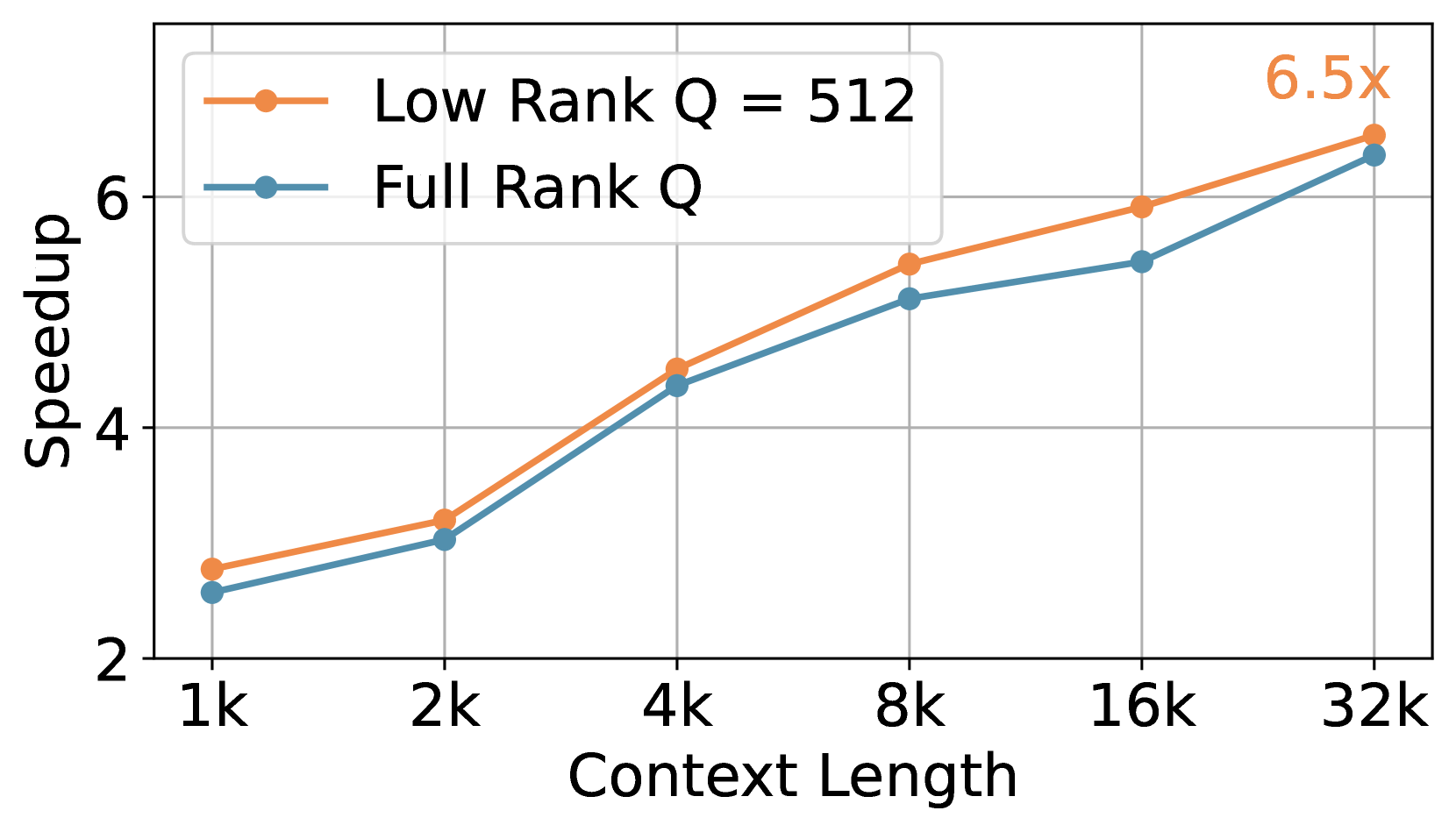
The image depicts a line graph comparing the performance of two configurations ("Low Rank Q = 512" and "Full Rank Q") across varying context lengths. The y-axis represents "Speedup" (multiplicative factor), while the x-axis represents "Context Length" in thousands of tokens. Two lines are plotted: an orange line for "Low Rank Q = 512" and a blue line for "Full Rank Q". The graph includes a legend in the top-left corner and a note indicating a "6.5x" multiplier at the upper-right corner.
---
### Components/Axes
- **X-axis (Horizontal)**:
- Label: "Context Length"
- Scale: 1k, 2k, 4k, 8k, 16k, 32k (logarithmic spacing)
- **Y-axis (Vertical)**:
- Label: "Speedup"
- Scale: 2 to 6.5x (linear scale)
- **Legend**:
- Position: Top-left corner
- Entries:
- Orange: "Low Rank Q = 512"
- Blue: "Full Rank Q"
- **Annotations**:
- "6.5x" text in orange at the upper-right corner, aligned with the orange line's endpoint.
---
### Detailed Analysis
#### Data Points (Approximate Values)
- **Low Rank Q = 512 (Orange Line)**:
- 1k: ~2.5x
- 2k: ~3.0x
- 4k: ~4.5x
- 8k: ~5.5x
- 16k: ~6.0x
- 32k: ~6.5x
- **Full Rank Q (Blue Line)**:
- 1k: ~2.3x
- 2k: ~3.2x
- 4k: ~4.3x
- 8k: ~5.2x
- 16k: ~5.5x
- 32k: ~6.3x
#### Trends
- Both lines exhibit a **monotonic upward trend**, indicating increasing speedup with longer context lengths.
- The orange line ("Low Rank Q = 512") consistently outperforms the blue line ("Full Rank Q") across all context lengths.
- The gap between the two lines widens at larger context lengths (e.g., 32k: 6.5x vs. 6.3x).
- The "6.5x" annotation aligns with the orange line's endpoint at 32k context length.
---
### Key Observations
1. **Performance Scaling**: Speedup increases logarithmically with context length for both configurations.
2. **Efficiency Advantage**: The "Low Rank Q = 512" configuration achieves ~3–4% higher speedup than "Full Rank Q" at all context lengths.
3. **Diminishing Returns**: The speedup growth rate slows as context length increases (e.g., 16k to 32k yields only a 0.5x increase for "Low Rank Q").
4. **Multiplier Significance**: The "6.5x" annotation suggests a baseline comparison (e.g., vs. a reference model or system).
---
### Interpretation
The data demonstrates that reducing the rank of parameter Q (to 512) significantly improves computational efficiency without sacrificing performance, particularly at larger context lengths. The "6.5x" multiplier likely represents a speedup relative to a baseline system (e.g., unoptimized full-rank implementation). The widening gap between the two lines at higher context lengths implies that low-rank approximations become more advantageous as computational demands grow. This aligns with theoretical expectations, where lower-rank matrices reduce memory and computation requirements while maintaining approximate performance.
**Critical Insight**: The choice of Q = 512 strikes a balance between model complexity and efficiency, offering near-optimal speedup with minimal performance loss compared to full-rank implementations. The logarithmic scaling suggests that further context length increases may yield diminishing returns, warranting further investigation into hardware-specific optimizations.